CM Sai: Chhattisgarh passes Ease of Doing Business Bill 2026

Synopsis
Chhattisgarh's assembly has passed the Ease of Doing Business Bill 2026, which CM Vishnu Deo Sai says will make the state India's first to implement a risk-based and trust-based business permission system, aiming to boost MSME growth, simplify investor procedures, and drive employment under the Viksit Chhattisgarh vision.
Key Takeaways
The Chhattisgarh Ease of Doing Business Bill, 2026 was passed by the state assembly on 16 July 2026 .
The state government claims Chhattisgarh will become India's first state to implement a risk-based and trust-based business permission system.
The legislation is designed to simplify investor procedures and provide a major boost to MSMEs .
The reform aligns with the national DPIIT-led Ease of Doing Business framework and the Make in India initiative.
Implementation rules and the risk-categorisation framework are yet to be notified and will determine the bill's on-ground impact.
The move is part of CM Vishnu Deo Sai's broader Viksit Chhattisgarh development agenda.
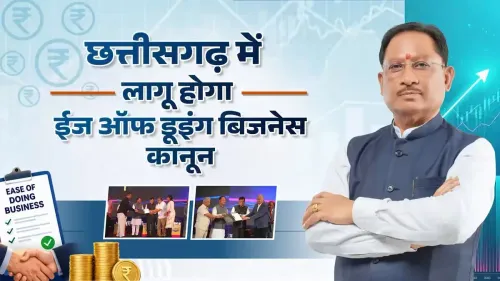
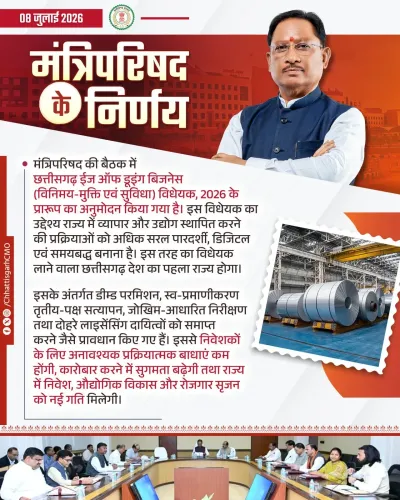
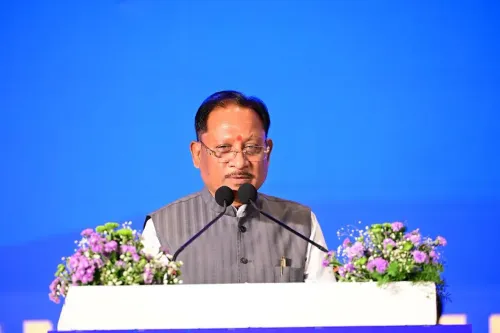
Chhattisgarh Chief Minister Vishnu Deo Sai announced on Thursday, 16 July 2026 that the state assembly has passed the Chhattisgarh Ease of Doing Business Bill, 2026, a landmark legislation that the government says will make the state the first in India to implement a risk-based and trust-based business permission system.
Context
Posting on X, CM Sai described the bill's passage as 'ek aitihasik kadam' (a historic step) toward giving fresh momentum to investment, industry, and employment in Chhattisgarh. He stated that the new framework will simplify procedures for investors, provide a significant boost to MSMEs, and reduce 'unnecessary obstacles from starting a business to expanding it.'
The legislation introduces what the state government is calling a 'trust-based and transparency-driven' permission regime — a departure from the conventional approval-first model toward one where businesses are assessed by the level of regulatory risk they pose before permissions are mandated.
Policy Backdrop
The bill fits within a decade-long national push on Ease of Doing Business (EoDB), a programme coordinated by the Department for Promotion of Industry and Internal Trade (DPIIT) since 2014-15. Under annual Business Reforms Action Plans, states have been ranked on regulatory simplification, single-window clearances, and reduction of compliance burdens.
The broader impetus traces to the Make in India initiative launched in 2014, which sought to position India as a global manufacturing hub. Since 2015, states have competed intensely on EoDB rankings, with several enacting dedicated facilitation laws. Risk-based regulatory models — already piloted in sectors such as labour and environment compliance in some states — represent the current frontier of these reforms.
Chhattisgarh, a mineral-rich state with major industries in steel, mining, power, and cement, has historically sought to leverage its resource base to attract industrial investment. The new bill is positioned as a structural upgrade to that effort.
Stakeholders and Impact
The legislation is expected to most directly benefit MSME entrepreneurs and prospective investors, who have long cited procedural delays and discretionary approvals as barriers to entry. By classifying businesses according to risk levels, the framework aims to fast-track low-risk ventures while maintaining scrutiny where it is genuinely warranted.
Larger investors eyeing Chhattisgarh's industrial corridors and mineral sectors may also find the trust-based model reduces transaction costs and timelines. The state government has framed the bill as central to its broader 'Viksit Chhattisgarh' (Developed Chhattisgarh) agenda — aligning with the national Viksit Bharat vision for 2047.
What's Next
The bill's passage through the assembly is the first step; attention will now turn to the notification of implementation rules and the rollout of the risk-categorisation framework across sectors. The state government's ability to attract fresh investment commitments in the near term will serve as an early indicator of the legislation's real-world impact.
Observers will also watch whether other states move to adopt similar trust-based models, which could intensify the interstate competition for industrial investment that has defined India's EoDB landscape since 2015.
Point of View
Allowing CM Sai to demonstrate legislative momentum less than three years into office. The 'first state' framing of the risk-based permission model is a deliberate positioning play in the intensely competitive interstate investment race that DPIIT's annual rankings have institutionalised. If implementation is swift and credible, it could meaningfully shift Chhattisgarh's industrial profile beyond its traditional mining and metals base. The real test, however, lies not in the legislation itself but in the notification of rules and the state bureaucracy's willingness to cede discretionary approval power — historically the stickiest point in EoDB reforms across India.
NationPress
16 Jul 2026
Frequently Asked Questions
What is the Chhattisgarh Ease of Doing Business Bill 2026?
The Chhattisgarh Ease of Doing Business Bill 2026 is a legislation passed by the Chhattisgarh state assembly that introduces a risk-based and trust-based business permission system, aiming to simplify regulatory approvals for investors and MSMEs and reduce procedural barriers to starting or expanding a business.
Is Chhattisgarh the first state in India to implement a risk-based business permission system?
The Chhattisgarh government has claimed the state will be the first in India to implement a risk-based and trust-based business permission system following the passage of the 2026 bill. This claim has been made by CM Vishnu Deo Sai; independent verification of the 'first state' status is pending.
How will the Chhattisgarh EoDB Bill 2026 benefit MSMEs?
According to CM Vishnu Deo Sai, the bill will provide a significant boost to MSMEs by simplifying procedures, reducing unnecessary regulatory obstacles from business registration through to expansion, and replacing discretionary approvals with a trust-based framework tied to assessed risk levels.
What is a risk-based business permission system?
A risk-based business permission system classifies businesses by the level of regulatory risk they pose — such as environmental or safety risk — and applies lighter-touch approvals to low-risk ventures while maintaining stricter oversight for high-risk ones. This reduces the compliance burden on the majority of small and medium businesses.
What is the Viksit Chhattisgarh vision mentioned by CM Sai?
'Viksit Chhattisgarh' (Developed Chhattisgarh) is CM Vishnu Deo Sai's state-level development agenda, aligned with the national 'Viksit Bharat' goal of making India a developed nation by 2047. The EoDB Bill 2026 is presented as a key legislative pillar of this vision.