CM Vishnu Deo Sai targets Congress over ballot paper poll drubbing
Synopsis
Chhattisgarh CM Vishnu Deo Sai slams Congress after the party failed to win any of the 28 Legislative Council seats contested across Uttar Pradesh, Maharashtra, Bihar, and Karnataka — all decided by ballot paper, the very method Congress has championed.
Key Takeaways
Congress won zero seats in elections for 28 Legislative Council seats across Uttar Pradesh, Maharashtra, Bihar, and Karnataka .
All these elections were conducted via paper ballots , not EVMs, because voters are MLAs, graduates, teachers, and local body representatives.
Karnataka — where Congress leads the state government — returned no Congress winner, which CM Sai specifically highlighted.
Chhattisgarh CM Vishnu Deo Sai used the result to challenge Congress's long-running claim that EVM-based elections are rigged against them.
CM Sai argued that electoral victories require public trust , not allegations about voting technology.
The BJP has consistently pointed to opposition losses in ballot-paper polls as a counter to EVM tampering narratives — this result gives that argument fresh force.
Congress has long demanded a return to ballot papers, calling electronic voting machines unreliable. Now, Chhattisgarh Chief Minister Vishnu Deo Sai is pointing to the party's own logic — and turning it back on them — after Congress failed to win a single seat in legislative council elections held across four states using exactly those paper ballots.
Zeroes across four states — including Congress's own Karnataka
The elections in question covered 28 Legislative Council seats spread across Uttar Pradesh, Maharashtra, Bihar, and Karnataka. Across all four, Congress drew a blank. The number that stings most for the party: not a single seat in Karnataka, a state where Congress runs the government. CM Sai did not let that pass. 'Despite having its own government in Karnataka, Congress could not win even one seat,' he wrote in a sharply worded post on X on Wednesday, October 28, 2026.
Legislative council elections are conducted via paper ballots because the electorate is made up of MLAs, graduates, teachers, and local body representatives — not the general public — making EVM deployment neither practical nor applicable. That procedural reality is precisely what makes the result so politically loaded.
The EVM argument and its new corner
The Indian National Congress and several opposition allies have questioned the integrity of electronic voting machines since their nationwide rollout in the early 2000s. The argument has resurfaced after nearly every major assembly and parliamentary loss — most prominently after the 2019 and 2024 Lok Sabha elections. The demand for a ballot-paper rollback has become a recognisable refrain in opposition politics.
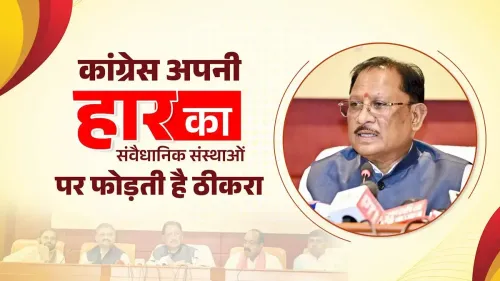
CM Sai's post cuts directly at that pattern. 'चुनाव EVM से हो या बैलेट पेपर से, जीत के लिए जनता का विश्वास चाहिए' — 'Whether the election is by EVM or ballot paper, winning requires the trust of the people' — he wrote, adding that 'false allegations and noise' are no substitute for that trust. The rhetorical question buried in the post lands hard: 'Congress, which repeatedly puts the process in the dock over electoral defeats — who will it blame now?'
A BJP pressure point that is unlikely to go away
This is not an isolated jab. BJP leaders have systematically flagged opposition losses in ballot-paper elections — Rajya Sabha polls, legislative council contests, President and Vice-President elections — as a counter-argument whenever EVM tampering claims circulate. The 28-seat council result gives the party fresh material for that argument, and CM Sai, as a senior state executive and a prominent voice for BJP in central India, has moved quickly to frame the narrative.
Congress's response to the results — and whether it recalibrates its electoral reform demands — will be closely watched ahead of the next round of state assembly elections.
In Indian politics, the ballot-paper debate has always been louder in defeat than in victory. This week, that asymmetry is on full display.
Point of View
Ballot-paper defeats need a different explanation. The Karnataka dimension is particularly damaging — losing council seats in a state you govern undermines both the organisational credibility and the electoral-fraud argument simultaneously. BJP has used this playbook before after Rajya Sabha and Presidential elections, and it tends to stick because it is empirically grounded rather than merely rhetorical. The deeper question the result raises is whether Congress can sustain the EVM demand as a political identity without it becoming a liability every time indirect elections produce unfavourable outcomes.
NationPress
28 Oct 2026
Frequently Asked Questions
What are Legislative Council elections and why are they held by ballot paper?
Legislative Councils are upper houses in bicameral state legislatures. Their elections use paper ballots because the electorate consists of MLAs, graduates, teachers, and local body members — not the general public — making EVM deployment impractical.
Which states held the 28 Legislative Council seat elections mentioned by CM Sai?
The elections covered seats in Uttar Pradesh, Maharashtra, Bihar, and Karnataka, totalling 28 seats according to CM Vishnu Deo Sai's post.
Why is Congress's zero tally in Karnataka considered especially significant?
Karnataka is governed by a Congress-led government, giving the party organisational and administrative resources in the state. Failing to win a single council seat there despite that advantage makes the result politically notable.
What is the BJP's argument against Congress's EVM tampering claims?
BJP leaders, including CM Sai, point out that Congress also loses elections conducted by paper ballot — such as legislative council, Rajya Sabha, and Presidential polls — suggesting the losses reflect a lack of public support rather than technological manipulation.
How long has Congress been raising concerns about EVMs in India?
The Indian National Congress and allied opposition parties have questioned EVM reliability since the machines were rolled out nationwide in the early 2000s, with the criticism intensifying after major electoral defeats.