CM Sai Flags Off 1,000 Pilgrims to Somnath on Special Train

Synopsis
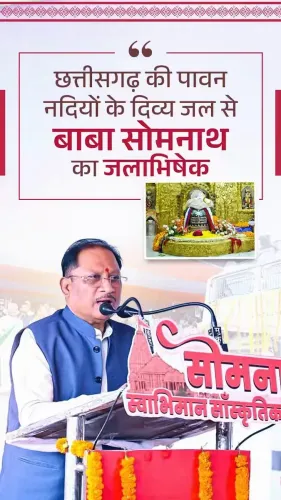
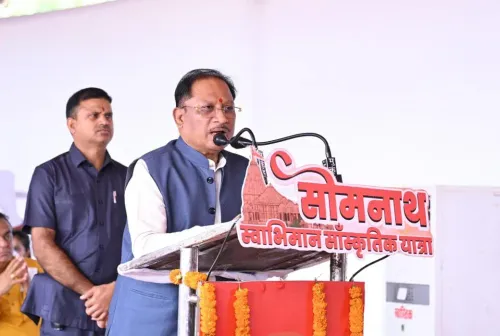
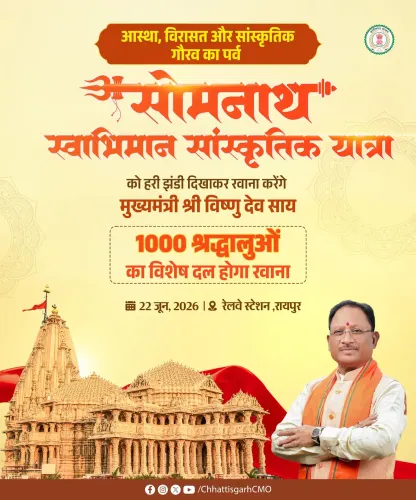
Chhattisgarh Chief Minister Vishnu Deo Sai announced the departure of 1,000 pilgrims on a special train to the Somnath Jyotirlinga in Gujarat under the state-backed Somnath Swabhiman Sanskritik Yatra, framing the pilgrimage as a tribute to Sanatan heritage and cultural pride.
Key Takeaways
1,000 pilgrims from Chhattisgarh have departed for the Somnath Jyotirlinga in Gujarat aboard a special train.
The initiative is called the Somnath Swabhiman Sanskritik Yatra , backed by the state government.
Chief Minister Vishnu Deo Sai described the yatra as a symbol of cultural consciousness and pride in Sanatan tradition.
Somnath is one of the twelve Jyotirlingas and a major site of Hindu heritage, located in Prabhas Patan, Gujarat .
The programme reflects a broader BJP-governed state pattern of organising state-facilitated pilgrimages to major religious sites.
The yatra aims to transmit Sanatan cultural values to future generations, according to CM Sai.
Chhattisgarh Chief Minister Vishnu Deo Sai announced on Tuesday, 23 June 2026 that 1,000 pilgrims from the state have departed aboard a special train for the Somnath Jyotirlinga in Gujarat, under the state-backed Somnath Swabhiman Sanskritik Yatra.
Posting on X, Chief Minister Sai described the yatra as a symbol of cultural consciousness, spiritual values, and pride in Sanatan heritage. In his words, 'यह पावन यात्रा श्रद्धालुओं को आस्था, संस्कृति और आध्यात्मिक चेतना से जोड़ते हुए हमारी गौरवशाली सनातन परंपरा के मूल्यों को भावी पीढ़ियों तक पहुंचाने का माध्यम बनेगी' — 'This sacred journey will connect devotees with faith, culture, and spiritual consciousness, becoming a medium to carry the values of our glorious Sanatan tradition to future generations.'
Context
The Somnath Swabhiman Sanskritik Yatra is a state-supported pilgrimage initiative that ferries devotees from Chhattisgarh to the Somnath temple in Prabhas Patan, Gujarat — one of the twelve sacred Jyotirlingas in Hinduism. The use of a dedicated special train underscores the government's logistical backing for the programme. Chief Minister Sai framed the yatra as an expression of 'swabhiman' (self-respect) and 'atmagaurav' (self-pride) rooted in cultural heritage.
Policy Backdrop
Since assuming office in December 2023, Chief Minister Sai's BJP-led government in Chhattisgarh has positioned cultural and religious outreach as a governance priority. State-sponsored pilgrimages to major Jyotirlingas and temples have become a recurring feature of BJP-governed states, serving both as welfare measures for devotees who may lack the means to travel independently, and as a visible assertion of Sanatan cultural identity. The Somnath temple itself carries deep national symbolism — rebuilt in the mid-20th century after centuries of destruction, it is widely regarded as a monument to Hindu resilience and heritage.
Stakeholders and Impact
The immediate beneficiaries are the 1,000 pilgrims from Chhattisgarh who gain state-facilitated access to one of India's most revered shrines. The religious tourism ecosystem — including hospitality, transport, and local businesses around Somnath, Gujarat — also stands to benefit from organised state-level pilgrim groups. For the Chhattisgarh government, the initiative reinforces its cultural outreach credentials ahead of any future electoral cycle.
What's Next
The Chhattisgarh government may look to expand similar yatras to other Jyotirlingas or major pilgrimage sites as part of a broader religious-tourism calendar. Integration with central government schemes promoting religious circuits could amplify the scale and frequency of such programmes. Observers will watch whether the Somnath Swabhiman Sanskritik Yatra becomes an annual fixture or is extended to cover additional destinations.
Point of View
Blending welfare optics with cultural-identity politics. By framing the initiative around 'swabhiman' and intergenerational heritage transmission, Chief Minister Sai positions his government as a custodian of Sanatan values — a narrative that carries electoral resonance in Chhattisgarh's politically competitive landscape. The Somnath temple's own history as a rebuilt symbol of Hindu revival lends the yatra additional ideological weight beyond routine religious tourism. Whether such programmes translate into durable policy infrastructure or remain episodic gestures will determine their long-term impact on the state's cultural-tourism sector.
NationPress
23 Jun 2026
Frequently Asked Questions
What is the Somnath Swabhiman Sanskritik Yatra?
The Somnath Swabhiman Sanskritik Yatra is a state-backed pilgrimage programme organised by the Chhattisgarh government that sends devotees from the state to the Somnath Jyotirlinga in Gujarat via a special train, aimed at promoting Sanatan cultural heritage.
How many pilgrims went from Chhattisgarh to Somnath?
According to Chief Minister Vishnu Deo Sai's post on 23 June 2026, 1,000 pilgrims from Chhattisgarh departed for the Somnath Jyotirlinga aboard a special train.
Where is the Somnath temple located?
The Somnath temple is located in Prabhas Patan in Gujarat and is one of the twelve Jyotirlingas — the holiest Shiva shrines in Hinduism.
Who is Vishnu Deo Sai?
Vishnu Deo Sai is the Chief Minister of Chhattisgarh and a BJP leader who assumed office in December 2023.
Why is the Somnath temple significant?
Somnath is considered the first and foremost of the twelve Jyotirlingas. The temple was rebuilt in the mid-20th century after centuries of destruction and is widely regarded as a symbol of Hindu cultural resilience and heritage.