CM Mohan Yadav Pushes MP Toward 'Milk Capital' Status

Synopsis
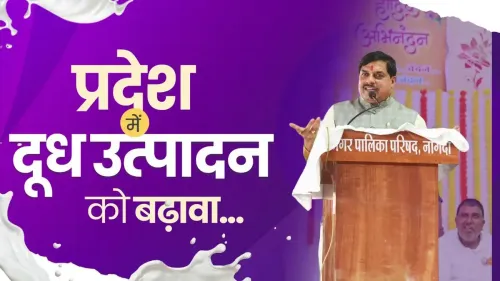
The Chief Minister's Office of Madhya Pradesh declared the state is advancing toward 'Milk Capital' status, spotlighting CM Dr. Mohan Yadav's push to elevate the state's dairy sector through cooperative expansion and livestock development policy.
Key Takeaways
The Chief Minister's Office of Madhya Pradesh announced on June 23, 2026 that the state is moving toward becoming India's 'Milk Capital' .
Mohan Yadav and the MP Department of Animal Husbandry were tagged, indicating coordinated government intent.
India's national milk production surpassed 230 million tonnes by 2022–23 , with Madhya Pradesh historically a mid-tier contributor seeking to rise in the rankings.
The Madhya Pradesh Livestock Development Policy 2016 and the national Operation Flood cooperative model form the policy foundation for the current dairy push.
Primary beneficiaries include dairy farmers and milk cooperatives who stand to gain from improved procurement, pricing stability, and processing infrastructure.
Upcoming state budget allocations and annual dairy production statistics will be key indicators of real progress toward the 'Milk Capital' goal.
The Chief Minister's Office of Madhya Pradesh announced on Tuesday, June 23, 2026, that the state is advancing steadily toward becoming the 'Milk Capital' of India, highlighting the dairy sector as a core pillar of the state's economic ambitions under Chief Minister Dr. Mohan Yadav.
Context
The post, shared from the official handle of the Chief Minister's Office, reads: 'मिल्क कैपिटल' बनने की दिशा में अग्रसर मध्यप्रदेश — translated as 'Madhya Pradesh advancing in the direction of becoming the Milk Capital.' The message tags Dr. Mohan Yadav and the Madhya Pradesh Department of Animal Husbandry, signalling coordinated state-level intent behind the push.
Madhya Pradesh, a central Indian state with one of the country's largest bovine populations, has historically ranked among mid-tier milk producers nationally. The 'Milk Capital' framing represents an aspirational target to move the state into the top tier of dairy-producing states.
Policy Backdrop
The state's dairy ambitions are not new. The Madhya Pradesh Livestock Development Policy 2016 laid out a framework for increasing milk output through breed improvement programmes, cooperative formation, and upgraded procurement infrastructure. These efforts draw on the foundational model established by Operation Flood (1970–1996), the national cooperative dairy initiative that transformed India into the world's largest milk producer.
India's national milk production grew from approximately 146 million tonnes in 2014–15 to over 230 million tonnes by 2022–23, driven largely by states with strong cooperative networks. Madhya Pradesh has sought to close the gap with leading producers by investing in processing capacity and expanding milk procurement through local dairy unions affiliated with the National Dairy Development Board.
The involvement of the Madhya Pradesh Department of Animal Husbandry — the nodal body for livestock development and dairy infrastructure — underscores that the 'Milk Capital' drive is positioned as a policy priority, not merely a communications exercise.
Stakeholders and Impact
Dairy farmers and milk cooperatives across the state stand to be the primary beneficiaries if the government's push translates into higher procurement prices, better cold-chain infrastructure, and expanded processing plants. Madhya Pradesh has a significant rural population dependent on livestock for supplementary income, making dairy expansion a direct rural-welfare lever.
Strengthening the cooperative milk network could also reduce dependence on unorganised private traders, giving farmers more stable and transparent pricing. Any new budget allocations for dairy processing facilities or breed improvement schemes would be watched closely by farmer groups and industry stakeholders alike.
What's Next
Analysts and sector observers will look to the Department of Animal Husbandry and Dairying's annual milk production statistics for measurable progress against the 'Milk Capital' goal. State budget sessions and livestock policy announcements from Chief Minister Dr. Mohan Yadav's government are the next likely venues for concrete scheme details or capital allocations. If the state follows through with infrastructure investment, Madhya Pradesh could meaningfully alter its position in India's dairy production hierarchy over the coming years.
Point of View
Positioning Madhya Pradesh alongside states like Gujarat — home of Amul — that have built political capital on dairy success. For CM Dr. Mohan Yadav, who took office in December 2023, anchoring his tenure to a measurable agricultural milestone serves both developmental and electoral logic in a state with a large rural voter base. The tagging of the Animal Husbandry Department signals an attempt to move the narrative from aspiration to institutional execution. Whether the ambition translates into verifiable output gains will depend on sustained budget commitment and cooperative-network deepening beyond the communications push.
NationPress
23 Jun 2026
Frequently Asked Questions
What does 'Milk Capital of India' mean for Madhya Pradesh?
It refers to the state government's stated goal of making Madhya Pradesh a top-ranked milk-producing state in India, on par with leading dairy states, by expanding cooperative infrastructure, improving livestock breeds, and increasing organised milk procurement.
Who is driving the Madhya Pradesh dairy expansion?
Chief Minister Dr. Mohan Yadav , in coordination with the Madhya Pradesh Department of Animal Husbandry , is spearheading the push, as indicated by the official Chief Minister's Office post tagging both entities.
What is Madhya Pradesh's current milk production status?
Madhya Pradesh has historically been a mid-tier milk producer in India. The country's total milk output crossed 230 million tonnes by 2022–23 , and the state aims to increase its share through cooperative expansion and processing capacity.
What policy supports Madhya Pradesh's dairy ambitions?
The Madhya Pradesh Livestock Development Policy 2016 provides the framework, focusing on breed improvement and cooperative formation. The state also draws on the cooperative dairy model pioneered by national Operation Flood (1970–1996).
How will we know if Madhya Pradesh's Milk Capital goal is succeeding?
Progress can be tracked through annual milk production data released by the Department of Animal Husbandry and Dairying and through state budget allocations for new dairy processing plants and procurement network expansion.