CM Mohan Yadav Pushes Dairy Grants to Boost MP Farmer Income
Synopsis
The Chief Minister's Office of Madhya Pradesh says the state is offering special grants to cattle-rearing livestock keepers to promote milk production and raise farmer incomes, framing the move as a core plank of Kisan Kalyan Varsh 2026.
Key Takeaways
The Chief Minister's Office of Madhya Pradesh announced on 31 May 2026 that the state is promoting dairy to increase farmer incomes.
Mohan Yadav confirmed special grants ( vishesh anudan ) are being given to livestock keepers who rear cattle ( gaupalan ).
The initiative falls under Kisan Kalyan Varsh 2026 , the state-designated year for farmer welfare programmes.
The policy aligns with the national Rashtriya Gokul Mission (2014) and Madhya Pradesh 's longstanding dairy development programmes.
Primary beneficiaries are small and marginal farmers seeking to diversify income beyond crop agriculture.
Detailed grant eligibility rules and scheme targets have not yet been made public.
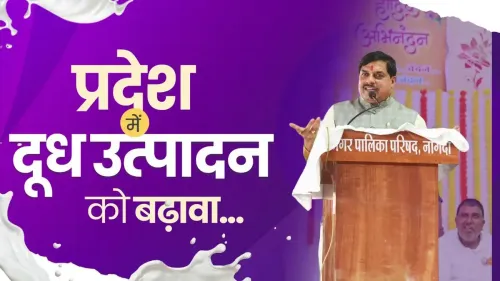
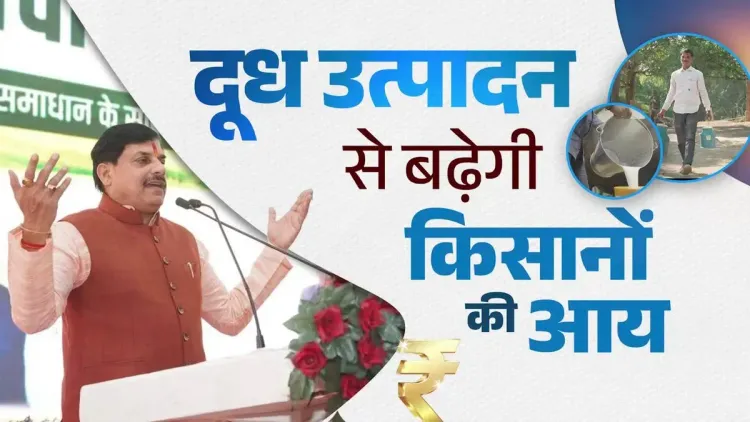
The Chief Minister's Office of Madhya Pradesh announced on Sunday, 31 May 2026 that the state government is actively promoting milk production to raise farmers' incomes, with special subsidies being offered to livestock keepers who rear cattle.
Posting on X, the office quoted Chief Minister Dr. Mohan Yadav: 'किसानों की आय बढ़ाने के उद्देश्य से प्रदेश सरकार दुग्ध उत्पादन को प्रोत्साहित कर रही है। इसके लिए गौपालन करने पर पशुपालकों को विशेष अनुदान दिया जा रहा है' ('With the objective of increasing farmers' income, the state government is encouraging milk production. For this purpose, special grants are being given to livestock keepers who rear cattle.')
The announcement was made under the hashtag #किसान_कल्याण_वर्ष_2026 (Kisan Kalyan Varsh 2026 — the state-designated Farmer Welfare Year), signalling that dairy promotion is a central pillar of Madhya Pradesh's rural economy agenda for the year.
Context
Dr. Mohan Yadav has been Chief Minister of Madhya Pradesh since December 2023, with a stated focus on the rural economy and agriculture-linked welfare schemes. The state has a large agrarian population, and crop income for small and marginal farmers remains volatile due to weather and market fluctuations. Dairy has long been promoted as a stable supplementary income source for such households. The post was tagged to @minmpkrishi, the official handle of the state's Agriculture Department, indicating inter-departmental coordination on the initiative.Policy Backdrop
Madhya Pradesh has run dairy development programmes since the 2010s, with state subsidies aligned to the national Rashtriya Gokul Mission, launched in 2014, which aims to conserve and develop indigenous bovine breeds while supporting milk production. The state's Department of Animal Husbandry and Dairying administers livestock schemes that include cattle purchase subsidies, veterinary support, and cooperative formation. The current push under Kisan Kalyan Varsh 2026 places dairy grants within a broader, year-long framework of farmer welfare announcements. The approach mirrors efforts across multiple Indian states that combine cattle subsidies, cooperative formation, and market linkages to diversify rural household earnings away from sole dependence on crop cycles.Stakeholders and Impact
The primary beneficiaries are dairy farmers and livestock keepers — particularly small and marginal farmers — across Madhya Pradesh's rural districts. By offering special grants specifically for gaupalan (cattle rearing), the government is targeting a segment of the agricultural community that may not have the capital to invest in quality breeding stock or infrastructure on its own. Dairy diversification is widely regarded as a means of raising the livestock sector's contribution to agricultural GDP, a national policy objective. For individual households, a steady milk income can cushion the impact of a poor crop season, reducing rural distress and dependence on credit.What's Next
Attention will now turn to the release of detailed grant guidelines, including eligibility criteria and the quantum of subsidy available per animal or household. Observers will also watch for reported changes in the number of registered dairy animals and milk procurement volumes in Madhya Pradesh through the remainder of 2026. The Kisan Kalyan Varsh framework suggests further farmer-focused announcements are likely before the year ends, with dairy remaining a key theme.Point of View
The Yadav government is building a year-long narrative of farmer welfare that can be amplified through successive announcements — a pattern common to state governments ahead of local body or assembly cycles. The focus on cattle grants also carries cultural resonance in a state where cow protection is a politically salient issue, allowing an economic measure to carry symbolic weight simultaneously. However, the impact on farmer incomes will ultimately depend on the scale of the subsidy, the efficiency of its delivery, and whether complementary infrastructure such as cold chains and cooperative networks keeps pace. Until grant guidelines are published and procurement data emerges, this remains a statement of intent rather than a measurable policy outcome.
NationPress
16 Sept 2026
Frequently Asked Questions
What is the dairy grant announced by MP CM Mohan Yadav?
CM Dr. Mohan Yadav announced that the Madhya Pradesh government is providing special grants to livestock keepers who rear cattle, with the aim of encouraging milk production and raising farmer incomes under Kisan Kalyan Varsh 2026.
What is Kisan Kalyan Varsh 2026 in Madhya Pradesh?
Kisan Kalyan Varsh 2026 is a state-designated year of farmer welfare initiatives in Madhya Pradesh, under which the government is rolling out a series of schemes — including dairy promotion — to improve rural livelihoods.
Who benefits from the Madhya Pradesh cattle rearing subsidy?
Livestock keepers and dairy farmers, particularly small and marginal farmers in Madhya Pradesh, are the primary beneficiaries of the special grants for cattle rearing announced by the state government.
How does the MP dairy scheme relate to the Rashtriya Gokul Mission?
Madhya Pradesh's dairy subsidies are aligned with the national Rashtriya Gokul Mission, launched in 2014, which supports indigenous breed development and milk production. The state has run complementary programmes since the 2010s.
What are the eligibility criteria for the MP gaupalan grant?
Detailed eligibility rules and the exact quantum of the special grant for cattle rearing have not yet been officially published; the state government is expected to release guidelines as the scheme is operationalised.