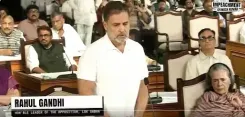
Smriti Irani calls opposition an 'obstruction party', not opposition
Synopsis
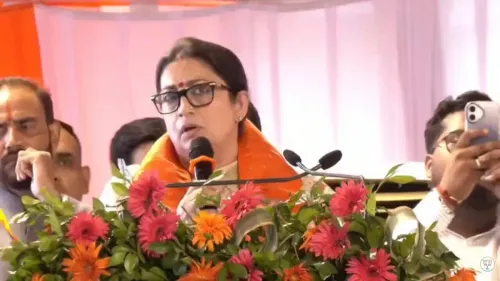
BJP leader Smriti Irani accused India's opposition of abandoning its constitutional duty, calling it an 'obstruction party' rather than a legitimate opposition — a pointed salvo ahead of the approaching Winter Session of Parliament.
Key Takeaways
BJP leader Smriti Irani posted a sharp Hindi critique of the opposition on Sunday, 1 November 2026 .
She said the opposition has replaced its duty of 'virodhh' (legitimate dissent) with 'avarodh' (pure obstruction).
The 'obstruction party' framing has been a recurring BJP charge since 2014 , typically peaking around contentious parliamentary sessions.
Opposition parties have historically countered that disruption is sometimes the only tool available to a legislative minority.
The post arrives ahead of the Winter Session of Parliament, signalling early narrative positioning by the ruling side.
No specific session trigger has been confirmed; the broader pattern of parliamentary disruption accusations is well established.
A sharp rebuke of India's parliamentary opposition landed on social media late Saturday night, as BJP leader Smriti Irani accused rival parties of abandoning their constitutional role and turning from a force of legitimate dissent into one of pure obstruction.
Posting in Hindi, Irani wrote: 'ये हमारा दुर्भाग्य है कि इस समय देश में विरोधी पक्ष अपना कर्तव्य त्यागकर, विरोध की बजाय अवरोध पक्ष बन चुका है।' — translated: 'It is our misfortune that at this time, the opposition in the country has abandoned its duty and, instead of being an opposition party, has become an obstruction party.'
The 'opposition vs obstruction' charge — and why it keeps returning
The framing is pointed and deliberate. In Indian parliamentary vocabulary, 'विरोध' (virodhh — opposition) carries the weight of democratic duty: scrutinising legislation, holding the government accountable, offering alternative policy. 'अवरोध' (avarodh — obstruction) strips all that away, leaving only blockage. By swapping one word for the other, Irani distils a long-running BJP charge into a single sentence. This is not the first time treasury-bench voices have reached for this argument. Since 2014, NDA leaders have repeatedly framed opposition walkouts, adjournment motions, and Well-intrusions as a deliberate strategy to prevent governance rather than enable accountability. The critique typically peaks around contentious legislative sessions — and the pattern is consistent enough that presiding officers of both Houses have periodically published productivity statistics to document the loss of parliamentary time.What gives the charge its bite — and its limits
The accusation lands hardest when session productivity data is bleak: hours lost to adjournments, bills passed without debate, Question Hour swallowed by sloganeering. When those numbers are public, the 'obstruction' label is difficult for opposition benches to shake off. Yet the charge also has well-worn counter-arguments. Opposition leaders have consistently argued that disruption is sometimes the only instrument available to a minority that cannot otherwise force debates onto the floor — that a government with a commanding majority can use the guillotine to push through legislation, leaving protest as the last tool of accountability. Neither argument is new; both will be relitigated the next time Parliament convenes. With the Winter Session of Parliament approaching, Irani's post reads as early positioning — framing any forthcoming disruption as a dereliction of duty before the first gavel falls.Point of View
The BJP attempts to shape how any forthcoming disruption is perceived by the public. The charge draws on a decade-long playbook in which the NDA has linked opposition protest tactics to poor parliamentary productivity, keeping the accountability lens on opposition conduct rather than government legislation. What makes the moment notable is its timing: a late-night Hindi-language post aimed squarely at a domestic audience signals that the parliamentary battle for public opinion has already begun. Whether the opposition can reframe disruption as democratic resistance — rather than dereliction — will define the Winter Session's political optics.
NationPress
1 Nov 2026
Frequently Asked Questions
What did Smriti Irani say about the opposition?
Smriti Irani said it is India's misfortune that the opposition has abandoned its duty and become an 'obstruction party' instead of a legitimate opposition — posting the remark in Hindi on 1 November 2026 .
What is the difference between 'virodhh' and 'avarodh' in Indian politics?
'Virodhh' means principled opposition — scrutinising legislation and holding the government accountable — while 'avarodh' means obstruction, implying a deliberate blocking of parliamentary business without constructive intent.
Has BJP made this 'obstruction' charge before?
Yes. Since 2014 , NDA leaders have repeatedly accused opposition parties of prioritising adjournments and walkouts over debate, a pattern that intensifies ahead of and during contentious parliamentary sessions.
Why does the opposition disrupt Parliament?
Opposition parties have argued that when a government holds a commanding majority and can use legislative tools like the guillotine to pass bills, public protest and disruption on the floor become the last available instruments of accountability.
Is the Winter Session of Parliament confirmed for 2026?
The Winter Session of Parliament is an annual fixture, typically held between November and December; its exact dates and agenda for 2026 had not been officially announced at the time of Irani's post.