CM Sai Govt Expands Cooperatives to Boost Chhattisgarh Farmers
Synopsis
The Chief Minister's Office of Chhattisgarh says the Vishnu Deo Sai government is forming new cooperative societies to raise farmer incomes and deepen rural development village by village, aligning with India's post-2021 national cooperative push.
Key Takeaways
The Chhattisgarh CMO announced on 4 July 2026 that new cooperative societies are being formed under the Vishnu Deo Sai government.
The initiative aims to raise farmer incomes and extend development to every village in the state.
Cooperative societies provide farmers with credit, inputs, marketing, and storage, reducing dependence on private intermediaries.
The drive aligns with the Union Ministry of Cooperation , established in July 2021 , which supports state-level cooperative expansion.
The 97th Constitutional Amendment Act 2011 gave cooperatives formal constitutional status in India.
Future scrutiny will focus on official registration data for new societies and linkages to central schemes such as the 10,000 FPO programme .
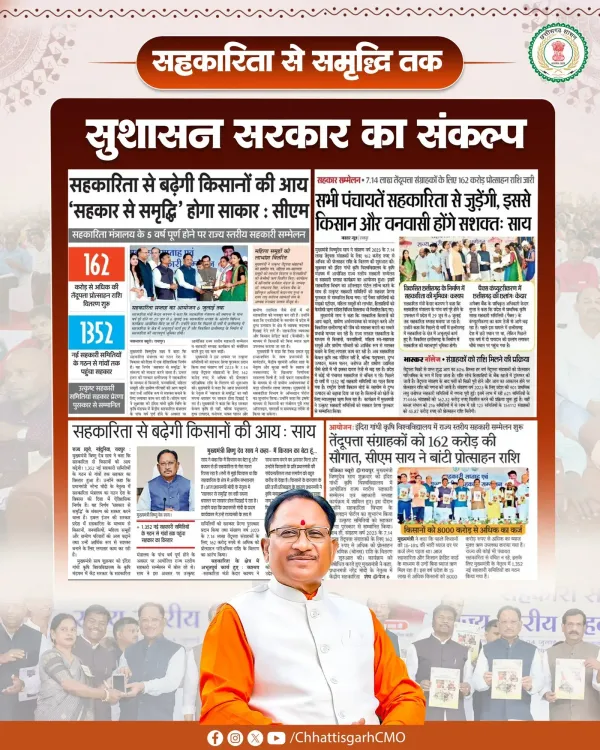
The Chief Minister's Office of Chhattisgarh on Saturday, 4 July 2026, highlighted the Vishnu Deo Sai government's push to form new cooperative societies across the state, asserting that the initiative is strengthening the rural economy and raising farmer incomes village by village.
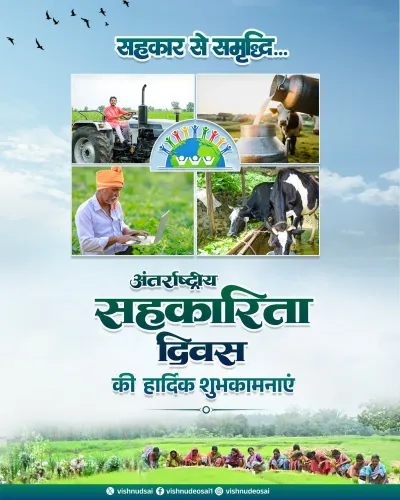
The official post, shared under the hashtags #SahkarSeSamriddhi (Prosperity through Cooperation) and #SushasanSarkar (Good Governance Government), stated: 'The picture is changing through cooperation — farmer incomes are rising and development is spreading to every village. With the formation of new cooperative societies under the Vishnu Deo Sai government, the rural economy is becoming stronger.'
Context
Cooperative societies in Chhattisgarh serve as the primary institutional channel through which farmers access credit, agricultural inputs, collective marketing, and storage facilities. For a state with a large agrarian and tribal population, these village-level bodies directly reduce dependence on private intermediaries and money-lenders. The Sai government, which took office in December 2023, has placed cooperative expansion at the centre of its rural development agenda.Policy Backdrop
The current cooperative push in Chhattisgarh fits within a broader national framework. The Government of India established a dedicated Ministry of Cooperation in July 2021 to modernise and revive the cooperative movement, providing states with policy support, training infrastructure, and new institutional frameworks. The 97th Constitutional Amendment Act of 2011 had earlier granted cooperatives formal constitutional status, recognising the right to form such societies. Indian states have since increasingly aligned their own cooperative expansion drives with the Centre's goal of raising farmer incomes through collective marketing and credit access. Chhattisgarh's focus on forming new primary agricultural credit societies and marketing cooperatives mirrors similar efforts in other states seeking to deepen rural economic institutions.Stakeholders and Impact
The primary beneficiaries of cooperative expansion are farmers and rural households across Chhattisgarh's districts. By bringing more villages under the cooperative network, farmers gain structured access to institutional credit at lower costs, reducing their vulnerability to crop-cycle debt. Collective marketing arrangements help small and marginal farmers negotiate better prices for their produce, while shared storage infrastructure reduces post-harvest losses. The state government's messaging underscores that these gains are intended to be distributed broadly — 'village by village' — rather than concentrated in already-developed agricultural belts.What's Next
Attention will now turn to whether the state's budget allocations reflect the scale of cooperative expansion being signalled, and whether official registration data for new societies will be made public in upcoming fiscal reviews. Analysts will also watch for any formal linkage between Chhattisgarh's state-level cooperative drive and central programmes such as the 10,000 Farmer Producer Organisations (FPO) scheme, which provides financial and institutional support to collective farming bodies. A transparent accounting of new society formations and measurable income-gain data will be critical to substantiating the government's claims of rural economic transformation.Point of View
Framing cooperative expansion as the Sai government's signature rural-economy intervention ahead of what the hashtag suggests is a milestone anniversary. The emphasis on 'village by village' reach signals an attempt to demonstrate distributive impact rather than aggregate growth — a politically important distinction in a state with a large tribal and marginal-farmer electorate. The alignment with New Delhi's cooperative ministry framework also allows the state government to claim credit for central policy momentum while reinforcing its own BJP identity. However, the absence of verifiable data on new society registrations or income gains means the announcement remains aspirational until backed by auditable numbers.
NationPress
4 Jul 2026
Frequently Asked Questions
What are cooperative societies and how do they help farmers in Chhattisgarh?
Cooperative societies are village-level institutions that provide farmers with institutional credit, agricultural inputs, collective marketing, and storage services, reducing their dependence on private moneylenders and intermediaries. In Chhattisgarh, they are a primary channel for rural financial inclusion.
What is the Vishnu Deo Sai government's cooperative policy?
The Vishnu Deo Sai government, in office since December 2023, has prioritised the formation of new cooperative societies across Chhattisgarh to strengthen the rural economy and raise farmer incomes, as highlighted by the Chief Minister's Office on 4 July 2026.
What is India's Ministry of Cooperation and why was it created?
The Ministry of Cooperation was established by the Government of India in July 2021 to modernise and revive the cooperative sector nationwide, providing states with policy support, training, and new institutional frameworks to boost farmer incomes through collective mechanisms.
What is the 97th Constitutional Amendment and how does it relate to cooperatives?
The 97th Constitutional Amendment Act of 2011 granted cooperatives formal constitutional status in India and recognised the right to form cooperative societies, providing a legal foundation for state and central governments to promote the cooperative movement.
What is the Sahkar Se Samridhi scheme in Chhattisgarh?
'Sahkar Se Samridhi' translates to 'Prosperity through Cooperation' and is the branding used by the Chhattisgarh government for its cooperative expansion drive, which aims to link farmers to institutional credit and collective marketing to improve rural incomes.