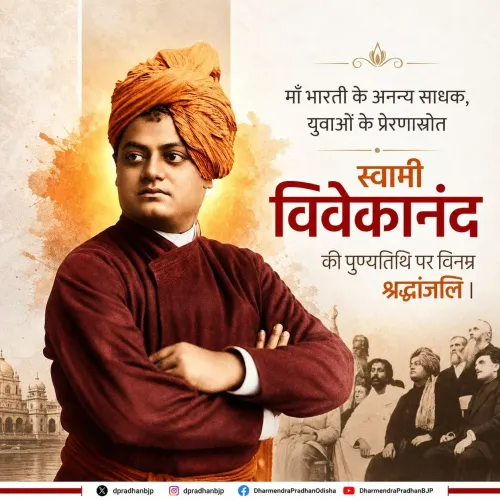
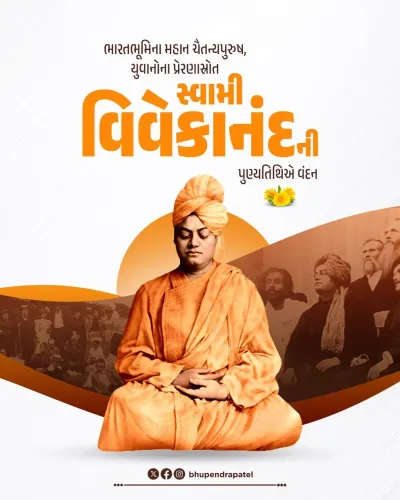
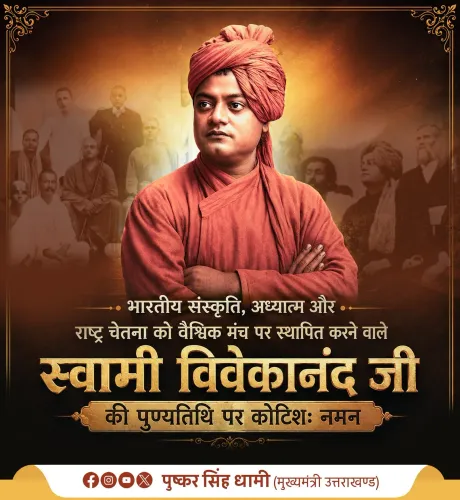
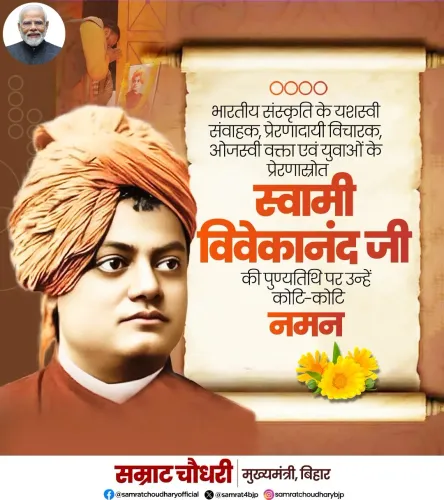
Goa CM Sawant Pays Tribute to Swami Vivekananda on Punyatithi
Synopsis
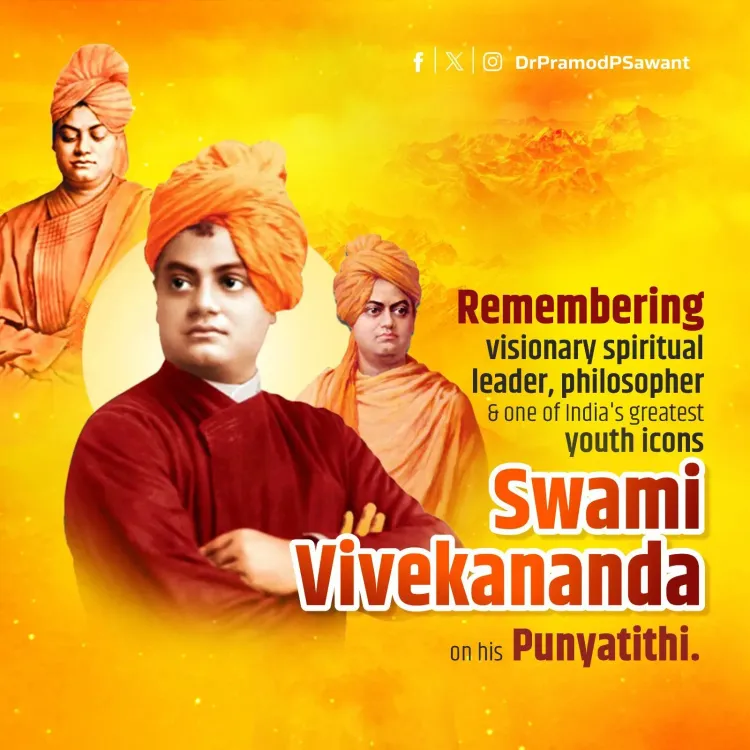
Goa Chief Minister Pramod Sawant paid tribute to Swami Vivekananda on his Punyatithi on 4 July 2026, calling the 19th-century monk 'one of India's greatest youth icons' and highlighting his teachings on self-confidence, service and national awakening as timeless guides for contemporary India.
Key Takeaways
Goa Chief Minister Pramod Sawant posted a tribute to Swami Vivekananda on his Punyatithi, 4 July 2026 .
Sawant described Vivekananda as 'a visionary spiritual leader, philosopher and one of India's greatest youth icons.' He highlighted three core Vivekananda ideals: self-confidence, service and Nation First .
Swami Vivekananda (1863–1902) founded the Ramakrishna Mission in 1897 and represented India at the 1893 Parliament of the World's Religions in Chicago.
The Government of India has observed 12 January as National Youth Day since 1984 to commemorate Vivekananda's birth anniversary.
The tribute aligns with a broader BJP pattern of invoking Vivekananda's philosophy in youth mobilisation and cultural nationalism messaging.
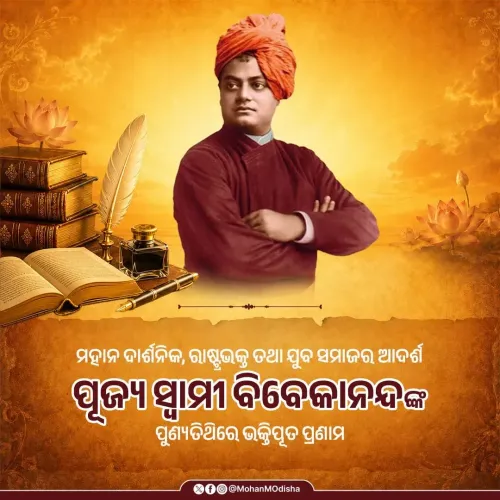
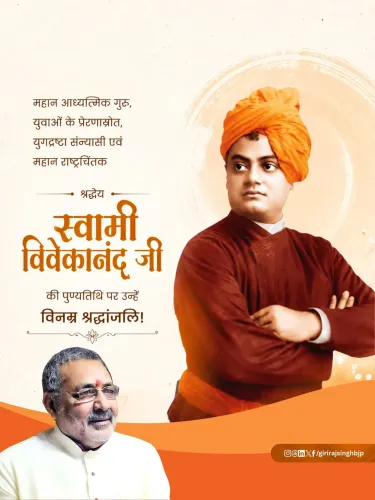
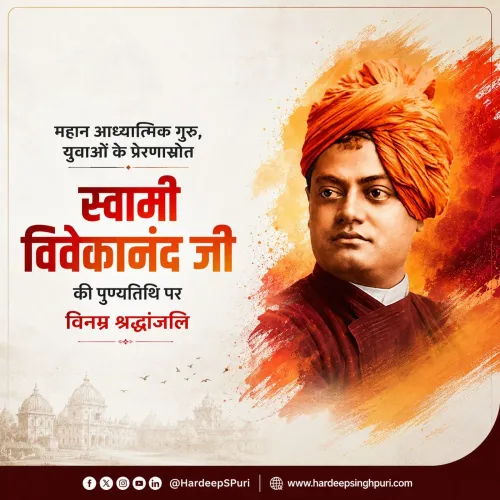
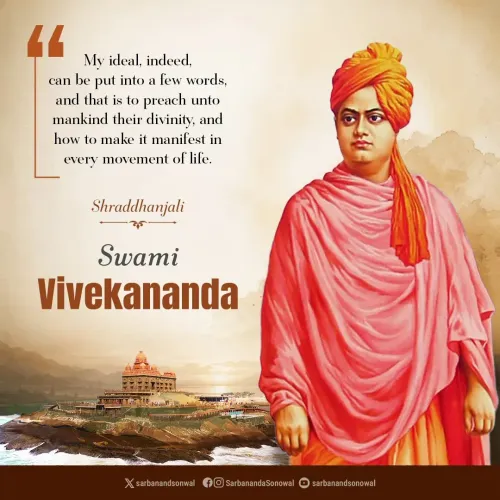
Goa Chief Minister Pramod Sawant on Saturday, 4 July 2026 paid tribute to Swami Vivekananda on his Punyatithi, remembering the 19th-century monk and philosopher as 'a visionary spiritual leader, philosopher and one of India's greatest youth icons' whose teachings awakened the spirit of self-confidence, service and 'Nation First' among Indians.
Context
Swami Vivekananda (1863–1902) remains one of the most widely invoked figures in Indian public life. His Punyatithi — the anniversary of his passing on 4 July 1902 — is observed each year by spiritual organisations, governments and political parties across the country. Chief Minister Sawant's post directly quoted Vivekananda's core ideals of self-confidence, selfless service and national awakening as the pillars of his legacy.
Sawant described Vivekananda's teachings as 'timeless,' underscoring their continued relevance to contemporary youth. The tribute comes from a leader who has consistently promoted cultural and spiritual heritage as part of Goa's public identity since assuming office in 2019.
Policy Backdrop
The Government of India declared 12 January — Vivekananda's birth anniversary — as National Youth Day in 1984, institutionalising his ideals as a framework for youth development policy. His founding of the Ramakrishna Mission in 1897 gave those ideals an organisational form; the Mission continues to operate educational and service institutions across India, including in Goa.
BJP leaders at both state and national levels have consistently invoked Vivekananda's emphasis on self-reliance and national service in their ideological outreach, particularly to young voters. Sawant's tribute fits within this established pattern of linking the monk's philosophy to contemporary 'nation first' messaging.
Stakeholders and Impact
Vivekananda's legacy resonates most directly with India's youth, students and the broader Hindu spiritual community — constituencies that both the BJP and organisations such as the Ramakrishna Mission actively engage. In Goa, the Mission's educational institutions give the tribute a local institutional dimension beyond its symbolic weight.
For Sawant, marking the Punyatithi publicly reinforces his government's positioning on cultural nationalism and value-based education — themes that carry electoral salience in a state where tourism-driven modernity coexists with strong traditional and religious identities.
What's Next
Observers will watch whether the Goa government follows the tribute with concrete announcements — such as new value-education modules or youth programmes citing Vivekananda — during the 2026–27 academic year. Ramakrishna Mission centres in the state are also expected to hold commemorative events marking the Punyatithi. Vivekananda's dual anniversaries — birth and death — have increasingly become occasions for state governments to announce youth-oriented policy initiatives, a trend that gives ceremonial tributes a potential policy afterlife.
Point of View
Using them as springboards for educational and cultural programme announcements. Whether Sawant's tribute translates into a concrete state initiative will be the real measure of its political weight.
NationPress
2 Oct 2026
Frequently Asked Questions
When is Swami Vivekananda's Punyatithi observed?
Swami Vivekananda's Punyatithi falls on 4 July each year, marking the anniversary of his passing in 1902 at Belur Math, West Bengal.
What did Goa CM Pramod Sawant say about Swami Vivekananda?
Chief Minister Pramod Sawant called Vivekananda 'a visionary spiritual leader, philosopher and one of India's greatest youth icons' and credited his timeless teachings with awakening the spirit of self-confidence, service and Nation First.
What is National Youth Day and why is it linked to Vivekananda?
National Youth Day is observed on 12 January — Vivekananda's birth anniversary — every year since the Government of India designated it in 1984 to promote his ideals of self-reliance and service among young people.
What is the Ramakrishna Mission and does it operate in Goa?
The Ramakrishna Mission is a humanitarian and educational organisation founded by Swami Vivekananda in 1897 . It runs schools, colleges and service centres across India, including institutions in Goa .
Why do BJP leaders frequently reference Swami Vivekananda?
BJP leaders invoke Vivekananda's emphasis on self-confidence, national service and cultural pride because his philosophy aligns closely with the party's ideological messaging around cultural nationalism and youth mobilisation.