CM Sai Govt Vows Strict Action on Illegal Mining in Chhattisgarh
Synopsis
The Chief Minister's Office of Chhattisgarh announced on 25 June 2026 that the Vishnu Deo Sai government will enforce strict laws, heavy penalties, and continuous action to curb illegal mining, transportation, and storage of minerals across the state.
Key Takeaways
The Chhattisgarh CMO issued a formal public statement on 25 June 2026 warning of strict legal action against illegal mining.
The crackdown covers illegal extraction, transportation, and storage of minerals — not just at the mine face.
Chief Minister Vishnu Deo Sai's BJP government, in power since December 2023 , framed the drive under its 'good governance' mandate.
Chhattisgarh holds major reserves of coal, iron ore, and bauxite, making illegal mining a significant fiscal and environmental concern.
The enforcement framework draws on the Mines and Minerals (Development and Regulation) Act and aligns with Supreme Court directives on mineral regulation.
Detailed new rules and penalty structures from the state mining department are awaited as the next concrete step.
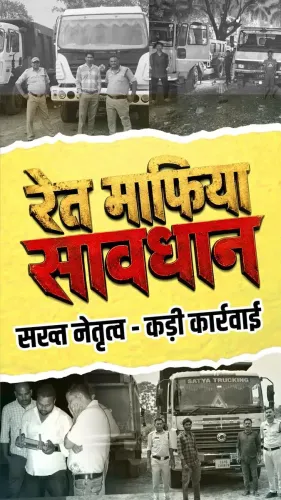
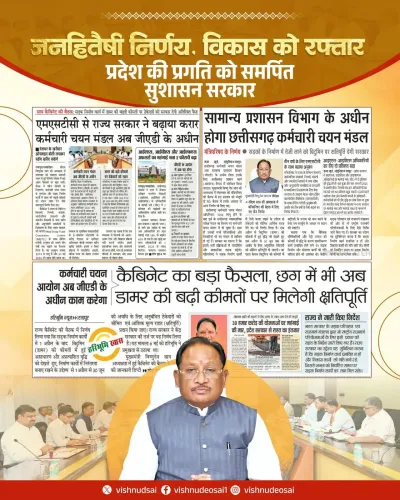
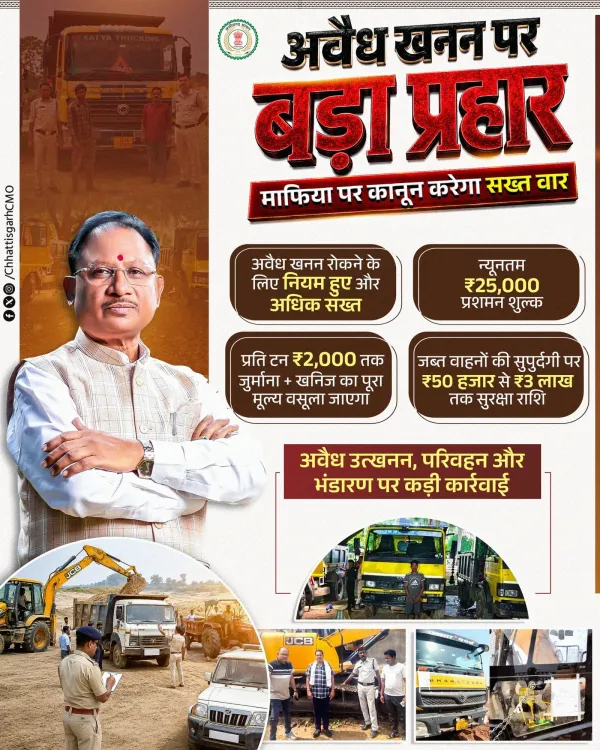
The Chief Minister's Office of Chhattisgarh on Thursday, 25 June 2026 issued a firm public message from the Vishnu Deo Sai government, declaring that illegal mining will face the full force of the law through stringent rules, heavy penalties, and sustained enforcement action across the state.
The post, shared on the official CMO handle, stated in Hindi: 'विष्णुदेव सरकार का स्पष्ट संदेश, अवैध खनन पर होगा कानून का सख्त प्रहार' — translated as 'A clear message from the Vishnu Deo government: the law will strike hard against illegal mining.' The statement specifically targets illegal extraction, transportation, and storage of minerals, signalling a comprehensive crackdown rather than a narrowly focused drive.
Context
Chhattisgarh is one of India's most mineral-abundant states, holding significant reserves of coal, iron ore, and bauxite. Mining activity — both legal and illegal — has long shaped the state's economy, its revenue streams, and the livelihoods of communities, including tribal populations living near extraction zones. Illegal mining diverts royalties away from the state exchequer and causes environmental degradation that disproportionately affects these communities. The Vishnu Deo Sai-led Bharatiya Janata Party government came to power in December 2023 after winning the state assembly elections. Since then, the administration has positioned good governance and rule-of-law enforcement as central planks of its agenda, as reflected in the hashtags #SuShasan (good governance) and #GoodGovernance accompanying the post.Policy Backdrop
The crackdown fits within a well-established national pattern. Mineral-rich states including Chhattisgarh, Jharkhand, and Odisha have periodically intensified enforcement against illegal mining to protect state revenues and comply with Supreme Court directives on mineral regulation. The primary legislative framework governing such action is the Mines and Minerals (Development and Regulation) Act, which empowers state governments to seize vehicles, impose fines, and prosecute offenders involved in unauthorised extraction or movement of minerals. The previous Congress government in Chhattisgarh also conducted enforcement drives between 2019 and 2023, seizing vehicles and levying fines on illegal sand and mineral miners. The current administration's messaging, however, emphasises the introduction of stricter rules and heavier penalties — though the precise details of any new regulatory amendments are yet to be formally published by the state mining department.Stakeholders and Impact
Legal mining leaseholders stand to benefit from a more level playing field if illegal operators are effectively penalised. Tribal communities in mineral-bearing districts have historically borne the environmental cost of unregulated extraction — depleted water tables, deforestation, and damaged agricultural land — making enforcement a matter of both ecological and social justice. State revenue authorities are the other key stakeholder: uncollected royalties from illegal mining represent a direct fiscal loss. Sustained crackdowns, if followed through with prosecutions and penalty recovery, can meaningfully augment the state's own tax revenues, which fund welfare and infrastructure programmes.What's Next
The immediate signal from the CMO is one of intent and political will. Concrete follow-through will be measured by the publication of detailed new rules or amendments by the Chhattisgarh mining department, and by quarterly data on seizures, fines collected, and prosecutions filed. Observers will watch whether the administration backs its public messaging with verifiable enforcement metrics, which would distinguish this drive from previous cyclical crackdowns that faded without structural change.Point of View
' the CMO is raising the political stakes — any visible rollback or selective enforcement will be easier for opponents to highlight. The move also resonates with a broader BJP pattern across mineral-rich states of using anti-illegal-mining drives to consolidate support among tribal and agrarian communities who suffer the externalities of unregulated extraction. The real test will be whether enforcement data — seizures, fines, prosecutions — is made public and sustained beyond the initial announcement cycle.
NationPress
25 Jun 2026
Frequently Asked Questions
What is the Chhattisgarh government doing about illegal mining?
The Vishnu Deo Sai government has announced a strict crackdown on illegal mining, covering unauthorised extraction, transportation, and storage of minerals, with heavy penalties and continuous enforcement action.
Who is Vishnu Deo Sai and why is he targeting illegal mining?
Vishnu Deo Sai is the Chief Minister of Chhattisgarh, leading the BJP government since December 2023. He has made good governance a central theme, and illegal mining poses a major threat to state revenues and tribal communities in the mineral-rich state.
Which minerals are illegally mined in Chhattisgarh?
Chhattisgarh has large deposits of coal, iron ore, and bauxite, all of which have historically been targets of illegal extraction operations that bypass royalty payments and environmental norms.
What law governs action against illegal mining in India?
The primary law is the Mines and Minerals (Development and Regulation) Act, which empowers state governments to seize vehicles, impose fines, and prosecute those involved in illegal extraction or transportation of minerals.
Has Chhattisgarh taken action against illegal mining before?
Yes, the previous Congress government conducted multiple enforcement drives between 2019 and 2023, seizing vehicles and imposing fines. The current BJP administration says its approach will involve stricter rules and heavier penalties.