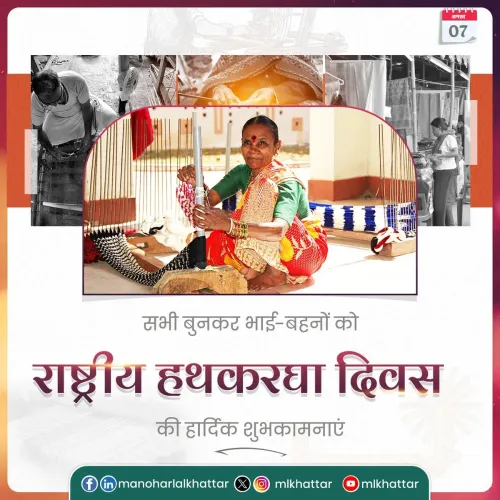
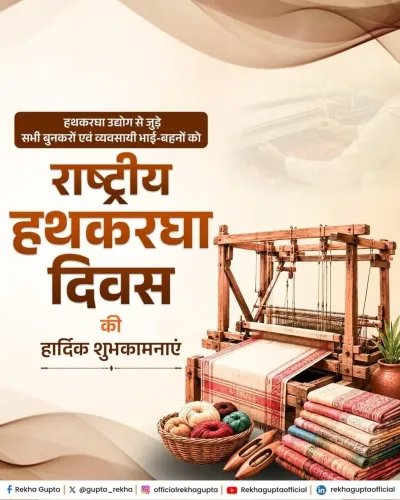
CM Sai hails Kosha Silk on National Handloom Day
Synopsis
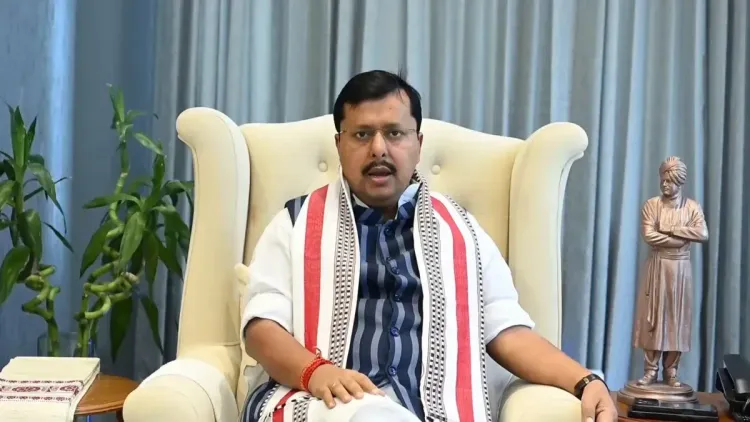
On National Handloom Day 2026, Chhattisgarh CM Vishnu Deo Sai celebrated the national recognition of the state's Kosha Silk, framing its weavers as the living embodiment of PM Modi's Vocal for Local and Atmanirbhar Bharat vision.
Key Takeaways
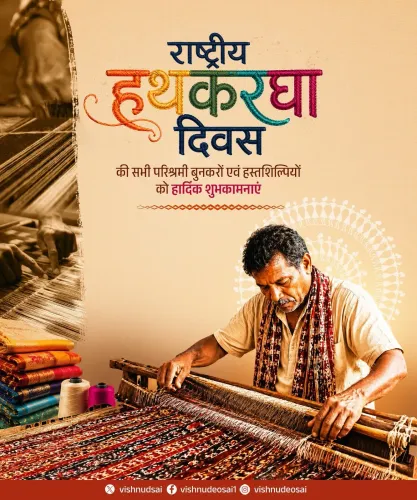
CM Vishnu Deo Sai posted on 7 August 2026 — National Handloom Day — to celebrate the public mention of Chhattisgarh's Kosha Silk by Nitin Navin .
National Handloom Day has been observed annually since 2015 , marking the anniversary of the Swadeshi movement launched on 7 August 1905 .
Kosha (Tussar) Silk is a distinctive Chhattisgarh product woven by largely tribal artisan communities and has been promoted under GI tagging and cluster development frameworks.
PM Modi's 'Vocal for Local' campaign, launched in 2020 under Atmanirbhar Bharat , has shaped central policy on handloom exports and domestic marketing.
CM Sai described weavers' skills as 'our cultural heritage and the strong identity of a self-reliant India.'
On National Handloom Day, 7 August 2026, Chhattisgarh Chief Minister Vishnu Deo Sai invoked Prime Minister Narendra Modi's 'Vocal for Local to Local to Global' vision to celebrate a moment of quiet pride — the public recognition of the state's prized Kosha (Tussar) Silk on a national platform.
Kosha Silk steps into the national spotlight
CM Sai's post was a direct response to a mention of Chhattisgarh's Kosha Silk by Nitin Navin on the occasion of National Handloom Day. Calling it a matter of pride for everyone, the Chief Minister wrote: 'Hamare bunakaron ka kaushal hamari sanskritik virasat aur Atmanirbhar Bharat ki sashakt pehchan hai' — 'Our weavers' skill is our cultural heritage and the strong identity of a self-reliant India.'
Kosha Silk, woven from the cocoons of the Antheraea mylitta silkworm found in the forests of Chhattisgarh, is one of the state's most distinctive artisanal products. It has long been positioned within the central government's framework of Geographical Indication tagging and handloom cluster development as a regional product with genuine export potential.
Vocal for Local — from a pandemic slogan to a textile policy spine
When Prime Minister Modi first amplified the 'Vocal for Local' call in 2020, it was framed as a post-pandemic economic imperative under the broader Atmanirbhar Bharat campaign. For India's handloom sector — which employs millions of weavers across rural clusters — the slogan translated into a renewed push for domestic marketing, e-commerce access, and export incentives.
National Handloom Day itself was first observed on 7 August 2015, chosen to commemorate the launch of the Swadeshi movement in 1905. The date anchors a living craft tradition to a foundational moment in India's political history — a deliberate act of cultural memory that successive governments have built policy around.
Weavers at the centre of the 'Local to Global' arc
The broader pattern is clear: India has been systematically using GI tags, national observances, and export platforms to push traditional textiles from village looms into global markets. Chhattisgarh's weavers, many from tribal communities with generations of Kosha-weaving knowledge, sit at the intersection of cultural preservation and the Atmanirbhar Bharat goal of reducing import dependence in textiles.
CM Sai's public acknowledgement on a high-visibility occasion keeps that arc alive at the state level — and signals that Raipur is watching for any central textile ministry announcements on cluster development or weaver welfare schemes that could follow.
Point of View
National Handloom Day has become a recurring opportunity to demonstrate that 'Vocal for Local' translates into concrete regional identity, not just sloganeering. The focus on Kosha Silk also carries an implicit tribal-welfare subtext, since a significant share of Chhattisgarh's weavers come from Adivasi communities — a constituency the BJP has invested in politically. Watchers should note whether this social-media moment is followed by any state budget allocation or central scheme announcement for weaver clusters.
NationPress
7 Aug 2026
Frequently Asked Questions
What is National Handloom Day and when is it celebrated?
National Handloom Day is observed every year on 7 August to honour India's handloom weavers and their cultural heritage. It was first celebrated in 2015 to mark the anniversary of the Swadeshi movement, which began on 7 August 1905 .
What is Kosha Silk from Chhattisgarh?
Kosha Silk , also known as Tussar Silk, is a traditional handwoven fabric produced in Chhattisgarh from the cocoons of wild silkworms found in the state's forests. It is one of the region's most prized artisanal products and has been promoted under India's Geographical Indication framework.
What is the Vocal for Local initiative by PM Modi?
PM Narendra Modi promoted 'Vocal for Local' from 2020 as part of the Atmanirbhar Bharat (Self-Reliant India) campaign, encouraging Indians to buy and champion domestically produced goods to boost local industries, including handloom and handicrafts.
What did Chhattisgarh CM Vishnu Deo Sai say on National Handloom Day 2026?
CM Vishnu Deo Sai said that the mention of Chhattisgarh's Kosha Silk by Nitin Navin on National Handloom Day was a matter of pride, and called the weavers' skill 'our cultural heritage and the strong identity of a self-reliant India.'
How does Atmanirbhar Bharat support handloom weavers in India?
The Atmanirbhar Bharat campaign has supported handloom weavers through GI tagging , e-commerce access, export incentives, and cluster development programmes aimed at preserving traditional weaving skills while expanding market reach domestically and globally.