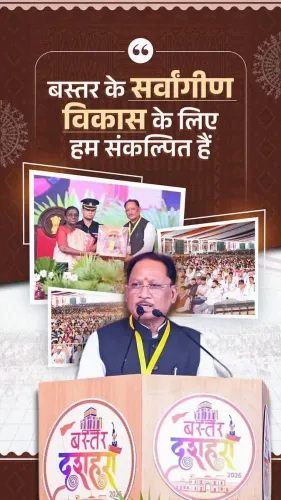
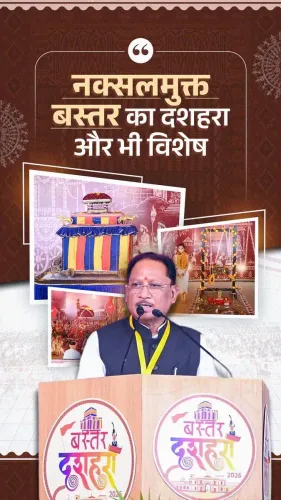
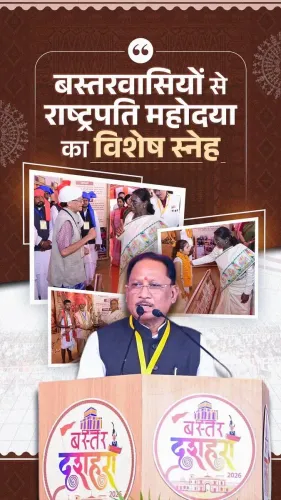
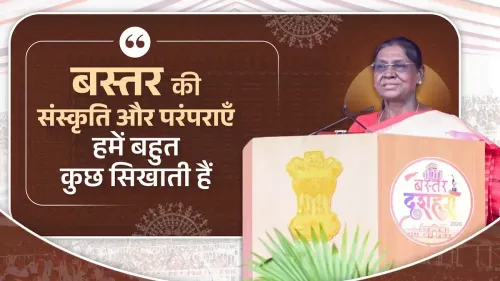
CM Sai hails President Murmu's presence at Bastar Dashhara 2026
Synopsis
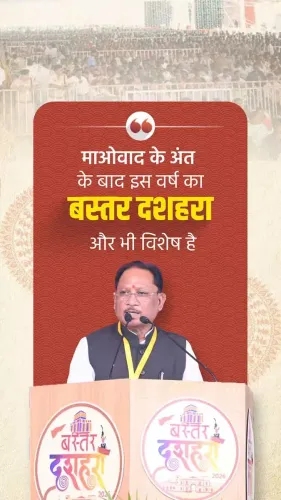
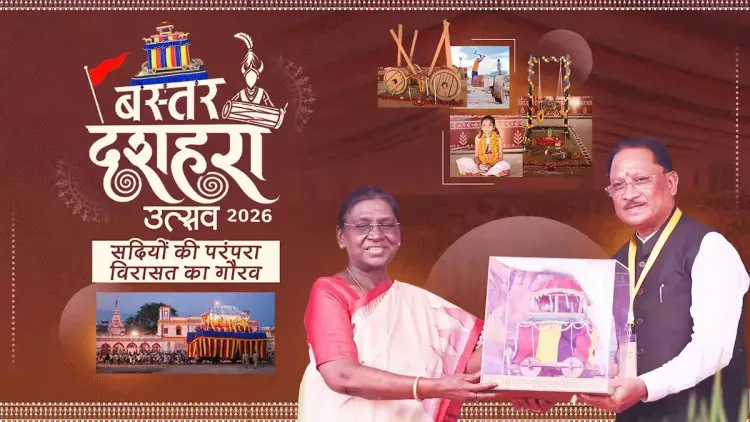
Chhattisgarh CM Vishnu Deo Sai hailed the Bastar Dashhara Utsav 2026 in Jagdalpur as historic, crediting President Draupadi Murmu's presence at the centuries-old tribal festival with making it an unforgettable moment for indigenous heritage and cultural pride.
Key Takeaways
Bastar Dashhara Utsav 2026 was held in Jagdalpur , Chhattisgarh, on 23 October 2026 .
President Draupadi Murmu — India's first tribal head of state — attended the festival, lending it national constitutional significance.
CM Vishnu Deo Sai described the festival as a living symbol of faith, tribal pride, and centuries-old cultural heritage.
Bastar Dashhara is distinct from mainstream Dussehra, centred on local deities and Muria tribal traditions including the Muria Darbar .
Chhattisgarh has supported Bastar Dashhara as a state-level cultural event since the early 2000s .
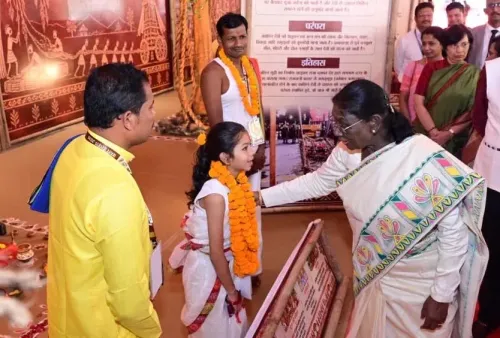
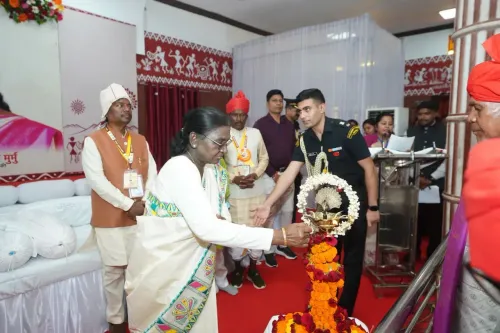
When the President of India walks into a tribal festival that has pulsed for centuries before the Republic existed, something larger is being said — about identity, recognition, and whose heritage gets a place in the national story. Chhattisgarh Chief Minister Vishnu Deo Sai on Friday, 23 October 2026, celebrated the Bastar Dashhara Utsav 2026 in Jagdalpur as a historic moment, marking the gracious presence of President Draupadi Murmu at the multi-week tribal festival.
What makes Bastar Dashhara unlike any other Dussehra in India
Most Indians know Dussehra as the burning of Ravana's effigy. Bastar Dashhara is something else entirely. Rooted in the indigenous traditions of the Muria and other tribal communities of the Bastar division, the festival revolves around local deities, clan rituals, and the legendary Muria Darbar — a gathering that predates the modern state by centuries. The effigy is absent. The goddess is central. That distinction matters.
CM Sai described the festival as a 'jeevant pratik' — a 'living symbol' — of faith, tribal pride, and a rich cultural heritage preserved across generations. His post on X tagged @rashtrapatibhvn and carried the hashtags #बस्तर_दशहरा_2026 and #मुरिया_दरबार, underlining the constitutional and community dimensions of the occasion simultaneously.
President Murmu's presence and what it signals
President Draupadi Murmu is not just India's head of state — she is the first person from a tribal community to hold the office. Her participation in Bastar Dashhara 2026 therefore carried a weight well beyond protocol. For the tribal communities of Bastar, it represented the nation's highest constitutional authority arriving not to observe from a distance, but to share in a celebration that is theirs.
Indian state governments have periodically invited constitutional dignitaries to major tribal festivals in central and eastern India, part of a broader pattern of official recognition for indigenous heritage. Chhattisgarh has supported Bastar Dashhara as a state-level cultural event since the early 2000s, building administrative infrastructure around what was already an ancient communal practice.
Jagdalpur at the centre of tribal cultural diplomacy
Jagdalpur, the district headquarters of Bastar division, serves as the primary stage for the main Dashhara celebrations each year. This year the town hosted not just the rituals and performances of local communities but a presidential visit that CM Sai called 'aitihasik evam avismarniya' — 'historic and unforgettable.' The Chief Minister's phrasing was deliberate: he credited the President's participation with elevating the festival beyond its annual cycle into a landmark moment for tribal cultural memory.
The convergence of tribal performers, folk traditions, collective faith, and national leadership at a single venue in Bastar is precisely the kind of image the state government has been curating — one where indigenous culture is not a footnote to development policy but the headline itself.
With state assembly sessions ahead and questions around cultural funding always present in Chhattisgarh politics, the Bastar Dashhara 2026 edition now sets a high watermark — one future administrations will be measured against.
Point of View
And having India's first tribal President as the chief guest transforms a regional festival into a national statement. For CM Sai — himself from the Jashpur tribal belt — the optics reinforce a message of indigenous representation at every tier of the republic. The event also signals that cultural recognition, not just welfare schemes, is now a live front in the competition for tribal political allegiance across central India.
NationPress
24 Oct 2026
Frequently Asked Questions
What is Bastar Dashhara and how is it different from regular Dussehra?
Bastar Dashhara is a multi-week tribal festival in the Bastar division of Chhattisgarh rooted in Muria and other indigenous community traditions. Unlike mainstream Dussehra, it centres on local deities and clan rituals — including the Muria Darbar — rather than the burning of Ravana's effigy.
Why did President Draupadi Murmu attend Bastar Dashhara 2026?
President Draupadi Murmu attended the Bastar Dashhara Utsav 2026 in Jagdalpur as the chief guest. As India's first tribal President, her participation was seen as a powerful gesture of national recognition for indigenous heritage and Bastar's tribal communities.
Where is Bastar Dashhara celebrated?
Bastar Dashhara is celebrated primarily in Jagdalpur, the district headquarters of the Bastar division in Chhattisgarh, where the main rituals and cultural performances are held each year.
What did CM Vishnu Deo Sai say about Bastar Dashhara 2026?
CM Vishnu Deo Sai described Bastar Dashhara as a living symbol of faith, tribal pride, and centuries-old cultural heritage, calling President Murmu's presence at the 2026 edition 'historic and unforgettable.'
How long has the Chhattisgarh government been supporting Bastar Dashhara?
Chhattisgarh governments have supported Bastar Dashhara as a state-level cultural event since the early 2000s, building administrative and logistical infrastructure around the ancient tribal festival.