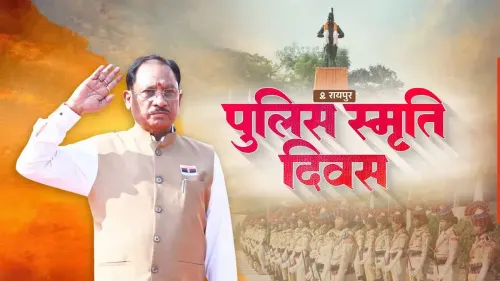
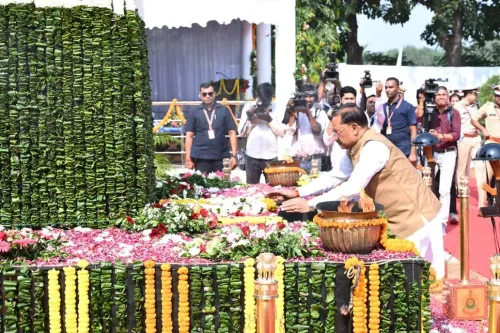
CM Vishnu Deo Sai salutes ITBP on Raising Day

Synopsis
Chhattisgarh Chief Minister Vishnu Deo Sai saluted ITBP's 'himveers' on the force's 64th Raising Day on 24 October 2026, calling their service on the Himalayan frontier a symbol of courage, discipline, and national dedication.
Key Takeaways
ITBP Raising Day falls on 24 October every year, marking the force's founding in 1962 in the aftermath of the Sino-Indian War.
Chief Minister Vishnu Deo Sai posted tributes on X on Saturday, 24 October 2026 , greeting all ITBP personnel as 'himveers' .
ITBP is a Central Armed Police Force under the Ministry of Home Affairs , responsible for guarding the India-China border along the Line of Actual Control.
The force operates at altitudes above 18,000 feet in extreme Himalayan conditions.
CM Sai described ITBP jawans as symbols of 'indomitable courage, discipline, and national dedication.'
Born in the crucible of the 1962 Sino-Indian War, the Indo-Tibetan Border Police has stood sentinel on the world's most forbidding frontier for 64 years — and on Saturday, 24 October 2026, Chhattisgarh Chief Minister Vishnu Deo Sai paused to honour every soldier who has kept that vigil.
Posting on X on the occasion of ITBP's Raising Day, CM Sai extended warm greetings to what he called the force's 'himveeron' — the 'warriors of snow' — saluting their courage, discipline, and devotion to the nation. 'Himalaya ki durgam chotiyonpar desh ki seemaon ki raksha mein tatpar ITBP ke jawan adamya sahas, anushasan aur rashtranishttha ke prateek hain' — 'The ITBP jawans, ever-ready to guard the nation's borders on the inaccessible peaks of the Himalayas, are symbols of indomitable courage, discipline, and national dedication,' he wrote.A force forged by war, tested by altitude
The ITBP was raised on 24 October 1962, in direct response to the Sino-Indian conflict that exposed the vulnerability of India's Himalayan frontier. Placed under the Ministry of Home Affairs, it is one of India's Central Armed Police Forces and holds the singular responsibility of guarding the India-China border — stretching across some of the harshest high-altitude terrain on earth, from Ladakh in the west to Arunachal Pradesh in the east along the Line of Actual Control.
ITBP personnel are trained to operate at altitudes exceeding 18,000 feet, enduring sub-zero temperatures, avalanche risk, and near-zero oxygen — conditions that make their duty one of the most physically demanding in any armed service in the world. CM Sai's tribute specifically noted that their 'valour and dedication is a source of inspiration for all of us.'
Why leaders salute the ITBP — and why it matters now
Public tributes from elected leaders on ITBP's Raising Day have become a fixture in Indian political life, especially in the years following renewed attention on the Line of Actual Control. The annual acknowledgement serves a dual purpose: it honours the force's institutional identity and underscores the political consensus — across parties and states — that border security commands respect above the noise of day-to-day politics.
For a Chief Minister of a landlocked state like Chhattisgarh, the gesture carries a symbolic weight: the border is distant geographically, but the sentiment of national solidarity travels far.
Sixty-four years after its founding battle, the ITBP's himveers remain exactly where they were placed — on the peaks, in the cold, watching.
Point of View
The message also serves to align Chhattisgarh's governance identity with a muscular national-security narrative that the party has consistently championed. The tribute carries no direct policy implication but contributes to the broader political signalling around India's high-altitude military posture. Over time, such ritualistic acknowledgements build cumulative pressure on the Centre to translate symbolic solidarity into tangible support — better pay, infrastructure, and equipment — for the forces guarding the frontier.
NationPress
24 Oct 2026
Frequently Asked Questions
When was ITBP founded and why?
The Indo-Tibetan Border Police was raised on 24 October 1962 , directly following the Sino-Indian War, to secure and guard India's Himalayan frontier with China.
Why did CM Vishnu Deo Sai post about ITBP?
Chhattisgarh Chief Minister Vishnu Deo Sai posted greetings on 24 October 2026 to mark ITBP's annual Raising Day, saluting the force's personnel for their courage and dedication on the Himalayan frontier.
What is the meaning of 'himveers' in the context of ITBP?
'Himveers' — literally 'warriors of snow' or 'brave ones of the Himalayas' — is the popular term of honour used for ITBP personnel, acknowledging their extraordinary service in high-altitude, sub-zero conditions.
How long has ITBP been guarding India's borders?
As of its 2026 Raising Day , the ITBP has been guarding India's Himalayan borders for 64 years , since its founding on 24 October 1962.