CM Sai Meets JP Nadda in Delhi, Discusses Chhattisgarh Health and Fertilizer Needs
Synopsis
Chhattisgarh Chief Minister Vishnu Deo Sai met Union Minister JP Nadda in New Delhi on 25 June 2026 to discuss public health, medical infrastructure, pharmaceuticals, and fertilizer supply, reaffirming the state's commitment to advancing development with central government support.
Key Takeaways
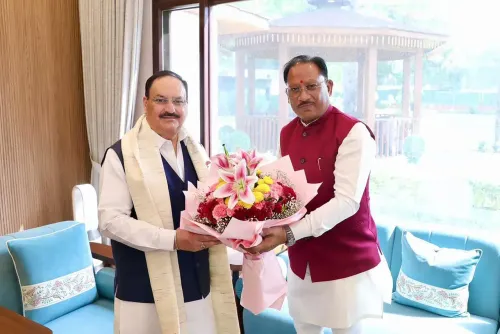
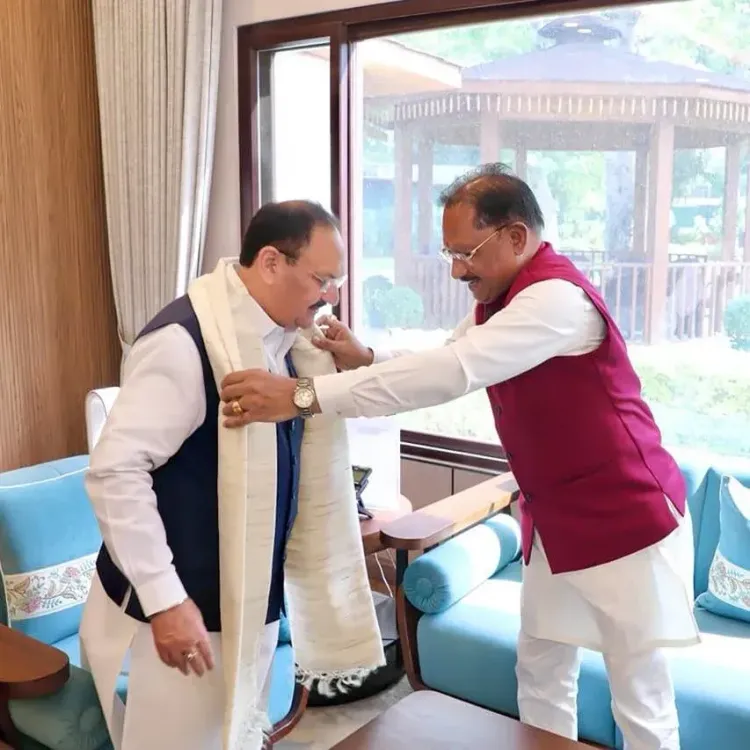
Chief Minister Vishnu Deo Sai held a courtesy meeting with Union Minister JP Nadda at his New Delhi residence on 25 June 2026 .
Discussions covered public health, medical infrastructure, pharmaceuticals, and fertilizers — all sectors under Nadda's dual ministerial portfolio.
Sai stated the Chhattisgarh government will continue to seek the full cooperation of the Government of India for state development.
Chhattisgarh benefits from central schemes including the National Health Mission and Ayushman Bharat PMJAY , both requiring active centre-state coordination.
Farming communities across the state depend on subsidised fertilizer supply routed through the Ministry of Chemicals and Fertilizers .
Upcoming state budget allocations or project announcements on health and fertilizer logistics will be the key indicators of follow-through.
Chhattisgarh Chief Minister Vishnu Deo Sai called on Union Minister JP Nadda at his residence in New Delhi on Thursday, 25 June 2026, for a courtesy meeting covering public health, medical infrastructure, pharmaceuticals, and fertilizers. The two leaders held what Sai described as a detailed and productive discussion on several departmental and contemporary issues.
Context
Posting on X, Chief Minister Sai wrote: 'आज दिल्ली में केंद्रीय स्वास्थ्य एवं परिवार कल्याण तथा रसायन एवं उर्वरक मंत्री श्री जेपी नड्डा जी के आवास पर शिष्टाचार मुलाकात की।' ('Today I paid a courtesy visit to Union Minister JP Nadda at his residence in Delhi.'). He added that the Chhattisgarh government would 'continue to strive to give new momentum to the state's development with the full cooperation of the Government of India.'
JP Nadda holds the dual portfolio of Union Minister of Health and Family Welfare and Minister of Chemicals and Fertilizers — two sectors directly relevant to Chhattisgarh, a state with a large rural and tribal population that depends heavily on both public health infrastructure and agricultural inputs.
Policy Backdrop
Chhattisgarh has been a beneficiary of central health schemes including the National Health Mission, which has provided funding and a framework for state-level health infrastructure since 2013, and the Ayushman Bharat Pradhan Mantri Jan Arogya Yojana, launched in 2018 to extend health coverage to economically weaker sections. Both schemes require continuous coordination between state administrations and the Union Ministry of Health to address gaps in implementation.
On the fertilizer front, Chhattisgarh's predominantly agrarian districts rely on timely and adequate supply of subsidised fertilizers routed through the Ministry of Chemicals and Fertilizers. Disruptions in supply chains can directly affect sowing seasons and farm output, making ministerial-level engagement on this subject particularly significant for the state.
Stakeholders and Impact
The primary beneficiaries of the issues discussed are Chhattisgarh's rural households, who depend on government hospitals and primary health centres for medical care, and farming communities that rely on subsidised fertilizer availability. State health departments and district administrations would be responsible for translating any centre-state alignment into ground-level delivery.
Such meetings between BJP-led state governments and union ministers are standard practice for aligning the implementation of central welfare schemes. They reinforce cooperative federalism on welfare delivery without necessarily requiring new legislative action, and often set the agenda for follow-up reviews and budget allocations.
What's Next
Observers will watch for any state budget allocations, memoranda of understanding, or project announcements related to health infrastructure and fertilizer logistics in Chhattisgarh in the coming weeks. The meeting signals the state government's intent to actively engage the Centre ahead of any upcoming central or assembly-level review sessions on scheme implementation.
Point of View
Particularly in welfare-heavy sectors. With Nadda holding both the health and chemicals portfolios, a single meeting allows Chhattisgarh to address two of its most pressing rural development challenges simultaneously. The public framing — emphasising 'full cooperation' from the Centre — also serves a political purpose, reinforcing the narrative of seamless BJP governance from state capitals to New Delhi. The real test will be whether this engagement translates into measurable improvements in health facility capacity or fertilizer availability before the next electoral cycle.
NationPress
25 Jun 2026
Frequently Asked Questions
Why did Chhattisgarh CM Vishnu Deo Sai meet JP Nadda in Delhi?
Chief Minister Vishnu Deo Sai paid a courtesy call on Union Minister JP Nadda on 25 June 2026 to discuss public health, medical infrastructure, pharmaceuticals, and fertilizer supply for Chhattisgarh, seeking the Centre's cooperation for the state's development.
What is JP Nadda's current ministerial role?
JP Nadda serves as Union Minister of Health and Family Welfare and Minister of Chemicals and Fertilizers in the Government of India.
What central health schemes is Chhattisgarh part of?
Chhattisgarh participates in the National Health Mission, which has funded state health infrastructure since 2013, and the Ayushman Bharat Pradhan Mantri Jan Arogya Yojana, launched in 2018 to provide health coverage to economically weaker sections.
Who is the Chief Minister of Chhattisgarh?
Vishnu Deo Sai has been the Chief Minister of Chhattisgarh since December 2023, representing the Bharatiya Janata Party.
What will happen after the Sai-Nadda meeting?
Analysts will watch for follow-up announcements on health infrastructure projects or fertilizer logistics for Chhattisgarh, including potential budget allocations or memoranda of understanding between the state and central government.