CM Sai Moves Chhattisgarh Toward Uniform Civil Code
Synopsis
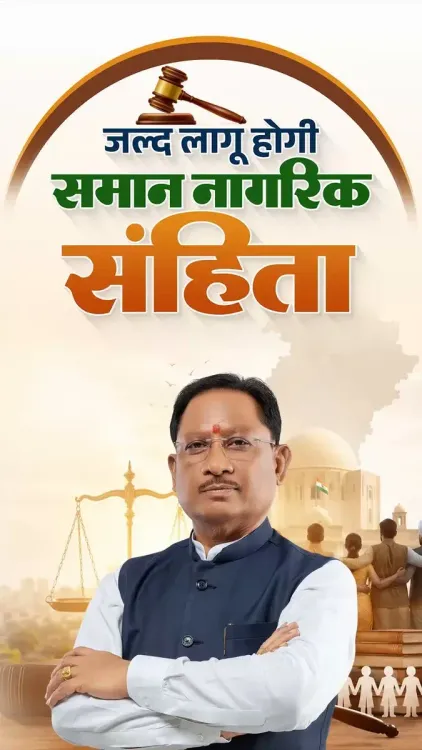
Chhattisgarh Chief Minister Vishnu Deo Sai declared on 25 July 2026 that his government is advancing toward a Uniform Civil Code for the state, invoking the Chhattisgarhi phrase 'one law for all' and framing UCC as a guarantee of equal rights and a just system for every citizen.
Key Takeaways
CM Vishnu Deo Sai announced on 25 July 2026 that the Chhattisgarh government is moving toward implementing a Uniform Civil Code (UCC) .
The announcement was made in Chhattisgarhi and Hindi, opening with 'सब्बो झन बर एक विधान!' — meaning 'One law for all!' in the local dialect.
Article 44 of the Indian Constitution has directed the state to pursue a uniform civil code since 1950 .
The BJP included UCC implementation in its national election manifestos in both 2014 and 2019 .
The next key development to watch is the potential introduction of a UCC draft bill in the Chhattisgarh state assembly.
No specific legislative timeline or draft provisions have been disclosed by the state government.
Chhattisgarh Chief Minister Vishnu Deo Sai announced on Saturday, 25 July 2026 that his government is actively moving toward implementing a Uniform Civil Code (UCC) in the state, framing the initiative as a step to ensure equal rights and equal opportunities for every citizen of Chhattisgarh.
Posting in Chhattisgarhi and Hindi, Chief Minister Sai opened with the phrase 'सब्बो झन बर एक विधान!' ('One law for all!') — a culturally resonant slogan in the local dialect — before stating that the government is advancing toward UCC implementation. He described the move as 'an important step toward ensuring equal rights, equal opportunities, and a just system for all citizens.'
Context
The Uniform Civil Code refers to a common set of personal laws — governing marriage, divorce, inheritance, and adoption — that would apply uniformly to all citizens regardless of religion, replacing the existing religion-specific personal law frameworks. Article 44 of the Indian Constitution, part of the Directive Principles of State Policy since 1950, directs the state to endeavour to secure a uniform civil code for citizens across India.
The announcement places Chhattisgarh among the BJP-governed states that have publicly committed to pursuing UCC at the state level. The party's national election manifestos in 2014 and 2019 both included a commitment to implementing UCC nationwide.
Policy Backdrop
The Bharatiya Janata Party (BJP) has long positioned the Uniform Civil Code as a cornerstone of its governance agenda, arguing that a single legal framework for personal matters is essential to achieving substantive equality among citizens. The party has consistently advocated replacing separate religious codes with a unified law applicable to all.
Similar UCC discussions and legislative moves have emerged in other BJP-ruled states, reflecting a coordinated policy direction from the party's central leadership. Chief Minister Sai's announcement fits within this broader national pattern of state-level momentum on the issue.
Stakeholders and Impact
The proposed UCC would affect all residents of Chhattisgarh, with particular implications for how personal and family law matters — including marriage, divorce, and inheritance — are governed for citizens across religious communities. Supporters argue it would standardise rights and eliminate legal inequalities rooted in religious affiliation.
Religious communities and civil society groups are key stakeholders in any UCC process, and public consultations typically accompany such legislative efforts. The nature and scope of community engagement in Chhattisgarh's process remains to be detailed by the state government.
What's Next
The immediate step to watch is whether the Chhattisgarh government introduces a draft UCC bill in the state assembly, along with any formal public consultation mechanism. The Chief Minister's post signals political intent but does not specify a legislative timeline or the provisions under consideration. How the state navigates the legal, social, and consultative dimensions of UCC implementation will determine the pace and shape of the policy's rollout.
Point of View
Coming at a time when the party has been consolidating its governance identity around this issue in state after state. The choice to open in Chhattisgarhi dialect — 'one law for all' — is a deliberate attempt to root a nationally contested policy in local cultural idiom, broadening its appeal beyond the party's core base. The move also reflects a pattern where BJP-governed states use UCC commitments to reinforce ideological continuity with the central leadership, even as the legislative and consultative details remain undefined. The real test will come when a draft bill is tabled, at which point the breadth of community consultation and the specific provisions will face far greater scrutiny.
NationPress
26 Jul 2026
Frequently Asked Questions
What is the Uniform Civil Code and why is Chhattisgarh pursuing it?
The Uniform Civil Code (UCC) is a proposed single set of personal laws covering marriage, divorce, inheritance, and adoption that would apply equally to all citizens regardless of religion. Chhattisgarh CM Vishnu Deo Sai announced on 25 July 2026 that his government is moving toward implementing UCC to ensure equal rights and a just system for every citizen of the state.
Has any Indian state already implemented a Uniform Civil Code?
Uttarakhand became a notable example of a BJP-governed state advancing UCC legislation. Other BJP-ruled states, including Chhattisgarh with this latest announcement, have signalled similar intent, reflecting the party's national policy commitment to UCC.
What does the Indian Constitution say about the Uniform Civil Code?
Article 44 of the Indian Constitution, part of the Directive Principles of State Policy since 1950, directs the state to endeavour to secure a uniform civil code for all citizens across India.
What is the BJP's position on the Uniform Civil Code?
The BJP has consistently advocated for UCC implementation, including it as a commitment in its national election manifestos in 2014 and 2019. The party argues a single legal framework for personal matters is essential for substantive equality among citizens.
What happens next after CM Sai's UCC announcement for Chhattisgarh?
The key step to watch is the introduction of a UCC draft bill in the Chhattisgarh state assembly, along with any public consultation process. CM Sai's post signals political intent but does not specify a timeline or the provisions being considered.