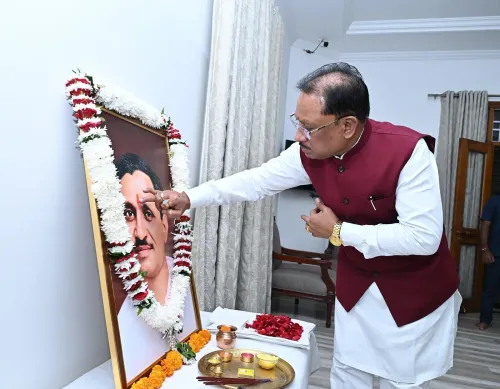
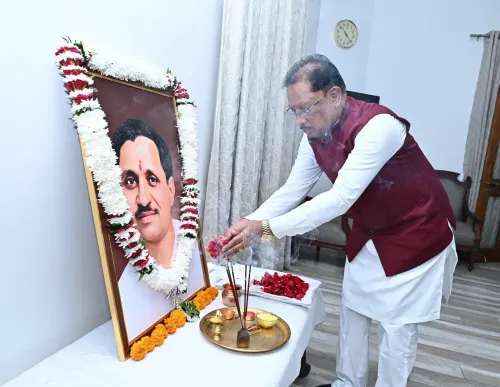
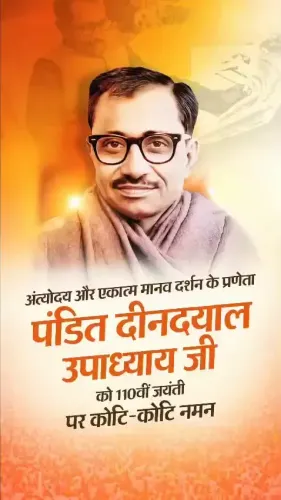
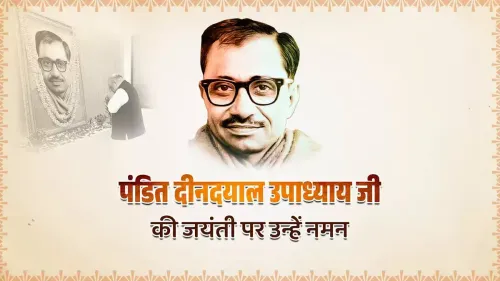
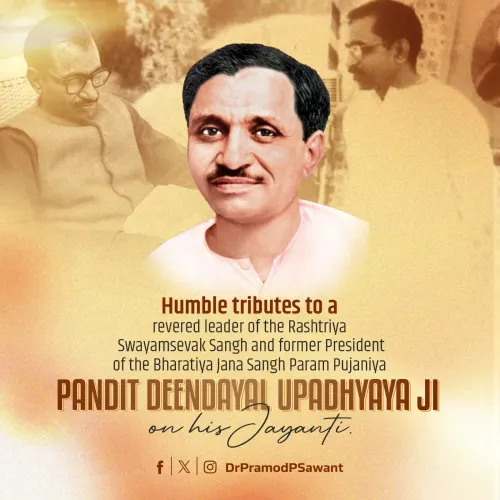
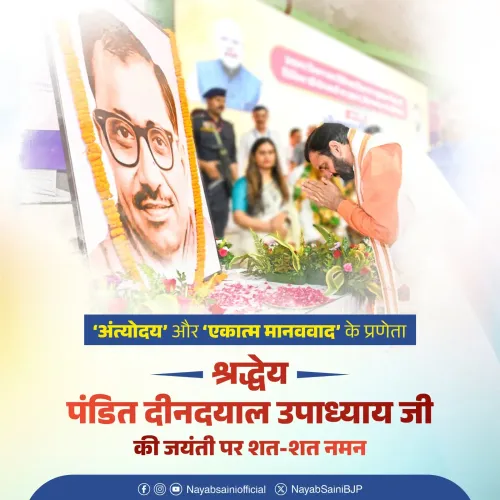
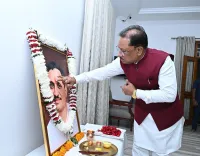
CM Sai pays tribute to Deendayal Upadhyay on his Jayanti
Synopsis
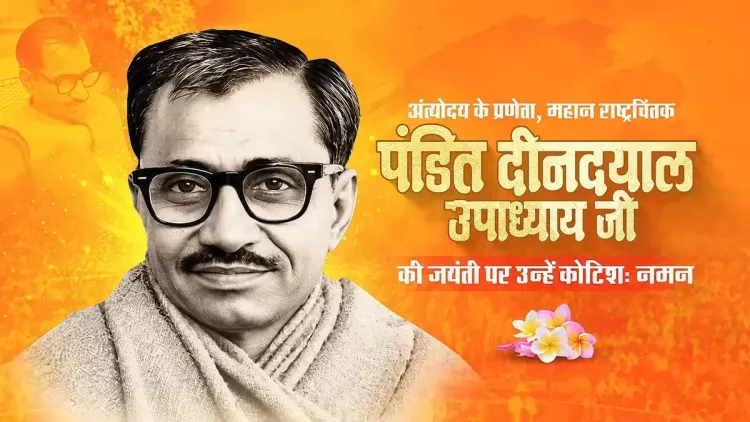
On Pandit Deendayal Upadhyay Jayanti, Chhattisgarh Chief Minister Vishnu Deo Sai paid tribute to the Jana Sangh founder, pledging to carry his Antyodaya vision — development for the last person in the social order — forward through state governance.
Key Takeaways
Pandit Deendayal Upadhyay Jayanti falls on 25 September ; CM Vishnu Deo Sai marked the occasion with a tribute on X.
Upadhyay founded the Bharatiya Jana Sangh in 1951 and articulated Integral Humanism and Antyodaya as guiding political philosophies.
The BJP formally adopted Integral Humanism as its governing philosophy at its formation in 1980 .
The Antyodaya Anna Yojana , launched in 2000 , took its name directly from Upadhyay's concept of uplifting the poorest households.
CM Sai reaffirmed his government's commitment to delivering development and opportunity to the 'last person on the social ladder' in Chhattisgarh .
BJP-led states routinely frame welfare delivery in housing, nutrition, and livelihoods within the Antyodaya framework, linking current programmes to foundational party ideology.
Every year on 25 September, the BJP pauses to remember the man whose ideas gave the party its soul — and this year, Chhattisgarh Chief Minister Vishnu Deo Sai marked Pandit Deendayal Upadhyay Jayanti with a heartfelt tribute, reaffirming that the ideologue's vision of lifting the last person in the social order remains the governing compass in Raipur.
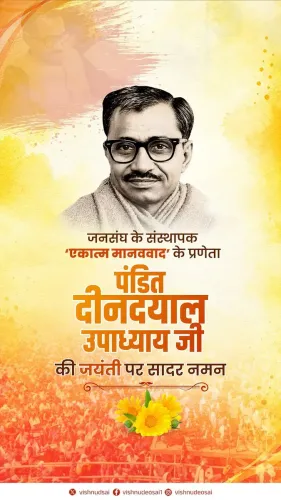
In his post, CM Sai described Upadhyay as 'mahan rashtrachhintak, jansangh ke sansthapak, ekatm manavvad aur antyodaya ke praneta' — 'a great national thinker, founder of the Jana Sangh, and the originator of Integral Humanism and Antyodaya' — offering what he called 'shat-shat naman', a hundredfold salutation. He wrote that Upadhyay never saw politics as a route to power, but as a means of serving society's most marginalised — and pledged that his government continues to work to carry development and opportunity to the very last rung of the social ladder.
The man who shaped a party's conscience
Pandit Deendayal Upadhyay founded the Bharatiya Jana Sangh in 1951, building an organisation rooted in cultural nationalism and a sharp critique of both Western capitalism and Soviet Marxism. His landmark lectures of 1965 laid out Integral Humanism — the idea that political economy must be anchored in the holistic development of the human being, not abstract state machinery or market forces. When the Bharatiya Janata Party was formally constituted in 1980, it adopted Integral Humanism as its official guiding philosophy, a lineage it has carried ever since.
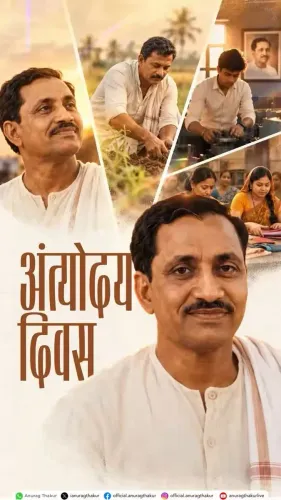
His second enduring contribution — Antyodaya, or 'rise of the last person' — became the rhetorical and programmatic touchstone for welfare policy across BJP-led governments. The Antyodaya Anna Yojana, launched in 2000 by an NDA government at the Centre, took its name directly from this concept, extending food security to the country's poorest households. The philosophical thread runs straight from Upadhyay's lectures to contemporary scheme design.
How Chhattisgarh reads Antyodaya today
For CM Sai, the tribute is more than ceremonial calendar-keeping. BJP-ruled states have consistently framed welfare delivery — in housing, nutrition, and livelihood programmes — within the Antyodaya vocabulary, explicitly linking current spending to the party's foundational ideology rather than short-term electoral cycles. Sai's post fits squarely into that pattern, signalling to party workers and the broader public that programmes targeting rural communities and the poorest households in Chhattisgarh draw their mandate from this older intellectual tradition.
Upadhyay's life, as CM Sai noted, was entirely dedicated to 'rashtraseeva, sangathan aur Bhartiya jeevan-mulyon' — national service, organisation, and Indian life-values. That three-part formulation — service, structure, culture — is the architecture BJP leaders return to on days like this, using the Jayanti not only as an occasion for remembrance but as a moment to re-state governing intent.
The ideas of a man who died in 1968 continue to shape budget speeches, scheme guidelines, and the political grammar of one of India's largest ruling parties. That kind of ideological longevity is rare — and worth understanding.
Point of View
And a public reminder that welfare spending is framed as philosophical duty rather than political transaction. CM Sai's emphasis on Antyodaya connects Chhattisgarh's current governance priorities to a seven-decade intellectual lineage, giving the state's poverty-alleviation programmes an ideological anchor that outlasts any single election cycle. This is a deliberate communication strategy — rooting policy in ideology insulates it from the charge of populism. Watching how Chhattisgarh's upcoming budget operationalises Antyodaya targets in housing and nutrition will reveal how far the rhetoric translates into allocations.
NationPress
25 Sept 2026
Frequently Asked Questions
When is Deendayal Upadhyay Jayanti celebrated?
Pandit Deendayal Upadhyay Jayanti is celebrated on 25 September every year, marking the birth anniversary of the Bharatiya Jana Sangh founder and BJP ideologue.
What is Antyodaya and who introduced the concept?
Antyodaya — meaning 'rise of the last person' — was articulated by Pandit Deendayal Upadhyay as the principle that politics and governance must prioritise the most marginalised individual in society. It later inspired the Antyodaya Anna Yojana food-security scheme launched in 2000.
What is Integral Humanism in Indian politics?
Integral Humanism is the political philosophy formulated by Pandit Deendayal Upadhyay in 1965, proposing a holistic model of development rooted in Indian cultural values as an alternative to both capitalism and communism. The BJP adopted it as its official guiding philosophy in 1980 .
Who is Vishnu Deo Sai and why is he paying tribute to Deendayal Upadhyay?
Vishnu Deo Sai is the Chief Minister of Chhattisgarh and a BJP leader. He paid tribute on 25 September 2026 — Deendayal Upadhyay Jayanti — reaffirming that his government's welfare work is guided by Upadhyay's Antyodaya philosophy of reaching the last person in the social order.
What was the Bharatiya Jana Sangh and how is it linked to the BJP?
The Bharatiya Jana Sangh was a nationalist political party founded by Pandit Deendayal Upadhyay in 1951 . It is widely regarded as the ideological predecessor of the Bharatiya Janata Party (BJP) , which was formally established in 1980 and inherited Jana Sangh's philosophical foundations.