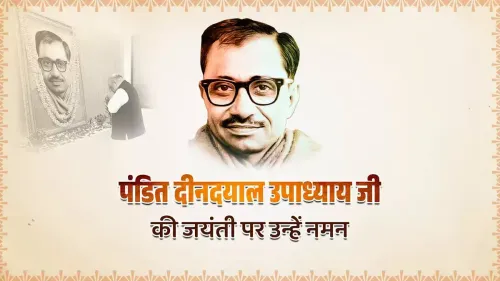
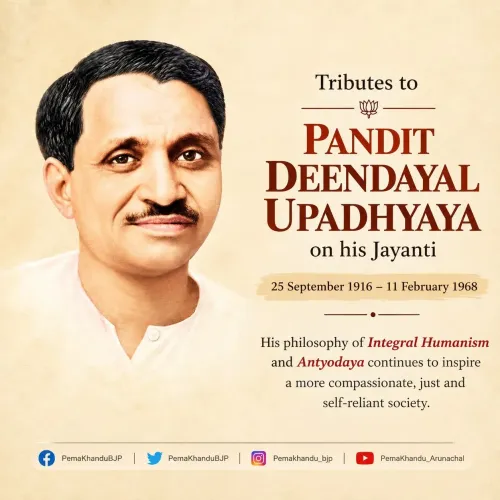
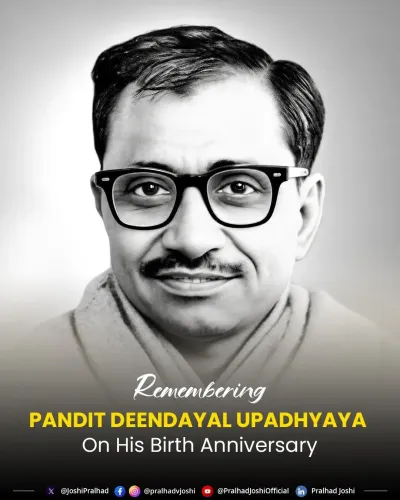
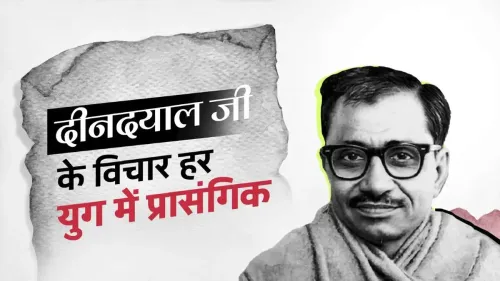
CM Sawant pays tribute to Deendayal Upadhyaya on Jayanti
Synopsis
Goa CM Pramod Sawant marked the birth anniversary of Pandit Deendayal Upadhyaya on 25 September 2026, paying tribute to the RSS leader and Jana Sangh president whose philosophy of Integral Humanism and Antyodaya remain foundational to BJP governance and ideology.
Key Takeaways
Goa CM Pramod Sawant paid tribute to Pandit Deendayal Upadhyaya on his Jayanti, 25 September 2026 .
Upadhyaya articulated Integral Humanism in four lectures in 1965 , rejecting both capitalism and communism in favour of an India-centric political philosophy.
He served as president of the Bharatiya Jana Sangh , founded in 1951 , until his death in 1968 .
The Bharatiya Janata Party , established in 1980 , explicitly adopted Upadhyaya's vision and Antyodaya as core founding principles.
The 25 September tribute has become an annual assertion of ideological continuity across all BJP-governed states and the RSS ecosystem.
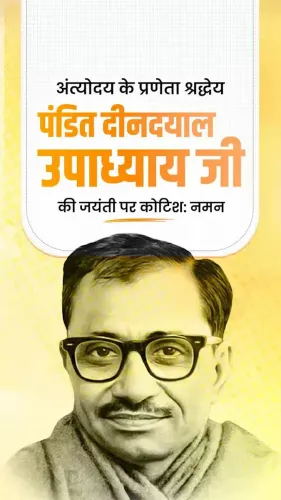
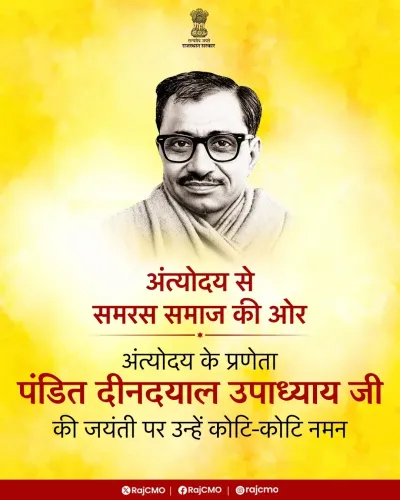
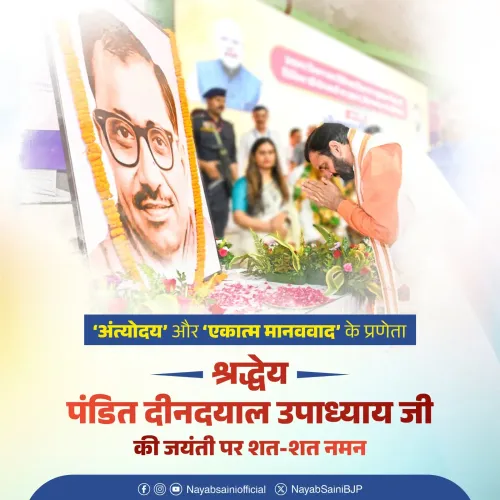
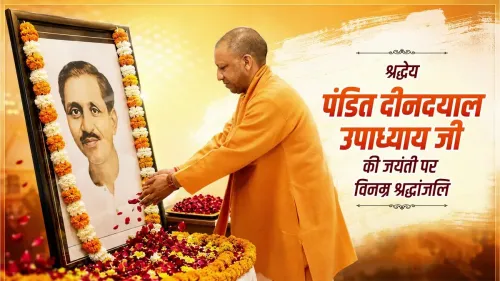
On the 110th birth anniversary of Pandit Deendayal Upadhyaya, Goa Chief Minister Pramod Sawant paid tribute on Friday, 25 September 2026 to the RSS pracharak and Jana Sangh president whose philosophy of Integral Humanism became the ideological cornerstone of Indian right-of-centre politics.
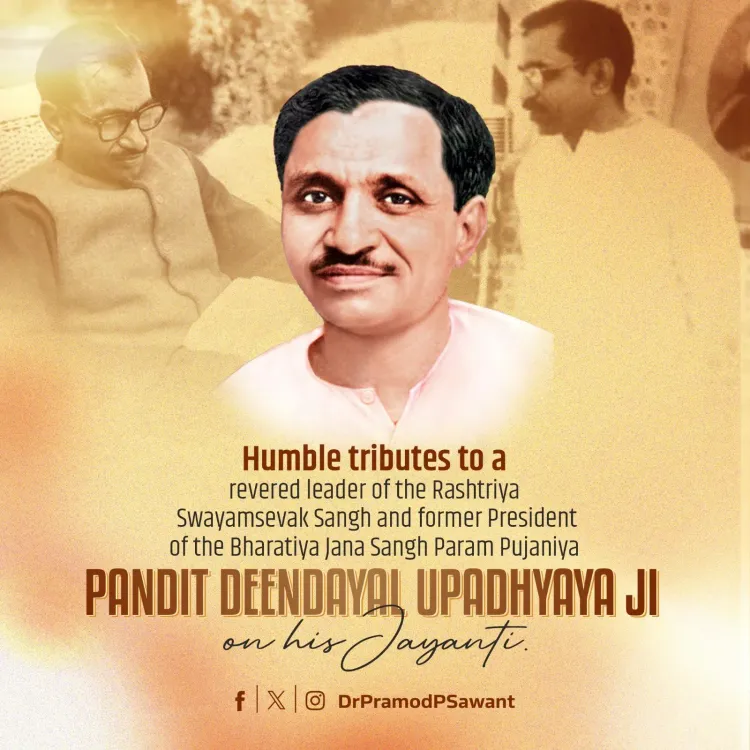
CM Sawant's post offered 'humble tributes' to the leader he called Param Pujaniya — most revered — invoking both Integral Humanism and the concept of Antyodaya, literally 'rise of the last person,' as continuing inspirations for 'public life and nation-building.'
The philosophy that outlived the party
Pandit Deendayal Upadhyaya delivered his landmark four lectures on Integral Humanism in 1965, laying out a political economy that rejected both Western capitalism and Soviet-style socialism in favour of a distinctly Indian framework centred on the individual, family, society, and nation as concentric rings of duty. He served as president of the Bharatiya Jana Sangh, the RSS-aligned electoral vehicle founded in 1951, until his death in 1968.
The Jana Sangh merged into the Janata Party experiment of the late 1970s before its political heirs re-emerged as the Bharatiya Janata Party in 1980, explicitly adopting Upadhyaya's vision as foundational doctrine. Antyodaya — welfare targeting the most marginalised — has since been a recurring rhetorical anchor in BJP governance, cited to frame everything from food security schemes to rural electrification drives.
A ritual of ideological continuity
The 25 September anniversary has become a fixed point in the BJP's political calendar. Leaders across every BJP-ruled state issue tributes on this date, a choreographed assertion that the party in power today traces a direct line back to the thinker who first gave it philosophical coherence. For CM Sawant, the post is also a signal to the RSS volunteer network and BJP workers in Goa that the government's welfare orientation remains rooted in Upadhyaya's original vision, not merely electoral arithmetic.
The Rashtriya Swayamsevak Sangh, founded in 1925, continues to regard Upadhyaya as one of the intellectual pillars whose work bridged the organisation's cultural nationalism with a programme for economic and political action. His Jayanti observance is accordingly treated not as a purely partisan event but as an ideological reaffirmation across the broader Sangh ecosystem.
Seven decades after those four lectures in 1965, the vocabulary Upadhyaya coined still shapes how India's ruling party describes its purpose — and every 25 September, it makes sure the country hears it again.
Point of View
Not by any single leader. For analysts, the consistency of this ritual across decades is itself a data point — it shows the BJP's remarkably durable capacity to maintain a founding-text identity even as its electoral coalition expands.
NationPress
25 Sept 2026
Frequently Asked Questions
Who was Pandit Deendayal Upadhyaya?
Pandit Deendayal Upadhyaya was an RSS pracharak and the president of the Bharatiya Jana Sangh , the predecessor party to the BJP. He developed the philosophy of Integral Humanism in 1965 and died in 1968. His ideas on welfare-for-the-last-person, called Antyodaya , became foundational doctrine for the BJP when it was founded in 1980.
What is Integral Humanism in Indian politics?
Integral Humanism is a political philosophy articulated by Pandit Deendayal Upadhyaya in four lectures in 1965 . It proposed an India-centric alternative to both Western capitalism and Soviet socialism, organising society around the individual, family, society, and nation as concentric circles of duty. The BJP adopted it as a foundational principle in 1980 .
What is Antyodaya and how does it relate to BJP governance?
Antyodaya , meaning 'rise of the last person,' is a concept drawn from Deendayal Upadhyaya's philosophy that welfare efforts must prioritise the most marginalised. The BJP has repeatedly invoked it to frame government schemes targeting rural poverty, food security, and basic services since coming to power.
Why do BJP leaders pay tribute to Deendayal Upadhyaya on 25 September?
25 September is the birth anniversary of Pandit Deendayal Upadhyaya , and the date has become a fixed annual ritual in the BJP-RSS ecosystem. Leaders across all BJP-governed states issue tributes on this day to assert ideological continuity between the party's current governance and its foundational Hindutva and economic thought.
What did Goa CM Pramod Sawant say about Deendayal Upadhyaya?
Goa CM Pramod Sawant offered 'humble tributes' to Upadhyaya on his Jayanti on 25 September 2026 , calling him Param Pujaniya (most revered) and stating that his philosophy of Integral Humanism and the vision of Antyodaya 'continue to inspire public life and nation-building.'