CM Sai: Chhattisgarh Installs Smart Classrooms in 9,000 Schools
Synopsis
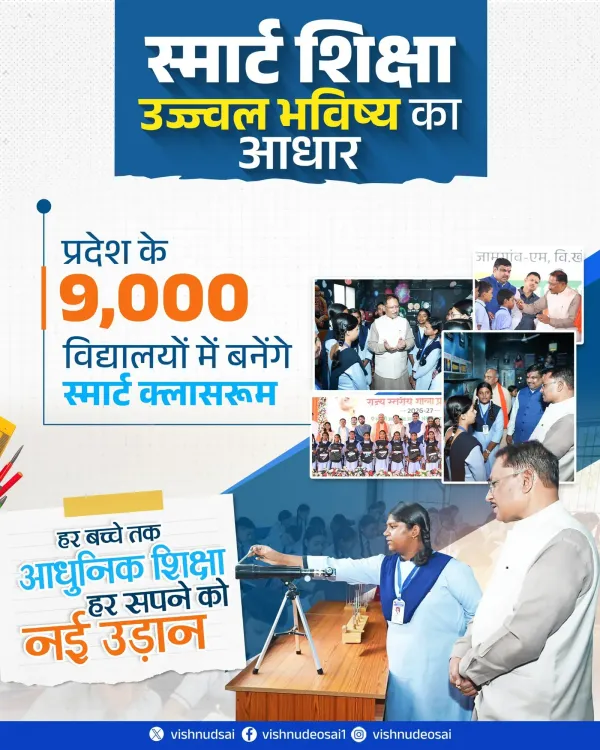
Chhattisgarh Chief Minister Vishnu Deo Sai announced on 22 July 2026 that the state has installed smart classrooms in 9,000 government schools, aiming to deliver modern, technology-enabled education to every child and build the foundation of a developed Chhattisgarh.
Key Takeaways
Chhattisgarh CM Vishnu Deo Sai announced smart classrooms have been developed in 9,000 government schools across the state.
The initiative aims to connect every child in Chhattisgarh to modern and quality education through technology integration.
The programme aligns with the National Education Policy 2020 and the Centre's Digital India initiative.
Primary beneficiaries include students from rural, tribal, and economically marginalised communities in government schools.
The BJP government in Chhattisgarh, in power since December 2023 , has positioned education modernisation as a core governance priority.
Utilisation rates, teacher training outcomes, and learning data from equipped schools will be key indicators of the programme's real-world impact.
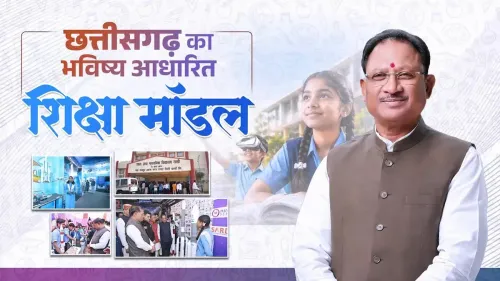
Chhattisgarh Chief Minister Vishnu Deo Sai on Wednesday, 22 July 2026 announced that the state government has developed smart classrooms across 9,000 schools, framing the initiative as a cornerstone of the state's push toward modern, quality education for every child.
Context
In a post on X, CM Sai wrote: 'स्मार्ट क्लासरूम से स्मार्ट भविष्य की ओर बढ़ता छत्तीसगढ़' ['Chhattisgarh moving towards a smart future through smart classrooms'], adding that the government is connecting every child to modern and quality education by equipping 9,000 schools across the state with smart classroom infrastructure. He noted that 'when education meets technology, dreams get new wings and the strong foundation of a developed Chhattisgarh is built.'
The announcement signals a significant scaling of digital education infrastructure in Chhattisgarh, a central Indian state where the BJP government led by Sai has made education modernisation a stated priority since taking office in December 2023.
Policy Backdrop
The smart classroom push aligns directly with the National Education Policy (NEP) 2020, which directed states to integrate technology and digital infrastructure into government schools to improve learning outcomes. The Centre's Digital India programme, launched in 2015, also promoted e-learning and smart infrastructure across government schools nationwide, providing both a policy framework and partial funding pathways for such state-level efforts.
Across BJP-governed states, smart-classroom projects have emerged as a flagship model for modernising government schooling and narrowing the urban-rural learning divide — a trend that accelerated notably in the post-COVID period when digital education gained mainstream policy acceptance. Chhattisgarh's stated scale of 9,000 schools mirrors parallel programmes undertaken in states such as Madhya Pradesh and Rajasthan.
Stakeholders and Impact
The primary beneficiaries of the initiative are students enrolled in Chhattisgarh's government schools, a population that includes a large proportion of children from rural, tribal, and economically marginalised communities who have historically had limited access to quality educational resources. Teachers in these schools are also key stakeholders, as smart classroom tools — typically including interactive displays, digital content libraries, and internet connectivity — require teacher training to be effective.
Education experts and civil society groups tracking learning outcomes in central Indian states have long highlighted infrastructure gaps in government schools as a barrier to educational equity. A programme of this stated scale, if fully implemented, could reshape access to technology-enabled learning for a substantial share of the state's school-going population.
What's Next
The effectiveness of the initiative will depend on utilisation rates, teacher readiness, and sustained maintenance of digital equipment — metrics that the Chhattisgarh state education department is expected to track. Observers will watch for learning outcome data from schools equipped under the programme, as well as whether supplementary allocations appear in the next Chhattisgarh state budget to expand or deepen the initiative. The programme's progress could also serve as a benchmark for the state's broader goal of building what CM Sai has called a 'developed Chhattisgarh.'
Point of View
' Sai is explicitly tying education infrastructure to the broader 'Viksit Bharat' narrative championed by the central leadership. The scale — 9,000 schools — is politically significant, but the harder test will come from independent assessments of whether digital tools are actually being used in classrooms and whether learning outcomes improve. If outcome data supports the rollout, it could strengthen the BJP's education governance credentials in a state with a large tribal and rural school-going population.
NationPress
20 Oct 2026
Frequently Asked Questions
How many schools in Chhattisgarh have smart classrooms?
According to Chief Minister Vishnu Deo Sai's announcement on 22 July 2026, smart classrooms have been developed in 9,000 government schools across Chhattisgarh.
What is the Chhattisgarh smart classroom initiative?
It is a state government programme to install digital teaching tools — such as interactive displays and digital content — in government schools, aimed at providing modern, quality education to every child in Chhattisgarh.
How does the Chhattisgarh smart classroom scheme relate to NEP 2020?
The National Education Policy 2020 directed all states to integrate technology and digital infrastructure into government schools, providing the policy framework that Chhattisgarh's smart classroom programme is designed to fulfil.
Who is the Chief Minister of Chhattisgarh?
Vishnu Deo Sai is the Chief Minister of Chhattisgarh. He assumed office in December 2023 as a BJP leader and has prioritised education infrastructure upgrades during his tenure.
Will rural students in Chhattisgarh benefit from smart classrooms?
Yes, rural, tribal, and economically marginalised students enrolled in government schools are the primary intended beneficiaries, as the initiative specifically targets the government school network where such communities are most represented.