CM Sai Signs MOUs With BSP, NMDC to Modernise Chhattisgarh ITIs
Synopsis
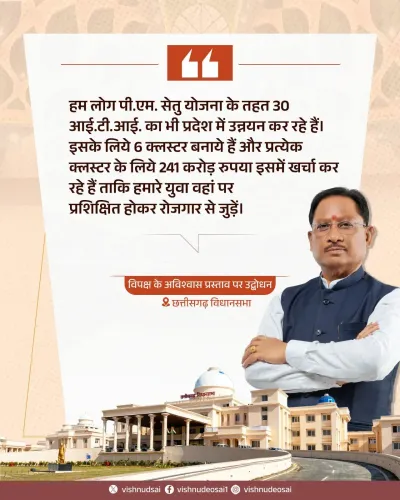
Chhattisgarh CM Vishnu Deo Sai announced a ₹1,446 crore plan to modernise 30 government ITIs under PM-Setu Yojana and signed MOUs with Bhilai Steel Plant and NMDC for Durg and Bastar skill clusters on 13 October 2026.
Key Takeaways
₹1,446 crore proposed investment to modernise 30 government ITIs in Chhattisgarh under the central PM-Setu Yojana.
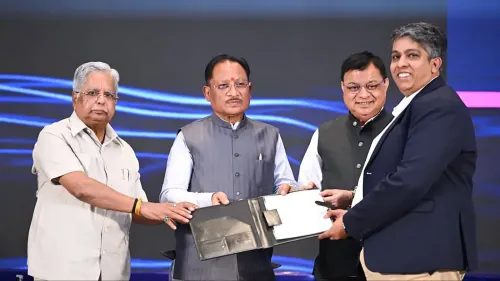
MOUs signed on 13 October 2026 at the Chhattisgarh Mantralaya with Bhilai Steel Plant (SAIL) and NMDC Limited .
Partnerships cover the Durg and Bastar clusters, linking ITI upgrades to major PSU industrial hubs.
PM-Setu Yojana aims to align ITI curricula with live industry requirements to improve youth employment and self-employment outcomes.
The scheme builds on the Skill India Mission (2015) and PMKVY framework of industry-linked vocational training.
Bastar's inclusion signals a policy intent to convert the mineral-rich region's resources into local livelihoods through formal skilling.
Thirty government ITIs, a ₹1,446 crore upgrade plan, and two landmark MOUs signed in a single day — Chhattisgarh Chief Minister Vishnu Deo Sai on Tuesday, 13 October 2026, announced a major push to rewire the state's vocational training ecosystem under the Centre's PM-Setu Yojana.
What the ₹1,446 Crore Modernisation Actually Means
The PM-Setu Yojana — a central scheme designed to upgrade government Industrial Training Institutes and align their curricula with live industry needs — will channel a proposed ₹1,446 crore into 30 state-run ITIs across Chhattisgarh. The investment is intended to replace ageing workshops and machinery with modern, industry-standard equipment, and to redesign training modules around what employers in steel, mining, and allied sectors are actually hiring for. CM Sai framed it as part of the broader national direction set by Prime Minister Narendra Modi: creating fresh pathways to both employment and self-employment for young people through aadhunik kaushal — modern skills.
The scheme builds on foundations laid by the Skill India Mission (launched 2015) and the Pradhan Mantri Kaushal Vikas Yojana, which brought short-cycle skill certifications to millions. PM-Setu goes a step further by anchoring upgrades inside existing ITI infrastructure rather than building parallel systems — a harder problem to solve, but the one that has persistently held back vocational outcomes.
Bhilai Steel Plant and NMDC Step In for Durg and Bastar
The most concrete development on Tuesday was the signing of MOUs at the Chhattisgarh Mantralaya between the state government and two public-sector giants: the Bhilai Steel Plant (a flagship SAIL subsidiary and one of the largest employers in the state) and NMDC Limited (the country's premier iron-ore mining company, with deep operations in Bastar). The agreements cover the Durg and Bastar clusters — a deliberate geographic choice that places skill infrastructure exactly where industrial demand already exists.
The cluster model reflects a well-established pattern in mineral-rich states: rather than expecting trainees to travel for industry exposure, it brings PSU expertise, equipment access, and potential placement pipelines directly into the ITI ecosystem. Bhilai anchors the Durg cluster, while NMDC's presence makes Bastar — long associated with insurgency and underdevelopment — a site of industrial skill-building instead.
Bastar's Bigger Stakes
The inclusion of Bastar in this rollout is not incidental. The region has historically suffered from low human-development indicators and limited formal employment, with successive governments struggling to convert its mineral wealth into local livelihoods. Tying an ITI modernisation drive to NMDC's operational footprint in the area signals a deliberate attempt to make that conversion real — though outcomes will depend on what courses are actually offered, how many seats are created, and whether placement linkages follow. Those details, alongside the full allocation of the ₹1,446 crore across the 30 ITIs, are what policymakers and students alike will now be watching for.
For CM Sai, Tuesday's announcements are also a visible state-level expression of the Modi government's skill agenda — a chance to demonstrate that central schemes can be operationalised, not just announced. The MOU signings with two PSUs give the plan industrial credibility. Whether the classrooms follow is the next chapter.
Point of View
PSU-backed training pipelines that address actual employer demand. For CM Sai, co-branding the rollout with PM-Setu Yojana tightly links state delivery to the Centre's narrative on youth empowerment, a politically salient frame ahead of future electoral cycles. The real test will be whether the ₹1,446 crore investment produces measurable placement rates or remains another ITI upgrade on paper. Bastar's inclusion is the most consequential variable — if the NMDC cluster delivers, it reframes development policy in one of India's most troubled regions.
NationPress
14 Oct 2026
Frequently Asked Questions
What is PM-Setu Yojana and what does it do for ITIs?
PM-Setu Yojana is a central government scheme aimed at modernising government Industrial Training Institutes (ITIs) by upgrading infrastructure, equipment, and curricula to match current industry requirements, helping youth gain employment-ready technical skills.
How much money will be invested in Chhattisgarh's ITI upgrades?
A proposed investment of ₹1,446 crore has been announced to modernise 30 government ITIs across Chhattisgarh under the PM-Setu Yojana.
Why did Chhattisgarh sign MOUs with Bhilai Steel Plant and NMDC?
The MOUs with Bhilai Steel Plant and NMDC are designed to create industry-linked skill training clusters in the Durg and Bastar regions, leveraging these PSUs' industrial infrastructure and expertise to provide practical, employment-relevant vocational training to ITI students.
Which districts are covered under the new ITI skill clusters in Chhattisgarh?
The MOUs signed on 13 October 2026 cover the Durg and Bastar clusters, with Bhilai Steel Plant anchoring the Durg cluster and NMDC Limited supporting the Bastar cluster.
How does PM-Setu Yojana relate to the Skill India Mission?
PM-Setu Yojana is a continuation and deepening of the Skill India Mission launched in 2015. While Skill India and PMKVY focused on scaling enrolments and short-term certifications, PM-Setu specifically targets the structural upgrade of existing government ITIs to make their training industry-aligned.