CM Sai Slams Dual Cash Counters at Liquor Shops in Assembly
Synopsis
Chief Minister Vishnu Deo Sai alleged on 18 July 2026 that liquor shops under the previous Congress government in Chhattisgarh operated dual cash counters — one feeding the state exchequer and one whose proceeds went unaccounted — while responding to an opposition no-confidence motion in the state assembly.
Key Takeaways
CM Vishnu Deo Sai made the remarks on 18 July 2026 during debate on an opposition no-confidence motion in the Chhattisgarh Legislative Assembly .
He alleged that liquor shops under the previous administration ran two cash counters — one remitting revenue to the state and one whose destination was left unstated.
The remarks are aimed at the Congress government led by Bhupesh Baghel that governed Chhattisgarh from 2018 to 2023 .
The BJP government has been reviewing the previous excise regime since coming to power after the December 2023 assembly elections.
A similar pattern of excise-related allegations has emerged in BJP-ruled Madhya Pradesh and Rajasthan after the 2023 election cycle.
The no-confidence motion is expected to be defeated given the BJP's legislative majority ; a formal excise inquiry could follow.
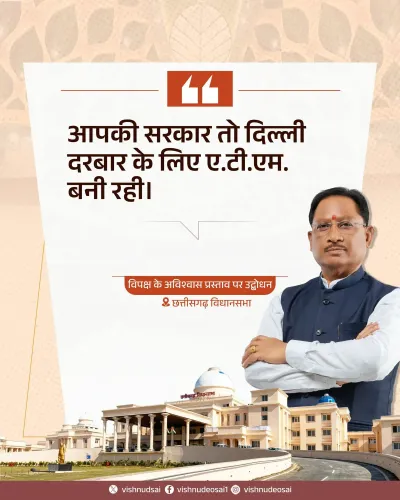
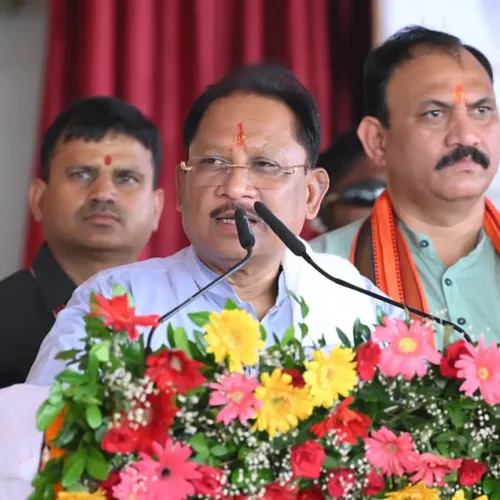
Chhattisgarh Chief Minister Vishnu Deo Sai on Saturday, 18 July 2026, made sharp allegations of financial irregularities in the previous government's excise regime while addressing an opposition no-confidence motion on the floor of the Chhattisgarh Legislative Assembly in Raipur.
Context
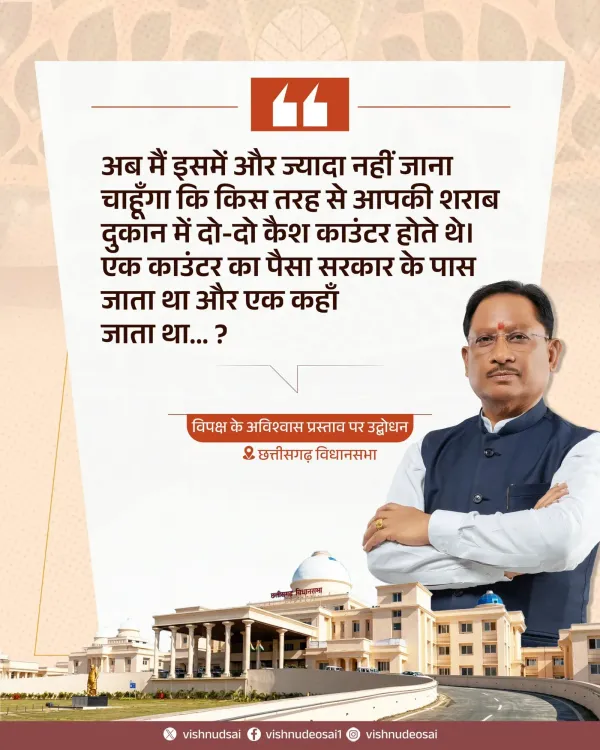
Speaking during the debate on the no-confidence motion, CM Sai made a pointed reference to what he described as a dual cash-counter system at liquor shops under the prior administration. In his words — 'किस तरह से आपकी शराब दुकान में दो-दो कैश काउंटर होते थे' ('how your liquor shops had two cash counters each') — he alleged that while one counter's revenue went to the state exchequer, the destination of the second counter's collections was left conspicuously unstated, drawing the inference that funds were siphoned away from public accounts.
The remark was directed at the opposition benches, where the Indian National Congress — which governed Chhattisgarh from 2018 to 2023 under Bhupesh Baghel — holds the principal opposition bloc. The CM stopped short of making a formal accusation, letting the rhetorical question hang in the chamber: 'एक कहाँ जाता था... ?' ('And where did the other one go... ?')
Policy Backdrop
The excise policy of the Baghel-led Congress government had expanded the number of liquor retail outlets and altered licensing norms across the state between 2018 and 2023. After the BJP's decisive victory in the December 2023 assembly elections, the incoming government initiated reviews of those excise arrangements, citing concerns over revenue transparency and licensing irregularities.
Excise revenue is among the largest non-tax income streams for Chhattisgarh, a mineral-rich state where liquor policy has long served as a flashpoint in political contestation. BJP governments in neighbouring states including Madhya Pradesh and Rajasthan have similarly raised dual-accounting allegations in their respective assemblies following the 2023 election cycle, reflecting a broader pattern of using excise governance as a proxy debate for corruption accountability.
Stakeholders and Impact
The opposition Congress, which tabled the no-confidence motion, faces direct political damage if the allegations gain traction with the public ahead of any future electoral cycle. Former CM Bhupesh Baghel and his colleagues are the implied targets of CM Sai's remarks, though no individual was named in the post.
State revenue officials and liquor vendors who operated under the previous licensing framework could face scrutiny if the government moves toward a formal inquiry or an investigative commission. Civil society groups and anti-corruption watchdogs in the state are likely to demand a time-bound audit of excise collections during the 2018–2023 period.
What's Next
The immediate procedural outcome will be the vote on the no-confidence motion itself, which the ruling BJP — commanding a majority in the assembly — is expected to defeat. The more consequential question is whether CM Sai's floor remarks translate into a formal investigative mechanism: an inquiry commission, a special audit, or a referral to the Enforcement Directorate or state police's economic offences wing.
If the government does announce a probe into excise irregularities during the monsoon or winter assembly session, Chhattisgarh could follow the template of other BJP-ruled states that have used post-election excise investigations as both a governance signal and a political instrument against predecessor administrations.
Point of View
Almost certain to fail numerically, becomes the opposition's own trap: it gives the ruling party a prime-time platform to relitigate the Congress excise era before a televised house. Whether this stays rhetoric or escalates into an investigative commission will determine whether it is a lasting governance narrative or a one-session political moment.
NationPress
18 Jul 2026
Frequently Asked Questions
What did CM Vishnu Deo Sai say about liquor shops in Chhattisgarh Assembly?
CM Sai alleged during the no-confidence motion debate on 18 July 2026 that liquor shops under the previous Congress government operated two cash counters — one that remitted money to the state government and a second whose collections went to an unstated destination, implying financial irregularities.
What is the no-confidence motion in Chhattisgarh Assembly 2026?
The opposition Congress tabled a no-confidence motion against the BJP government led by CM Vishnu Deo Sai in the Chhattisgarh Legislative Assembly. The BJP holds a majority in the house, making the motion's defeat widely anticipated.
Who was Chhattisgarh Chief Minister before Vishnu Deo Sai?
Bhupesh Baghel of the Congress party served as Chief Minister of Chhattisgarh from 2018 to 2023. His government's excise policy is the subject of CM Sai's allegations in the July 2026 assembly address.
What was the Chhattisgarh excise policy controversy?
The Congress government between 2018 and 2023 expanded liquor retail outlets and revised licensing norms, which the subsequent BJP government has flagged for review, citing concerns about revenue transparency and alleged irregularities in collection.
Will there be an inquiry into Chhattisgarh's previous excise policy?
No formal inquiry has been announced as of CM Sai's 18 July 2026 address. Political observers expect the government may announce an investigative commission or audit during the monsoon or winter assembly session if it chooses to escalate the matter beyond floor rhetoric.