CM Sai to attend cooperative, women empowerment events in Raipur
Synopsis
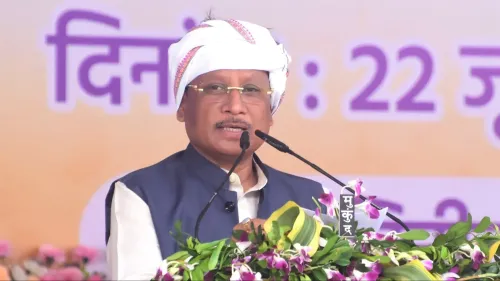
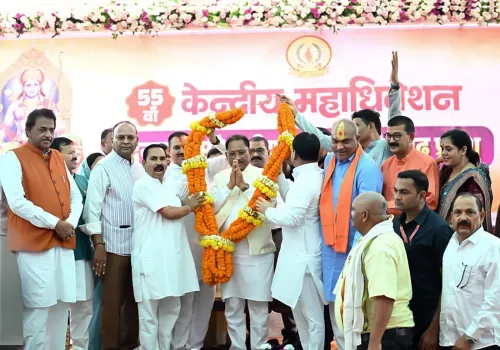
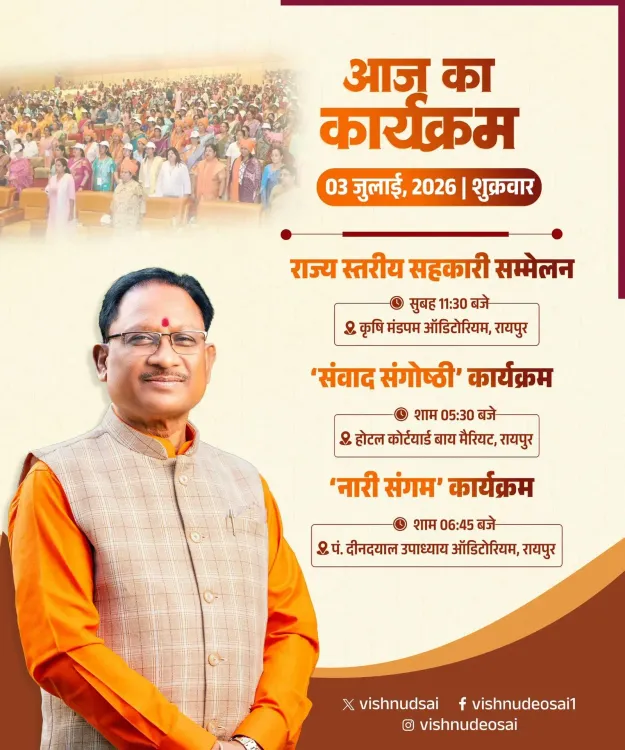
Chhattisgarh Chief Minister Vishnu Deo Sai participated in a state-level cooperative conference, Samvad Sangoshti dialogue seminar, and Nari Sangam women's empowerment programme in Raipur on 3 July 2026, reaffirming farmer welfare and women's empowerment as the state's core development priorities.
Key Takeaways
CM Vishnu Deo Sai attended three events in Raipur on 3 July 2026 : a state-level cooperative conference, a Samvad Sangoshti seminar, and the Nari Sangam programme.
The CM described farmer welfare and women's empowerment as the 'core mantra' of Chhattisgarh's development journey.
The cooperative conference aligns with the central government's 'Sahakar se Samriddhi' framework launched after the Ministry of Cooperation was established in July 2021 .
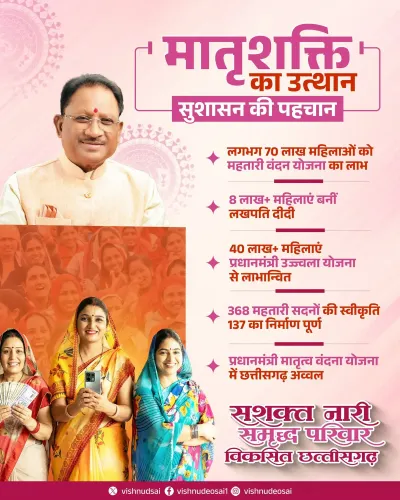
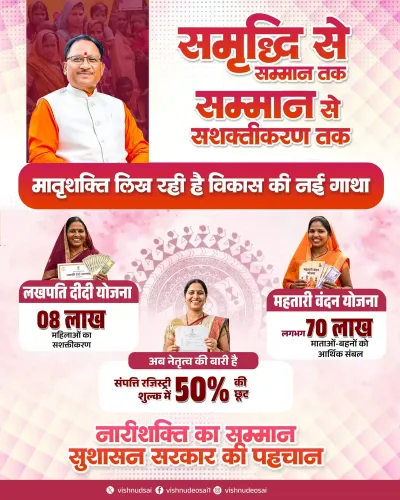
The Nari Sangam programme focuses on women's self-help groups, aiming to deepen financial inclusion and livelihood support for rural women.
Follow-up policy announcements on cooperative credit and women's SHG linkages are expected from the Chhattisgarh cooperative department in the coming months.
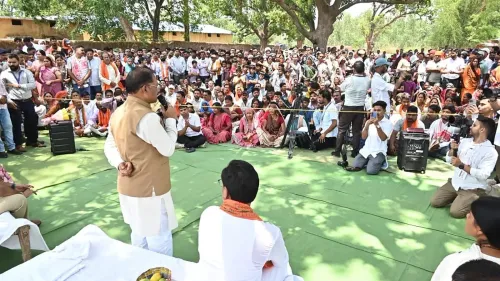
Chhattisgarh Chief Minister Vishnu Deo Sai announced on Friday, 3 July 2026 that he would attend a state-level cooperative conference, a Samvad Sangoshti (dialogue seminar), and the Nari Sangam women's empowerment programme, all held in Raipur. The events bring together cooperative institutions and women's self-help groups under a single platform focused on rural welfare and agricultural development.
Context
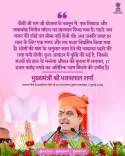
In his post, CM Sai wrote: 'Kisan kalyan aur nari sashaktikaran ke sankalp ke saath viksit Chhattisgarh ke nirman ki disha mein nirantar aage badhna hi hamari vikas yatra ka mool mantra hai' — 'Moving forward continuously towards building a developed Chhattisgarh, with the resolve of farmer welfare and women's empowerment, is the core mantra of our development journey.' The statement frames cooperatives and women-centric schemes as twin pillars of the state's growth agenda.
The state-level cooperative conference in Raipur serves as a convergence point for cooperative societies, farmer producer organisations, and rural development officials from across Chhattisgarh. Such gatherings are typically used to review performance, share best practices, and signal upcoming policy priorities.
Policy Backdrop
The cooperative sector in India received a significant institutional boost when the central government established a dedicated Ministry of Cooperation in July 2021, advancing what it called the 'Sahakar se Samriddhi' ('Prosperity through Cooperation') vision. This framework seeks to expand cooperatives beyond traditional credit functions into marketing, processing, and value addition for agricultural produce.
Chhattisgarh, a central Indian state formed in 2000 with a large tribal and agrarian population, has a cooperative network that is central to rural credit and input supply for small farmers. After the BJP returned to power following the December 2023 assembly elections, the state government reiterated its commitment to strengthening farmer producer organisations and women's self-help groups as vehicles for rural income growth.
The Nari Sangam programme specifically targets women's self-help groups, aiming to deepen financial inclusion and livelihood support for rural women — a demographic that forms a significant share of Chhattisgarh's agricultural workforce.
Stakeholders and Impact
The primary beneficiaries of the cooperative and women's empowerment agenda are small and marginal farmers and rural women across Chhattisgarh's districts. Cooperative institutions provide these groups access to credit, seeds, and market linkages that would otherwise be difficult to secure individually.
Women's self-help groups linked to state and central schemes have increasingly become delivery channels for welfare programmes ranging from nutrition support to micro-enterprise financing. Events like Nari Sangam are designed to strengthen these linkages and surface ground-level feedback to policymakers.
What's Next
The 3 July 2026 Raipur conference is expected to generate follow-up directives from the state cooperative department, potentially covering new credit facilities, market linkage announcements, or expanded self-help group coverage. Observers will watch the state's cooperative department orders and budget allocations in the coming months to gauge the scale of implementation. The events also set the political tone ahead of any mid-term policy reviews, reinforcing the state government's messaging on farmer welfare and women's empowerment as central to its governance narrative.
Point of View
Suggesting the state is aligning its rural development architecture closely with central priorities. Such events also serve an organisational function, activating the party's cooperative and self-help group networks at the grassroots. The real test will be whether the conference produces concrete budget commitments or remains a symbolic statement of intent.
NationPress
3 Jul 2026
Frequently Asked Questions
What is the Nari Sangam programme in Chhattisgarh?
Nari Sangam is a state-level programme in Chhattisgarh focused on women's self-help groups and empowerment initiatives, designed to strengthen financial inclusion and livelihood support for rural women.
What did CM Vishnu Deo Sai announce at the Raipur cooperative conference on 3 July 2026?
CM Vishnu Deo Sai attended the state-level cooperative conference, Samvad Sangoshti, and Nari Sangam in Raipur, reaffirming that farmer welfare and women's empowerment are the core priorities of Chhattisgarh's development agenda. Specific new scheme announcements from the event have not been confirmed.
What is the 'Sahakar se Samriddhi' policy and how does it relate to Chhattisgarh?
'Sahakar se Samriddhi' — meaning 'Prosperity through Cooperation' — is the central government's framework, backed by the Ministry of Cooperation established in July 2021, to expand cooperatives into marketing and value addition. Chhattisgarh's state-level cooperative conference aligns with this national approach.
Who is Vishnu Deo Sai and when did he become Chief Minister of Chhattisgarh?
Vishnu Deo Sai is a BJP leader who became Chief Minister of Chhattisgarh in December 2023 following the state assembly elections. He is the first tribal Chief Minister of the state.
What is the importance of cooperatives for farmers in Chhattisgarh?
Cooperative institutions in Chhattisgarh provide small and marginal farmers access to credit, agricultural inputs, and market linkages. The state has a large agrarian and tribal population, making cooperatives a key channel for rural welfare delivery.