CM Sai Highlights Agri-Tech Push on 12 Years of Kisan Samriddhi
Synopsis
Chhattisgarh Chief Minister Vishnu Deo Sai marked 12 years of Kisan Samriddhi on 11 June 2026 by highlighting drone-assisted farming, smart irrigation, record pulse output, oilseed acreage expansion, natural farming spread, and Soil Health Card distribution as milestones of technology-driven agricultural governance in the state.
Key Takeaways
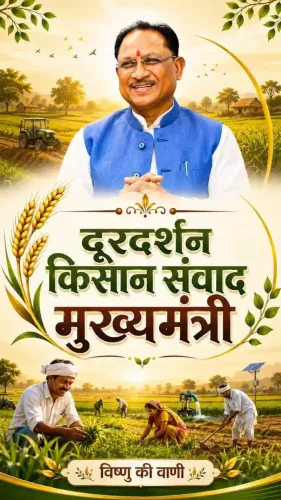
CM Vishnu Deo Sai posted on 11 June 2026 marking #12YearsOfKisanSamriddhi , citing technology-driven agriculture as central to his government's agenda.
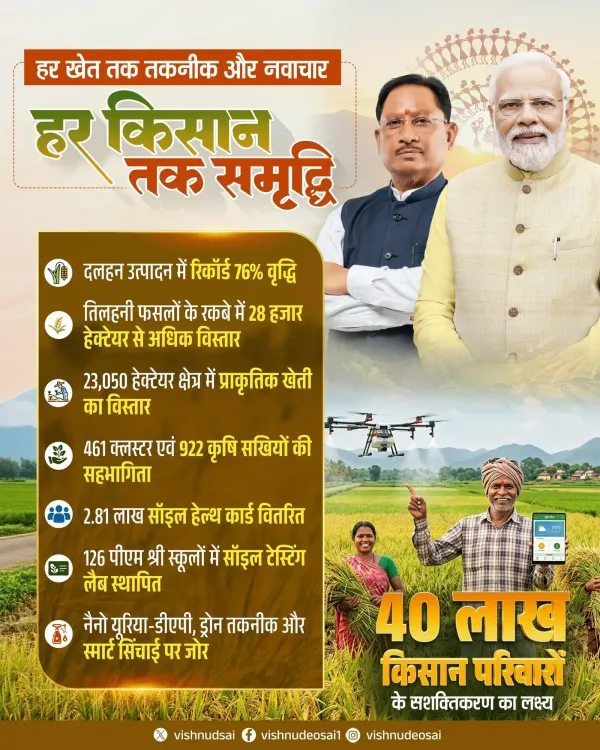
The post claims record pulse production and expanded oilseed crop acreage in 2025-26 as key agricultural achievements.
Innovations cited include smart irrigation , drone technology , crop diversification , and natural farming spread across thousands of hectares.
Lakhs of farmers in Chhattisgarh are stated to have received Soil Health Cards under the national scheme first launched in 2015 .
Chhattisgarh's push on pulses and oilseeds mirrors a national priority to reduce import dependence and improve farmer incomes beyond paddy cultivation.
Independent verification will hinge on final rabi 2025-26 production data from the Union Ministry of Agriculture and state budget disclosures for 2026-27 .
Chhattisgarh Chief Minister Vishnu Deo Sai on Thursday, 11 June 2026 highlighted his government's commitment to technology-driven agriculture, citing advances in smart irrigation, drone technology, crop diversification, and soil health management as markers of farmer prosperity under what he termed 'good governance' (suशासन).
Context
Posting on the occasion of the hashtag #12YearsOfKisanSamriddhi, CM Sai wrote: 'The good-governance government has resolved to link agriculture with technology and make it a means of prosperity. Through innovations such as smart irrigation, drone technology, and crop diversification, we are making agriculture more profitable.' The post marks twelve years of a farmer-prosperity initiative, though the specific programme's origins predate the current state administration.
Sai, who assumed office in December 2023 after the BJP returned to power in Chhattisgarh, has consistently framed agricultural modernisation as a pillar of his administration's governance agenda.
Policy Backdrop
The claims made in the post align with several central and state-level policy frameworks. The Pradhan Mantri Krishi Sinchayee Yojana (2015) laid the groundwork for micro-irrigation and water-use efficiency across Indian states, while the Soil Health Card scheme (2015) provided farmers with soil nutrient assessments and fertiliser recommendations to improve productivity.
The National Food Security Mission (2007) had earlier targeted pulses and oilseeds production through area expansion and technology adoption — a thrust that Chhattisgarh's current push on pulse production and oilseed acreage expansion directly echoes. CM Sai's post specifically cited 'record growth in pulse production in 2025-26, expansion of oilseed crop acreage, spread of natural farming across thousands of hectares, and the benefit of Soil Health Cards to lakhs of farmers' as achievements of the period.
Indian states have increasingly integrated drone-based services, precision irrigation, and natural farming clusters into their agriculture plans in line with central guidelines on sustainable intensification. Chhattisgarh's stated focus on diversifying away from rice-dominant cropping mirrors a national priority to reduce import dependence on edible oils and pulses while improving farmer incomes.
Stakeholders and Impact
The primary beneficiaries cited are farmers — referred to in the post as annadata (providers of food) — across Chhattisgarh, a state whose agrarian economy is heavily anchored in paddy cultivation. A shift toward pulses, oilseeds, and natural farming would, if sustained, diversify income streams for cultivators and reduce the state's dependence on a single crop cycle.
Agricultural extension agencies and input suppliers are also implicated, as drone procurement, soil testing infrastructure, and natural farming clusters require coordinated delivery mechanisms at the block and district levels. The scale of implementation — described in broad terms in the post — will depend on state budget allocations and administrative capacity in the coming financial year.
What's Next
Attention will now turn to Chhattisgarh's agriculture budget allocations for 2026-27, particularly line items for drone procurement and natural farming cluster expansion. The release of final rabi 2025-26 production estimates by the Union Ministry of Agriculture will provide an independent measure against the record pulse-production claims cited by the Chief Minister. How the state translates these stated achievements into verifiable output data will be closely watched by farming communities and policy observers alike.
Point of View
Timed to a milestone hashtag and designed to frame the BJP's Chhattisgarh tenure as synonymous with farmer welfare and agricultural modernisation. The invocation of drone technology, natural farming, and soil health cards positions the state administration as aligned with both central government priorities and global sustainable-agriculture discourse. However, the absence of specific, verifiable figures — hectares, card numbers, production volumes — means the post functions more as a political signal than a policy report. The broader pattern is clear: Indian state governments increasingly use social media anniversaries to consolidate agricultural-welfare narratives ahead of budget cycles and eventual electoral cycles.
NationPress
15 Sept 2026
Frequently Asked Questions
What is #12YearsOfKisanSamriddhi that CM Sai posted about?
#12YearsOfKisanSamriddhi is a hashtag marking twelve years of a farmer-prosperity initiative, used by Chhattisgarh CM Vishnu Deo Sai on 11 June 2026 to highlight agricultural achievements including drone technology, smart irrigation, and Soil Health Card distribution in the state.
What agricultural achievements did Chhattisgarh CM Vishnu Deo Sai claim for 2025-26?
CM Sai cited record growth in pulse production, expansion of oilseed crop acreage, spread of natural farming across thousands of hectares, and distribution of Soil Health Cards to lakhs of farmers as key achievements of 2025-26.
What is the Soil Health Card scheme mentioned by CM Sai?
The Soil Health Card is a national scheme launched in 2015 that provides farmers with information on their soil's nutrient status and recommendations for appropriate fertiliser use, aimed at improving crop productivity and reducing input costs.
How is drone technology being used in Chhattisgarh agriculture?
Chhattisgarh's government has cited drone technology as part of its smart agriculture push, primarily for crop monitoring and precision input application, in line with central government guidelines on agricultural technology adoption across Indian states.
What is natural farming and why is Chhattisgarh promoting it?
Natural farming refers to chemical-free cultivation methods that rely on locally available bio-inputs. Chhattisgarh is promoting it as part of a broader national push for sustainable agriculture that reduces input costs for farmers and improves soil health over time.