CM Sai Pays Tribute to Chhattisgarhi Folk Legend Khuman Saw
Synopsis
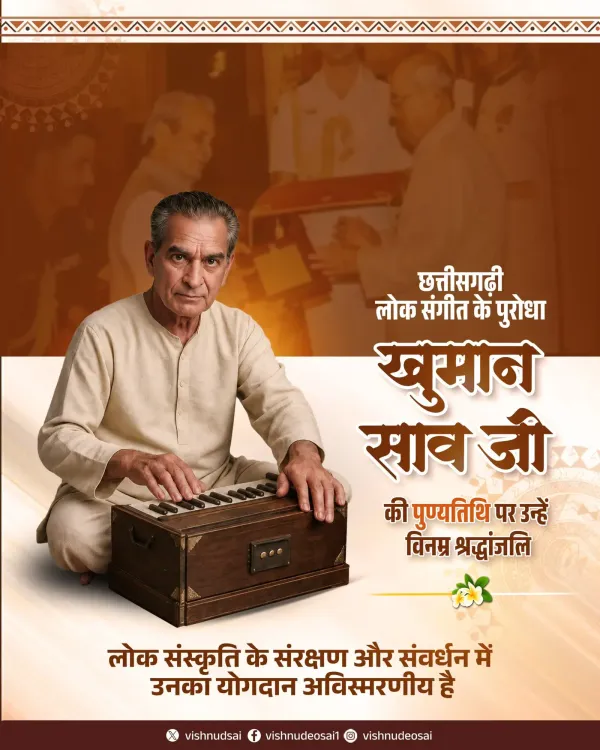
Chhattisgarh Chief Minister Vishnu Deo Sai marked the death anniversary of folk music legend Khuman Saw on 9 June 2026, crediting the late artist with carrying Chhattisgarhi folk traditions to the wider public through his compositions and performances.
Key Takeaways
CM Vishnu Deo Sai posted a tribute to late Chhattisgarhi folk singer Khuman Saw on his death anniversary on 9 June 2026 .
Khuman Saw is recognised as a pioneer of Chhattisgarhi folk music , known for popularising regional folk tunes and cultural compositions.
The Chief Minister credited Saw's work with bringing Chhattisgarh's folk traditions to a broad public audience.
CM Sai said Saw's musical legacy would continue to inspire future generations to stay connected with their culture.
The tribute follows a pattern of Chhattisgarh state governments marking folk artists' anniversaries since the state's formation in 2000 .
Chhattisgarh Chief Minister Vishnu Deo Sai on Tuesday, 9 June 2026, paid homage to late folk music stalwart Khuman Saw on his death anniversary, honouring the artist's lifelong contribution to preserving and popularising the folk traditions of Chhattisgarh.
Context
Posting on X, CM Sai offered a tribute in Hindi, writing: 'Chhattisgarhi lok sangeet ke purodha Swargiya Khuman Saw ji ki punyatithi par unhe vinamra shraddhanjali' — 'A humble tribute to the departed pioneer of Chhattisgarhi folk music, Khuman Saw, on his death anniversary.' The Chief Minister described how Saw's melodious singing, folk compositions, and culturally resonant works carried the living traditions of Chhattisgarh to every corner of society.
CM Sai added that Saw's invaluable musical legacy would continue to inspire future generations to remain connected with their culture and heritage.
Policy Backdrop
Since Chhattisgarh was carved out as a separate state in 2000, successive state governments have periodically marked the anniversaries of prominent folk artists through official tributes and cultural programmes. Such commemorations are part of a broader institutional effort to document and sustain the state's distinct tribal and folk cultural identity.
The BJP-led administration under CM Sai, which assumed office in December 2023, has aligned itself with a wider national push by BJP-governed states to spotlight indigenous cultural figures as anchors of regional heritage promotion.
Stakeholders and Impact
The tribute carries significance for the community of folk musicians, cultural practitioners, and Chhattisgarhi heritage groups who regard Khuman Saw as a foundational figure in the state's musical canon. His compositions, rooted in local dialects and rural life, helped bring Chhattisgarhi folk forms to audiences beyond the state's tribal heartland.
For younger artists and students of regional music, official recognition at the level of the Chief Minister reinforces the cultural and institutional value placed on folk traditions that might otherwise receive limited mainstream attention.
What's Next
Cultural observers will watch whether the tribute translates into tangible state-level initiatives — such as folk music academy programmes, documentation projects, or public concerts — that reference Khuman Saw's legacy in the months ahead. Such steps would indicate whether the commemoration is part of a structured cultural preservation effort or a standalone ceremonial gesture.
Point of View
Which routinely invoke regional folk icons to reinforce local identity alongside national heritage narratives. For a state like Chhattisgarh — with its rich tribal and folk culture — such gestures also serve to consolidate the ruling party's connect with communities for whom these artists are symbols of lived tradition. The tribute's weight will ultimately be measured by whether it is followed by concrete policy action in folk music preservation or remains a ceremonial social-media moment. Either way, it keeps the conversation around Chhattisgarhi cultural heritage visible in the public sphere.
NationPress
26 Oct 2026
Frequently Asked Questions
Why did CM Vishnu Deo Sai pay tribute to Khuman Saw?
CM Vishnu Deo Sai paid tribute to Khuman Saw on his death anniversary, recognising the late artist's contribution to preserving and spreading Chhattisgarhi folk traditions .
What is Chhattisgarhi folk music?
Chhattisgarhi folk music is a distinct regional musical tradition from the central Indian state of Chhattisgarh , rooted in the dialects, rural life, and tribal heritage of the region.
When did Vishnu Deo Sai become Chief Minister of Chhattisgarh?
Vishnu Deo Sai assumed office as Chief Minister of Chhattisgarh in December 2023 after the BJP won the state assembly elections.
Does the Chhattisgarh government support folk music preservation?
The Chhattisgarh state government has periodically marked anniversaries of folk artists through official tributes and cultural programmes since the state's formation in 2000 , as part of broader heritage promotion efforts.