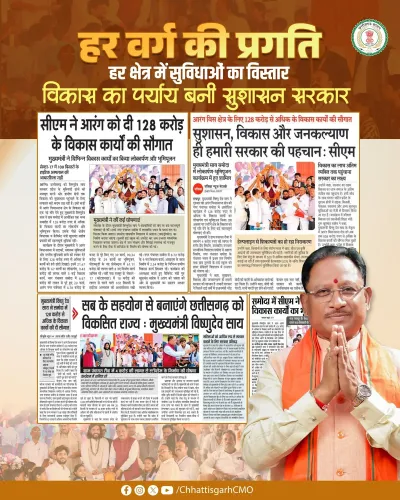
CM Sai Calls BJP Workers Pillars of Nation-First Governance
Synopsis
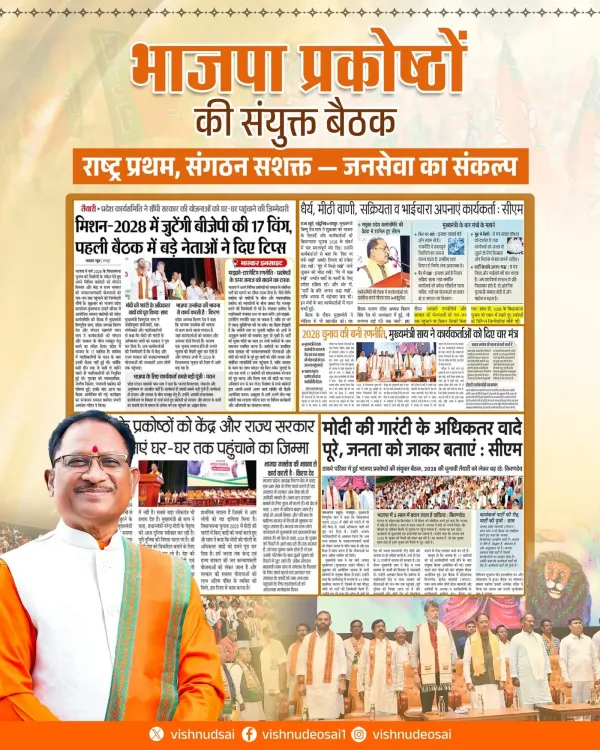
Chhattisgarh Chief Minister Vishnu Deo Sai on 11 July 2026 called BJP workers 'powerful carriers' of national interest and public service, urging them to deliver welfare and good governance to the last person in society and strengthen public trust.
Key Takeaways
CM Vishnu Deo Sai posted on 11 July 2026 calling BJP workers bearers of national interest and public service, not merely party representatives.
He invoked the principle of 'Rashtra Pratham' (Nation First) as the guiding spirit for all party and government activity.
The message specifically targeted outreach to 'samaj ke antim vyakti' — the last person in society — mirroring Antyodaya welfare philosophy.
Sai has led the Chhattisgarh government since December 2023 , with welfare delivery and administrative reform as stated priorities.
The statement aligns with a broader BJP pattern across governed states of publicly linking cadre work to government performance and electoral trust.
District-level organisational reviews and welfare scheme audits are anticipated in the coming months following this public directive.
Chhattisgarh Chief Minister Vishnu Deo Sai on Saturday, 11 July 2026 called upon BJP party workers to carry the resolve of public welfare and good governance to every last person in society, framing them as powerful bearers of national interest rather than mere organisational representatives.
Context
Posting in Hindi on X, CM Sai wrote: 'हमारे देवतुल्य कार्यकर्ता केवल संगठन के प्रतिनिधि नहीं, बल्कि राष्ट्रहित और जनसेवा के संकल्प के सशक्त वाहक है।' ['Our godlike workers are not merely representatives of the organisation, but powerful carriers of the resolve for national interest and public service.'] He urged all to keep the spirit of 'Rashtra Pratham' (Nation First) supreme and to strengthen the trust of the people.
The message underscores a recurring theme within BJP-governed states: that party cadre and government delivery machinery are inseparable instruments of nationalist governance. Sai specifically invoked the phrase 'samaj ke antim vyakti' ['the last person in society'], echoing the Gandhian principle of 'Antyodaya' that the party has long claimed as a governance touchstone.
Policy Backdrop
Since assuming office in December 2023 following the BJP's decisive victory in the Chhattisgarh assembly elections, CM Sai has positioned welfare scheme delivery and administrative reform as the twin pillars of his government. The administration has emphasised last-mile outreach for centrally and state-sponsored programmes targeting tribal communities, farmers, and economically weaker sections — constituencies that proved decisive in the 2023 election outcome.
The 'Nation First' framing is consistent with messaging adopted across BJP-ruled states since 2014, where organisational cadre are publicly tasked with bridging the gap between government schemes and beneficiaries on the ground. The language of 'sushasan' ['good governance'] has been a consistent marker of the party's state-level communication strategy.
Stakeholders and Impact
BJP workers across Chhattisgarh's 33 districts are the immediate audience for this message, which functions both as motivational guidance and as a public accountability signal to citizens. For ordinary residents — particularly in rural and tribal belts — the statement implies a renewed push to ensure that welfare entitlements reach intended beneficiaries without administrative bottlenecks.
Civil society observers note that such statements from chief ministers carry operational weight: they typically precede district-level organisational reviews or intensified scheme-saturation drives. The emphasis on 'strengthening public trust' also signals that the government is conscious of maintaining its electoral credibility ahead of future political cycles.
What's Next
State-level BJP organisational reviews and district-level welfare scheme audits are expected in the coming months, consistent with the pattern following similar public exhortations by CM Sai and other party chief ministers. The administration is likely to direct district collectors and party booth-level workers to coordinate on scheme outreach, particularly in Chhattisgarh's interior regions. How effectively this cadre-government synergy translates into measurable welfare delivery will be closely watched by both party leadership and the electorate.
Point of View
Signals governance intent to the public, and reinforces the 'Nation First' ideological brand that the party has cultivated since 2014. By framing workers as 'godlike' bearers of national resolve rather than political operatives, the messaging elevates organisational loyalty into a civic duty — a rhetorical move that blurs the line between party and government in ways that critics argue conflates partisan activity with public service. The invocation of 'the last person in society' is a deliberate echo of Antyodaya, lending the statement a constitutional and Gandhian legitimacy that transcends party politics. Ahead of potential organisational reviews in Chhattisgarh, this public directive also functions as a performance benchmark against which cadre accountability will implicitly be measured.
NationPress
9 Oct 2026
Frequently Asked Questions
Who is Vishnu Deo Sai and what is his role in Chhattisgarh?
Vishnu Deo Sai is the Chief Minister of Chhattisgarh and a senior BJP leader. He assumed office in December 2023 after the party won the state assembly elections.
What did CM Sai say about BJP workers on 11 July 2026?
CM Sai said BJP workers are not merely organisational representatives but 'powerful carriers' of national interest and public service, urging them to uphold the 'Nation First' spirit and deliver welfare to every last person in society.
What does 'Rashtra Pratham' mean in the context of BJP governance?
'Rashtra Pratham' means 'Nation First' and is a core ideological slogan used by the BJP to frame party and government activity as being driven by national interest above partisan considerations.
What welfare priorities has the Chhattisgarh government set since 2023?
Since December 2023 , the Sai government has prioritised last-mile delivery of welfare schemes and administrative reforms, with a focus on tribal communities, farmers, and economically weaker sections in Chhattisgarh .
What is expected to follow CM Sai's message to BJP workers?
District-level BJP organisational reviews and welfare scheme audits are expected in the coming months in Chhattisgarh , consistent with the pattern that follows such public directives from the Chief Minister.