CM Saini backs Queen Elizabeth's School Gurugram as GEDU's India debut
Synopsis
Haryana CM Nayab Singh Saini has announced that Queen Elizabeth's School, Gurugram will be GEDU Global Education's first India campus, operating under the Cambridge International Curriculum — framing the tie-up as a concrete step toward Viksit Bharat 2047 and NEP 2020 goals.
Key Takeaways
Queen Elizabeth's School, Gurugram will be GEDU Global Education's first school campus in India.
The school will follow the Cambridge International Curriculum , benchmarked across more than 160 countries.
CM Nayab Singh Saini met GEDU Group CEO Dr.
Vishwajeet Rana on 1 August 2026 to discuss the partnership.
The initiative is positioned as a contribution to the national Viksit Bharat 2047 vision of building a developed India by Independence's centenary.
The move aligns with the National Education Policy 2020 , which encourages international curriculum adoption and global academic partnerships.
Enrollment timelines and additional campus plans have not yet been formally announced.
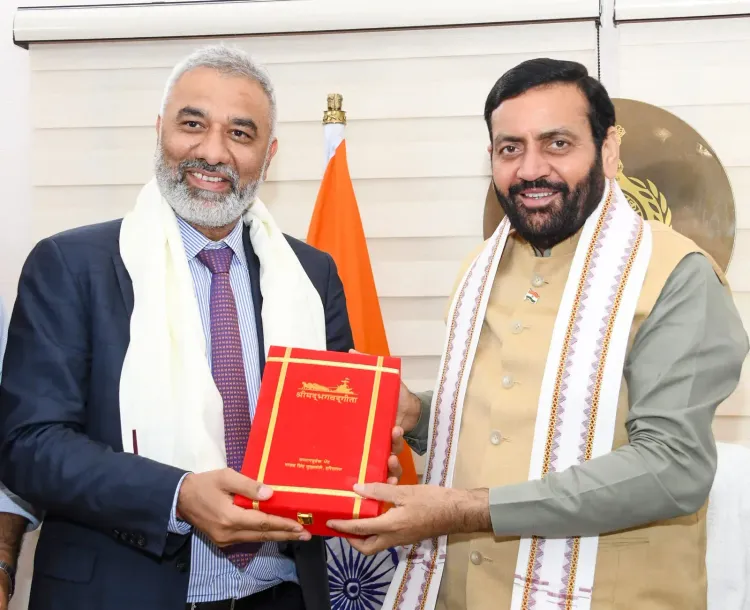
A global education group is planting its first Indian flag in Gurugram — and Haryana Chief Minister Nayab Singh Saini is making it state policy. On Saturday, 1 August 2026, Saini met Dr. Vishwajeet Rana, Group CEO of GEDU Global Education, to discuss weaving international partnerships into Haryana's school system, announcing that Queen Elizabeth's School, Gurugram will be GEDU's first campus in India.
Queen Elizabeth's School: Cambridge curriculum lands in Gurugram
The school will operate under the Cambridge International Curriculum, the globally benchmarked framework used by thousands of institutions across more than 160 countries. For Haryana students, that means access to a standardised learning pathway recognised by universities worldwide — a significant upgrade from what most government-adjacent schooling partnerships have historically offered.
Saini described the development as 'an important step towards providing world-class learning opportunities for our students,' directly tying it to the national Viksit Bharat 2047 vision — Prime Minister Narendra Modi's blueprint to position India as a fully developed economy by the centenary of Independence.
NEP 2020's blueprint made real in Haryana
This move does not emerge in a vacuum. The National Education Policy 2020 explicitly encouraged Indian institutions to adopt international curricula and forge global academic partnerships — a mandate that states have moved on at varying speeds. Haryana's engagement with GEDU is among the more concrete state-level expressions of that policy, converting a central directive into a physical campus.
The broader pattern is clear: since NEP 2020, several states have pursued tie-ups with international education groups to raise learning outcomes and workforce readiness. Haryana is now visibly in that race, with Gurugram — already a hub of multinational corporate presence — as the logical launchpad.
What Haryana's push for a 'globally competitive knowledge ecosystem' means
Saini's stated goal is a 'globally competitive knowledge ecosystem through meaningful collaborations' — language that signals this is intended as a template, not a one-off. The Gurugram campus is GEDU's first India school; if it scales, additional campuses and curricula partnerships could follow across the state.
The immediate questions are practical: enrollment timelines, fee structures, and whether the school's reach extends beyond Gurugram's affluent corridors to students from less privileged backgrounds. Those details remain to be formalised. What is already on the record is a sitting Chief Minister publicly endorsing a private international school group as a pillar of state education strategy — a signal the market and policymakers alike will read carefully.
Haryana has drawn the line from a single school in Gurugram to a developed India in 2047. The distance between those two points is where the real work begins.
Point of View
Lending it ideological coherence beyond routine infrastructure news. The choice of Gurugram as the launchpad is shrewd: the city's multinational corporate base creates an immediate, affluent catchment, but it also raises the equity question of whether such partnerships will ever reach students outside premium urban pockets. If GEDU scales beyond Gurugram, this announcement could be remembered as the opening move in a broader Haryana education liberalisation play.
NationPress
1 Aug 2026
Frequently Asked Questions
What is Queen Elizabeth's School Gurugram?
Queen Elizabeth's School, Gurugram is set to be the first India campus of GEDU Global Education, operating under the Cambridge International Curriculum to offer globally benchmarked schooling to students in Haryana.
What is GEDU Global Education?
GEDU Global Education is an international education group led by Group CEO Dr. Vishwajeet Rana. Queen Elizabeth's School, Gurugram will be its first school campus in India.
What is the Cambridge International Curriculum?
The Cambridge International Curriculum is a globally recognised framework developed by Cambridge Assessment International Education, used by schools in more than 160 countries to deliver standardised learning outcomes accepted by universities worldwide.
How does this relate to Viksit Bharat 2047?
Viksit Bharat 2047 is the Government of India's vision to make India a fully developed nation by 2047. CM Saini has framed the Gurugram school partnership as a contribution to that goal by building a globally competitive knowledge ecosystem in Haryana.
What does NEP 2020 say about international school partnerships?
The National Education Policy 2020 explicitly encourages Indian schools and higher education institutions to adopt international curricula and form global academic partnerships, providing the policy foundation for tie-ups like the GEDU-Haryana collaboration.