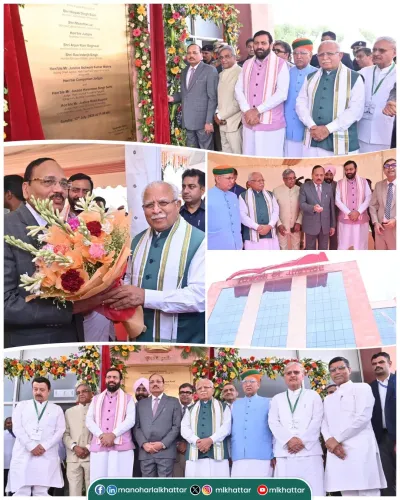
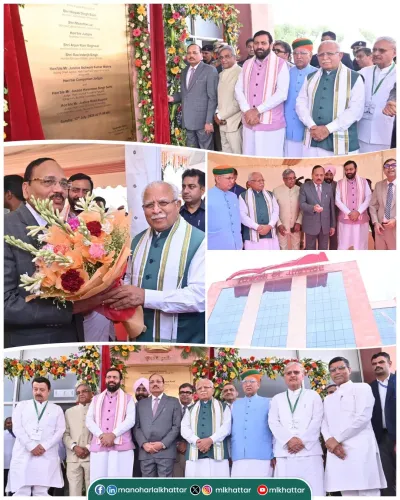
CM Saini Dedicates Tower of Justice to Nation in Gurugram

Synopsis
Haryana Chief Minister Nayab Singh Saini dedicated the Tower of Justice — a modern judicial facility — to the nation in Gurugram, calling the city a global hub of knowledge, technology, and investment and the new complex a pilgrimage site of modern justice.
Key Takeaways
Haryana Chief Minister Nayab Singh Saini dedicated the Tower of Justice to the nation in Gurugram on 13 July 2026 .
CM Saini described Gurugram as a strong global centre of knowledge, technology, innovation, startups, and investment.
The Tower of Justice is a purpose-built modern judicial facility designed to serve Gurugram's rapidly growing population and business community.
The dedication aligns with Haryana 's broader pattern of pairing economic infrastructure growth with parallel investments in governance and civic facilities.
The move connects to the national e-Courts Mission Mode Project , which pushes states to modernise district-level judicial infrastructure.
The judiciary , legal fraternity, litigants, and the city's large business community are the primary beneficiaries of improved court infrastructure.
Haryana Chief Minister Nayab Singh Saini on Sunday, 13 July 2026, dedicated the Tower of Justice — a modern judicial facility — to the nation in Gurugram, describing the city as a strong global centre of knowledge, technology, innovation, startups, and investment.
Posting on X in Hindi, CM Saini declared: 'गुरुग्राम की धरती आज ज्ञान, प्रौद्योगिकी, नवाचार, स्टार्टअप्स और वैश्विक निवेश का मजबूत केंद्र बन चुकी है' ('The land of Gurugram has today become a strong centre of knowledge, technology, innovation, startups, and global investment'). He called the Tower of Justice a 'आधुनिक न्याय का तीर्थ' — a 'pilgrimage site of modern justice' — dedicated on this 'glorious land.'
Context
Gurugram, situated in the National Capital Region, has evolved over three decades from a satellite town into one of India's foremost corporate and technology hubs, hosting multinational firms, IT parks, and a thriving startup ecosystem. The city's rapid economic ascent has brought with it a corresponding surge in legal and civic demand, making upgrades to judicial infrastructure a pressing administrative priority.
The Tower of Justice is positioned as a landmark governance facility intended to serve Gurugram's expanding population and its large professional and business community. By framing the inauguration in the language of both economic pride and civic duty, CM Saini signalled the state government's intent to match Haryana's growth story with commensurate institutional investment.
Policy Backdrop
Haryana's approach to urban governance has increasingly involved pairing economic infrastructure — expressways, tech parks, metro connectivity — with investments in civic and judicial facilities. This pattern accelerated from the 1990s onward as Gurugram attracted large-scale private capital and the state sought to build supporting public institutions.
At the national level, the e-Courts Mission Mode Project has pushed states to modernise district and subordinate court infrastructure, digitise case management, and improve physical court facilities. The dedication of the Tower of Justice in Gurugram aligns with this broader push, reflecting both state ambition and central policy direction for judicial modernisation in high-growth districts.
Stakeholders and Impact
The judiciary, the legal fraternity, and the millions of litigants who access courts in Gurugram stand to benefit most directly from improved judicial infrastructure. A dedicated, purpose-built facility can reduce case pendency, improve access to justice, and provide better working conditions for judges and court staff.
For the broader business and startup community that CM Saini highlighted in his post, a stronger judicial ecosystem directly underpins commercial confidence — dispute resolution, contract enforcement, and investor protection all hinge on the efficiency of local courts. The symbolic framing of the facility as a 'pilgrimage site of modern justice' also carries a political message about the BJP-led state government's governance priorities ahead of future electoral cycles.
What's Next
Attention will now turn to whether Haryana follows through with similar judicial infrastructure upgrades across other high-growth districts. State officials and the legal community will watch for integration of the Tower of Justice with e-courts platforms, digital filing systems, and video-conferencing facilities that have become standard expectations under national judicial modernisation programmes.
The rollout of additional district-level judicial complexes in Haryana — and the pace at which they are connected to national digital court networks — will be the clearest indicator of whether this inauguration marks the beginning of a sustained infrastructure drive or a standalone symbolic moment.
Point of View
CM Saini is making an implicit argument that rule-of-law infrastructure is as essential to growth as roads or metro lines. The move fits a broader national pattern of state governments using judicial modernisation as a visible governance deliverable ahead of electoral cycles. Whether the Tower of Justice becomes a model for district-level replication across Haryana — or remains an isolated showcase project — will define its long-term political and policy significance.
NationPress
12 Jul 2026
Frequently Asked Questions
What is the Tower of Justice in Gurugram?
The Tower of Justice is a modern, purpose-built judicial facility in Gurugram, Haryana, dedicated to the nation by Chief Minister Nayab Singh Saini on 13 July 2026 to serve the city's growing population and legal community.
Who inaugurated the Tower of Justice?
Haryana Chief Minister Nayab Singh Saini inaugurated and dedicated the Tower of Justice to the nation in Gurugram.
Why is a new judicial facility being built in Gurugram?
Gurugram's rapid growth as a corporate, IT, and startup hub has significantly increased demand for legal and civic services, making upgraded court infrastructure a priority for the Haryana state government.
How does the Tower of Justice relate to India's e-courts programme?
The Tower of Justice aligns with the national e-Courts Mission Mode Project, which encourages states to modernise district and subordinate court facilities, improve physical infrastructure, and integrate digital case management systems.
What did CM Nayab Singh Saini say about Gurugram?
CM Saini said that Gurugram has become a strong global centre of knowledge, technology, innovation, startups, and investment, and called the Tower of Justice a 'pilgrimage site of modern justice' on this glorious land.