CM Saini Hails GI Tag for Sirsa Kinnow as Historic Win
Synopsis
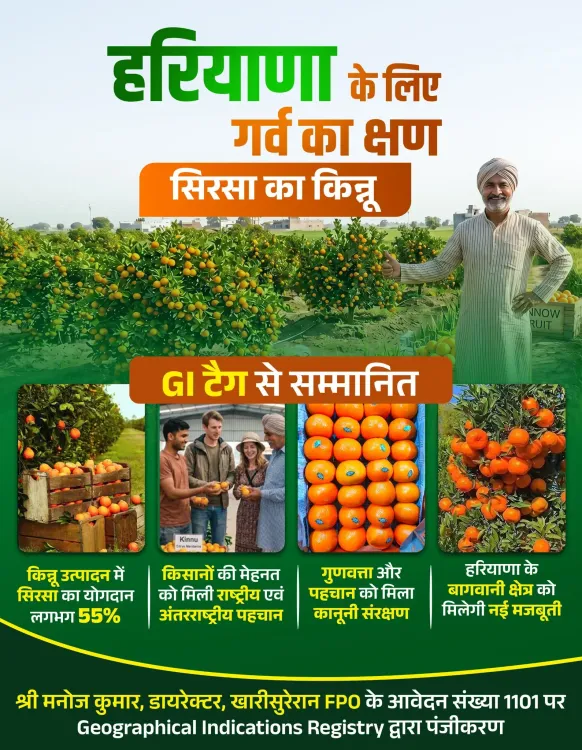
Haryana Chief Minister Nayab Singh Saini hailed the GI tag awarded to Sirsa's Kinnow as a historic milestone for the state's farmers and horticulture sector, saying it will unlock national and international market opportunities and deliver fair prices to growers.
Key Takeaways
Sirsa Kinnow has received a Geographical Indication (GI) tag, conferring legal protection and a distinct regional identity on the citrus fruit.
CM Nayab Singh Saini called the recognition a 'historic achievement' for Haryana's farmers, horticulture sector, and agricultural heritage.
The GI tag is expected to help Kinnow growers in Sirsa access better markets, command premium prices, and explore export opportunities.
India has registered over 500 GI tags since the framework was established in 1999 , with agricultural produce forming a significant share.
The development aligns with the central government's Atmanirbhar Bharat agenda of boosting farm incomes through value addition and brand differentiation.
The recognition may encourage other Haryana districts to pursue GI filings for their distinctive agricultural products.
Haryana Chief Minister Nayab Singh Saini on Thursday, 2 July 2026, celebrated the award of a Geographical Indication (GI) tag to Sirsa's Kinnow citrus fruit, calling it a historic achievement for the state's farmers and horticulture sector. Saini posted on X that the recognition would give Sirsa Kinnow a distinct identity at the national and international level while opening better markets and fair prices for growers.
Context
In his post, CM Saini described the GI tag as 'हरियाणा के लिए गौरव का क्षण' ('a moment of pride for Haryana'), calling it an 'ऐतिहासिक उपलब्धि' ('historic achievement') for the state's farmers, horticulture sector, and rich agricultural heritage. He credited the development to the leadership of Prime Minister Narendra Modi and reaffirmed the Haryana government's commitment to raising farmer incomes and taking the state's agriculture and horticulture to new heights.
Sirsa, a district in western Haryana, is one of the state's most significant Kinnow-producing belts. Kinnow is a high-yield mandarin hybrid widely grown across north-western India, prized for its juice content and shelf life.
Policy Backdrop
India's framework for protecting unique regional products rests on the Geographical Indications of Goods (Registration and Protection) Act, 1999. A GI tag legally certifies that a product originates from a specific region and possesses qualities or a reputation attributable to that origin, giving producers the right to prevent misuse of the name.
The central government accelerated GI registrations after 2014, crossing 500 registered tags by 2023, with agricultural produce forming a major share. The push aligns with broader policy goals under Atmanirbhar Bharat — securing premium prices for distinctive Indian goods, boosting exports, and reducing dependence on undifferentiated commodity markets.
Haryana has progressively sought GI recognition for its agricultural products as part of crop-diversification efforts, moving beyond its traditional identity as a wheat-and-paddy state toward higher-value horticulture.
Stakeholders and Impact
Farmers in Sirsa and surrounding districts stand to benefit most directly. A GI tag allows producers to command a price premium by differentiating their product from generic Kinnow grown elsewhere, and it provides legal protection against imitation or misrepresentation in domestic and export markets.
The horticulture supply chain — including traders, cold-chain operators, and exporters — is also expected to gain from the enhanced brand value. Internationally, the GI certification can ease market access in countries that recognise Indian GI registrations, potentially expanding export volumes in coming seasons.
For the broader farming community in Haryana, the development reinforces the state government's stated agenda of income enhancement through value addition rather than volume alone.
What's Next
The immediate focus will be on translating the GI recognition into measurable gains — higher farm-gate prices for Kinnow growers in Sirsa and increased export enquiries. Industry observers will track whether the tag drives a tangible uptick in pricing and shipment volumes in the seasons ahead.
The recognition may also prompt other Haryana districts with distinctive produce to accelerate their own GI filing processes, broadening the state's portfolio of protected agricultural brands and deepening its horticulture diversification push.
Point of View
CM Saini is also stitching a local win into the larger national story of GI-driven farmer welfare — a pattern visible across BJP-governed states. The real test will be whether the tag translates into measurable price gains at the farm gate or remains a symbolic milestone. If Sirsa Kinnow successfully commands a premium in domestic and export markets, it could serve as a template for Haryana's broader horticulture diversification ambitions.
NationPress
2 Jul 2026
Frequently Asked Questions
What is a GI tag and why does Sirsa Kinnow getting one matter?
A Geographical Indication (GI) tag is a legal certification under the Geographical Indications of Goods (Registration and Protection) Act, 1999 that links a product to its specific region of origin. For Sirsa Kinnow , it means the fruit's name is legally protected, producers can prevent misuse, and the tag helps command premium prices in national and international markets.
What did Haryana CM Nayab Singh Saini say about the Kinnow GI tag?
CM Nayab Singh Saini called it a 'moment of pride' and a 'historic achievement' for Haryana's farmers and horticulture sector. He said the recognition would give Sirsa Kinnow a distinct national and international identity and help farmers access better markets and fair prices.
Where is Sirsa and why is it known for Kinnow?
Sirsa is a district in western Haryana with a significant horticulture economy. Its agro-climatic conditions are well-suited to Kinnow cultivation — a high-yield mandarin hybrid prized for its juice content — making it one of the major Kinnow-producing belts in north-western India.
How many GI tags has India registered so far?
India crossed 500 registered GI tags by 2023 , with the pace of registration accelerating after 2014 . Agricultural produce forms a large share of these registrations, reflecting the government's push to protect distinctive regional farm products.
How will the GI tag benefit Haryana Kinnow farmers practically?
The GI tag allows Sirsa Kinnow growers to differentiate their produce from generic Kinnow, enabling them to seek price premiums from buyers. It also provides legal protection against imitation, improves prospects for export market access, and strengthens the overall supply chain's brand value.