CM Saini Launches Paperless Registry 2.0 and Auto Mutation in Haryana
Synopsis
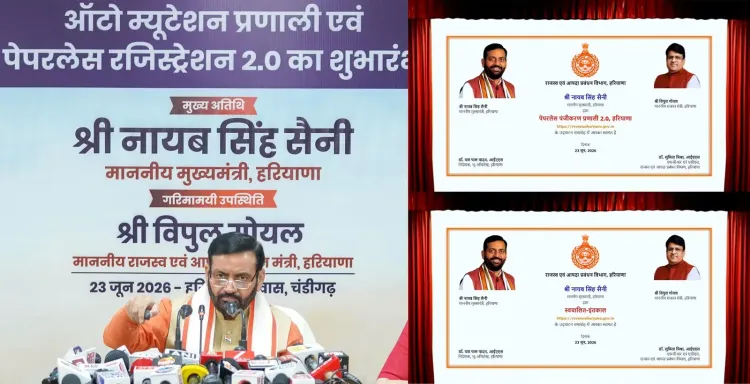
Haryana Chief Minister Nayab Singh Saini launched Paperless Registry 2.0 and the Auto Intkal System on 23 June 2026, integrating property registration with mutation in a single digital workflow to benefit lakhs of farmers and landowners under the Digital India agenda.
Key Takeaways
Paperless Registry 2.0 (second phase) and the Auto Intkal System were launched in Haryana on 23 June 2026 by CM Nayab Singh Saini .
The new system integrates the mutation (intkal) process directly with property registration, eliminating a separate application step.
Haryana's Paperless Registry System has been operational since 1 November 2025 , with Phase 2 extending its scope.
The Auto Intkal System is expected to benefit lakhs of farmers and landowners across the state.
Application forms have been simplified compared to the earlier process to improve accessibility.
The initiative aligns with the national Digital India programme and the National Land Records Modernization Programme .
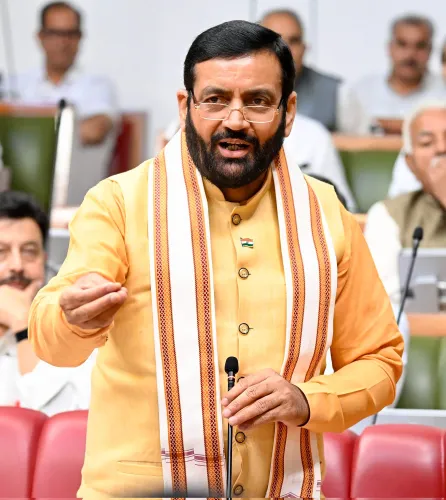
Haryana Chief Minister Nayab Singh Saini on Tuesday, 23 June 2026 launched Paperless Registry 2.0 (the second phase) and the Auto Intkal (mutation) System in Haryana, marking a significant step in the state's digital governance agenda. The reforms integrate the property mutation process directly with registration, aiming to reduce bureaucratic delays for millions of landowners and farmers across the state.
Context
Announcing the initiative on X, CM Saini wrote: 'Digital India, Digital Haryana' — framing the launch as part of a broader push for a transparent administrative system. He noted that the application form has also been simplified compared to the earlier process, easing the burden on citizens navigating property transactions. The post confirmed that the Paperless Registry System has been operational in the state since 1 November 2025.
Under the new arrangement, the intkal (mutation) process — the official updating of land ownership records after a sale or inheritance — is now integrated with registration itself. Previously, citizens had to complete registration and then separately apply for mutation, a two-step process that often caused significant delays.
Policy Backdrop
The launch sits within the national Digital India programme, the flagship e-governance initiative introduced by the central government in 2015 to drive paperless administration and citizen-centric digital services across states. Haryana's move also builds on the National Land Records Modernization Programme, which began in 2008 to computerise land records and reduce property disputes through digitisation.
Multiple Indian states have progressively worked to integrate land registration with mutation processes under the Digital India umbrella, aiming to cut red tape in revenue administration. Automated mutation directly addresses a long-standing bottleneck: after a property changes hands, delays in updating official ownership records have historically created legal uncertainty and scope for corruption.
Stakeholders and Impact
The Auto Intkal System is expected to provide significant relief to lakhs of farmers and landowners across Haryana, as CM Saini stated in his post. For rural property holders in particular, the manual mutation process has historically required multiple visits to revenue offices and was vulnerable to delays and informal payments.
The integration of registration and mutation into a single paperless workflow reduces the number of touchpoints between citizens and government officials, which is a key transparency objective. Simplified application forms further lower the barrier for first-time or low-literacy users engaging with the land records system.
What's Next
The broader trajectory points toward deeper integration of Haryana's state land portal with national frameworks such as the NLRMP and emerging land-identity systems. Possible legislative amendments to align with the updated registration and mutation workflows may also follow as the system matures.
The success of Paperless Registry 2.0 will likely be measured by reduction in mutation pendency rates and citizen grievances related to land transactions — metrics that will determine whether the state scales the model further or refines it in subsequent phases.
Point of View
And success here could pressure neighbouring states to accelerate similar reforms. The framing around 'Digital India, Digital Haryana' also serves a political purpose — tethering state-level delivery to the central government's flagship programme. Whether the system achieves its transparency goals will ultimately depend on backend implementation quality and grievance redressal mechanisms, not just the launch announcement.
NationPress
23 Jun 2026
Frequently Asked Questions
What is Haryana's Paperless Registry 2.0?
Paperless Registry 2.0 is the second phase of Haryana's digital property registration system, launched on 23 June 2026. It integrates the mutation (intkal) process directly with registration, so property ownership records are updated automatically without a separate application.
What is the Auto Intkal System in Haryana?
The Auto Intkal System is an automated mutation mechanism launched in Haryana that updates land ownership records simultaneously with property registration. It is designed to benefit lakhs of farmers and landowners by removing delays in the traditional manual mutation process.
When did Haryana's Paperless Registry System start?
According to Chief Minister Nayab Singh Saini, the Paperless Registry System was successfully implemented in Haryana from 1 November 2025. The second phase, Paperless Registry 2.0, was launched on 23 June 2026.
How does the new system benefit farmers in Haryana?
Farmers and landowners in Haryana will no longer need to make separate visits to revenue offices for mutation after completing property registration. The integrated digital process reduces delays, lowers opportunities for corruption, and simplifies the application form.
Is Haryana's land registration reform part of Digital India?
Yes. CM Nayab Singh Saini explicitly framed the launch under the 'Digital India, Digital Haryana' banner. The reform aligns with the central government's Digital India programme launched in 2015 and the National Land Records Modernization Programme initiated in 2008.