CM Saini Launches Auto-Mutation & Paperless Revenue Registration 2.0

Synopsis
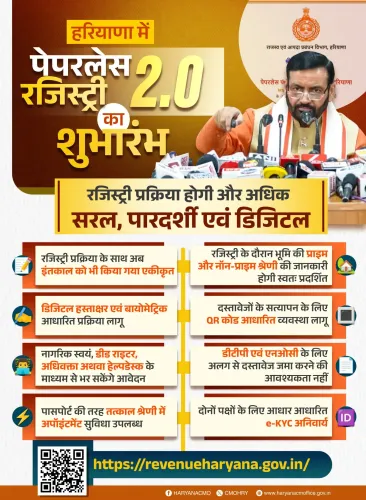
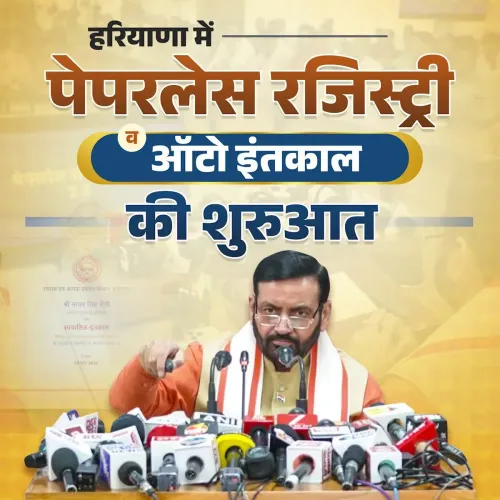
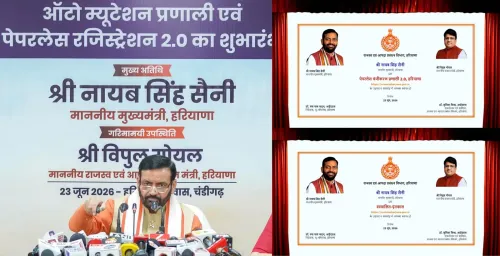
Haryana Chief Minister Nayab Singh Saini launched Auto-Mutation and Paperless Revenue Registration 2.0 in Chandigarh on 23 June 2026, upgrading the state's digital land-records system to automate property mutation and eliminate paper-based deed registration for landowners across Haryana.
Key Takeaways
CM Nayab Singh Saini launched Auto-Mutation and Paperless Revenue Registration 2.0 on 23 June 2026 in Chandigarh .
The initiative automates the updating of land ownership records immediately after a registered property transaction, removing the need for a separate manual mutation application.
The '2.0' upgrade refines an earlier digital platform built on Haryana's land-records computerisation under the Digital India Land Records Modernization Programme .
Primary beneficiaries are Haryana's landowners and property buyers, who face delays and title disputes under the existing manual system.
District-wise rollout timelines and potential integration with central portals such as Bhudhaar and PARAS will determine the programme's reach.
The reform aligns with the broader national Digital India agenda to reduce discretion and improve transparency in revenue administration.
Haryana Chief Minister Nayab Singh Saini on Tuesday, 23 June 2026, launched the Auto-Mutation and Paperless Revenue Registration 2.0 initiative at Chandigarh, marking a significant upgrade to the state's digital land-records infrastructure.
Context
The launch was announced live by CM Saini via a direct broadcast, signalling the administration's intent to move land-record services further into the digital domain. Auto-mutation refers to the automatic updating of land ownership records in government databases upon completion of a registered property transaction, eliminating the need for a separate, often time-consuming, manual application. The '2.0' designation indicates a refined iteration of an earlier digital platform already operating in Haryana.
The initiative covers both components of the property-transaction chain — mutation of revenue records and registration of deeds — bringing them under a unified, paperless workflow accessible from Chandigarh and, by extension, across the state's revenue offices.
Policy Backdrop
Haryana began computerising land records under the centrally sponsored Digital India Land Records Modernization Programme (DILRMP), which gained momentum through the 2010s. That programme pushed states to digitise record-of-rights, automate mutation workflows, and integrate registration and revenue databases to reduce human discretion and opportunities for corruption.
The broader national Digital India agenda has encouraged multiple Indian states to introduce automated mutation and paperless registration systems. Upgrades branded as '2.0' typically add features such as real-time SMS alerts, integration with Aadhaar-verified identity checks, online fee payment, and tighter linkage between the sub-registrar's office and the revenue patwari's records. Watchers will track whether Haryana's version integrates with central portals such as Bhudhaar or PARAS.
Chandigarh, the Union Territory that serves as the joint capital of Haryana and Punjab, is frequently chosen as the launch venue for high-visibility state government programmes, given its administrative concentration and infrastructure.
Stakeholders and Impact
The primary beneficiaries are Haryana's millions of landowners and property buyers who currently navigate multi-step, in-person processes to get mutations effected after a sale, inheritance, or gift deed. Delays in mutation can cloud title, complicate future transactions, and expose landowners to disputes — problems that an automated, paperless pipeline is designed to address.
Revenue officials — including tehsildars, naib-tehsildars, and patwaris — will see their workflow altered as the system routes mutation requests automatically from the registration database rather than through physical files. Transparency advocates argue such automation reduces the scope for unofficial payments that historically accompanied manual mutation approvals.
What's Next
Attention will now turn to the district-wise rollout timeline and the pace at which Haryana's sub-registrar offices and revenue circles are brought onto the upgraded platform. Integration with central land-data frameworks and the availability of citizen-facing grievance redressal within the 2.0 system will be key markers of its operational success. CM Saini's administration is expected to publish implementation milestones as the system scales beyond the launch event.
Point of View
Building on a national Digital India narrative that resonates with property-owning middle-class voters. By branding the initiative as '2.0', CM Saini signals continuity with prior reform while claiming a visible upgrade — a common political framing for incremental technology improvements. The real test will be last-mile adoption: whether patwaris and sub-registrar offices across Haryana's diverse districts absorb the new workflow or revert to parallel manual processes. If the integration with central land-data portals materialises, Haryana could position itself as a benchmark state for revenue digitisation, strengthening the administration's governance credentials.
NationPress
22 Sept 2026
Frequently Asked Questions
What is Auto-Mutation and Paperless Revenue Registration 2.0 in Haryana?
It is an upgraded digital system launched by Haryana CM Nayab Singh Saini on 23 June 2026 that automatically updates land ownership records in government databases after a property transaction is registered, eliminating the need for a separate manual mutation application and removing paper from the deed-registration process.
Who launched Haryana's Auto-Mutation 2.0 and when?
Haryana Chief Minister Nayab Singh Saini launched the initiative live on 23 June 2026 from Chandigarh .
What is auto-mutation of land records?
Auto-mutation is the automatic transfer of property ownership in government revenue records immediately after a sale, inheritance, or gift deed is registered, without requiring the new owner to file a separate mutation application before revenue officials.
How does this affect landowners in Haryana?
Landowners and property buyers in Haryana will no longer need to follow up separately with revenue offices to get mutations effected after registration, reducing delays, paperwork, and the risk of title disputes.
Is Haryana's paperless registration linked to the central Digital India programme?
Yes. Haryana built its earlier land-records digitisation on the centrally sponsored Digital India Land Records Modernization Programme , and the 2.0 upgrade continues that trajectory. Integration with central portals such as Bhudhaar and PARAS is being watched as a next step.