CM Saini Targets Congress Over Vande Mataram Row on I-Day

Synopsis
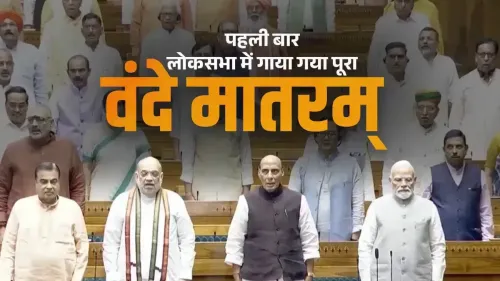
On Independence Day 2026, Haryana CM Nayab Singh Saini accused Congress of historically suppressing Vande Mataram, claiming the national song was sung at Red Fort for the first time — reigniting a recurring BJP-Congress battle over national symbols.
Key Takeaways
Haryana CM Nayab Singh Saini posted on 15 August 2026 accusing Congress of blocking Vande Mataram in the past.
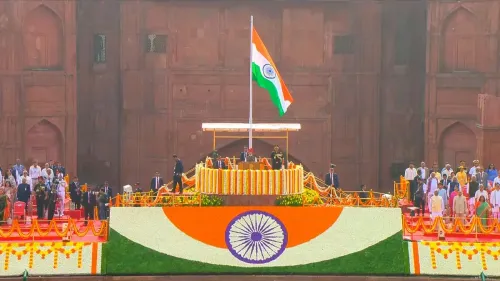
He claimed Vande Mataram was sung at Red Fort for the first time this Independence Day.
He named Rahul Gandhi and Sonia Gandhi as the Congress figures allegedly responsible for stopping the song.
Vande Mataram was recognised as India's national song by the Constituent Assembly in 1950 .
The BJP routinely raises national-symbol rhetoric around Independence Day and Republic Day as a political contrast with Congress.
The specific incident cited by Saini was not independently verified at the time of publication.
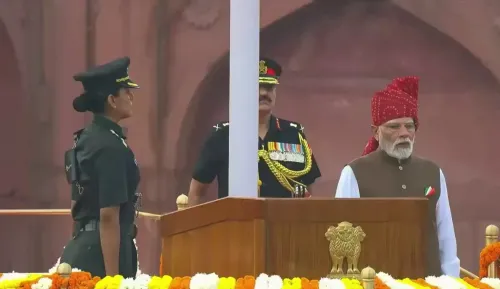
On Independence Day, 15 August 2026, Haryana Chief Minister Nayab Singh Saini sharpened a familiar political blade — accusing the Congress of historically obstructing Vande Mataram, India's national song, even as he claimed the anthem was sung at Red Fort for the first time this year.
Posting in Hindi, Saini drew a pointed contrast: 'एक तरफ पहली बार लाल किले पर वंदे मातरम गीत गाया गया' ('On one side, Vande Mataram was sung at Red Fort for the first time') — and on the other, he alleged, Congress's 'Yuvraj and his mother' had once moved to stop the song from being sung. 'Insulting symbols of national pride has long been Congress's political character,' he wrote.
The Vande Mataram Fault Line in Indian Politics
Vande Mataram was adopted as India's national song by the Constituent Assembly in 1950, alongside the national anthem. But its status has never been entirely above politics. The song's origins in Bankim Chandra Chatterjee's 19th-century novel Anandamath and its association with the independence movement gave it deep nationalist weight — yet periodic disputes over its mandatory recitation have kept it a live political flashpoint.
Saini's post names Rahul Gandhi — the Congress leader opponents routinely call 'Yuvraj' (crown prince) — and his mother, former Congress president Sonia Gandhi, as the figures who allegedly blocked the song. The specific incident he references was not independently verifiable from available records at the time of publication.
BJP's Independence Day Messaging and the Congress Counter
The BJP has consistently woven national-symbol rhetoric into its Independence Day communications, and Saini's post fits squarely into that pattern. Accusations of Congress 'appeasement' at the cost of cultural icons resurface reliably every 15 August and 26 January, functioning as both a mobilisation tool for the base and a frame for contrasting governance philosophies.
Congress has historically pushed back on such characterisations, arguing its record on national unity speaks for itself across decades of governance. Whether the party's spokespersons respond formally to this specific charge — or whether the 2026 Red Fort programme is taken up in parliamentary proceedings — will determine how far this exchange travels beyond social media.
For now, CM Saini has planted a flag on Independence Day that is as much about the past as the present: the fight over who owns India's patriotic memory is, by any measure, far from over.
Point of View
The post keeps the charge vivid while retaining plausible rhetorical distance. The broader pattern suggests this is less about a single incident and more about cementing a long-term cultural contrast ahead of electoral cycles. Whether Congress chooses to engage or ignore will itself be read as a political signal.
NationPress
15 Aug 2026
Frequently Asked Questions
What did Haryana CM Nayab Singh Saini say about Vande Mataram on Independence Day 2026?
CM Saini claimed that Vande Mataram was sung at Red Fort for the first time on 15 August 2026, and accused Congress leaders — referring to Rahul Gandhi and Sonia Gandhi — of having previously obstructed the singing of the national song.
What is Vande Mataram and why is it significant?
Vande Mataram is India's national song, adopted by the Constituent Assembly in 1950. It originates from Bankim Chandra Chatterjee's 19th-century novel Anandamath and played a prominent role in the independence movement.
Why do BJP leaders call Rahul Gandhi 'Yuvraj'?
'Yuvraj' means crown prince in Hindi. BJP leaders use the term to suggest that Rahul Gandhi's prominence in Congress is due to dynastic inheritance rather than democratic merit — a long-running line of political attack.
Has Congress been accused of opposing Vande Mataram before?
Yes. BJP and other nationalist groups have periodically accused Congress of ambivalence toward Vande Mataram, particularly around disputes over mandatory recitation in public institutions. Congress has consistently denied opposing the national song.
Is it confirmed that Vande Mataram was sung at Red Fort for the first time in 2026?
The claim was made by CM Saini in his post. This specific assertion could not be independently verified from available records at the time of publication.