CM Sai's School Keinta Abhiyan brings education to Abujhmad
Synopsis
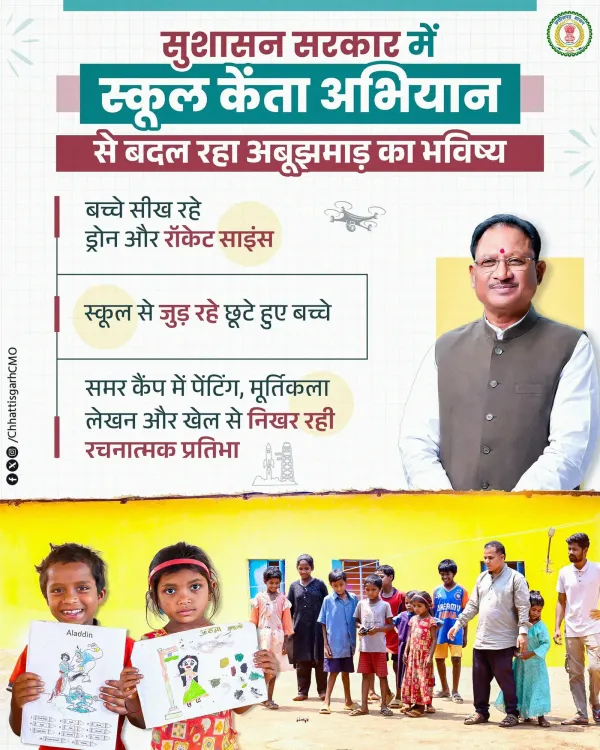
The Vishnu Deo Sai government's School Keinta Abhiyan is reconnecting out-of-school tribal children in Chhattisgarh's remote Abujhmad region with education through summer camps that combine drone training, rocket science, painting, sculpture and indigenous sports.
Key Takeaways
School Keinta Abhiyan is a Chhattisgarh state campaign to re-enrol children who have dropped out of school in the Abujhmad tribal region.
Summer camps under the Abhiyan offer training in drones, rocket science, painting, sculpture, writing and local sports .
Abujhmad spans Narayanpur and Bijapur districts and has long faced educational access challenges due to remote terrain and left-wing extremism.
The initiative is backed by the Vishnu Deo Sai -led BJP government, which took office in December 2023 with a focus on tribal welfare.
The campaign aligns with the Right to Education Act, 2009 and the Samagra Shiksha central framework for improving tribal enrolment.
Retention outcomes after the summer camps will determine whether the model is scaled to additional districts.
The Chief Minister's Office of Chhattisgarh announced on Saturday, 27 June 2026 that the School Keinta Abhiyan, launched under the Vishnu Deo Sai government, is bringing renewed educational access to Abujhmad — one of India's most remote tribal belts — by re-enrolling out-of-school children and running summer camps that blend technology with local culture.
Context
The CMO's post states that the campaign is bringing 'shiksha ki nayi roshni' (a new light of education) to Abujhmad. Children who had dropped out of school are being reconnected with formal education, while summer camps offer them hands-on exposure to drones, rocket science, painting, sculpture, writing and local sports.
Abujhmad straddles Narayanpur and Bijapur districts in southern Chhattisgarh. It is home to Gond and other indigenous communities and has historically suffered from limited infrastructure and the impact of left-wing extremism, making routine school access a persistent challenge for tribal children.
Policy Backdrop
The Right to Education Act, 2009 placed a legal obligation on states to ensure free and compulsory elementary education and to bring out-of-school children back into the system. Chhattisgarh, like other states with large tribal populations, has channelled central support through Samagra Shiksha — the umbrella scheme that evolved from Sarva Shiksha Abhiyan — to improve enrolment and infrastructure in hard-to-reach districts.
Successive Chhattisgarh governments have run re-enrolment drives in Maoist-affected and tribal areas, but the introduction of STEM modules such as drone operation and rocket science alongside cultural activities marks a shift in approach. The strategy reflects a broader national pattern of using innovation and locally adapted content to improve retention among indigenous students in aspirational districts.
Stakeholders and Impact
The primary beneficiaries are tribal children in Abujhmad who had fallen out of the formal schooling system. By pairing re-enrolment with engaging summer camp activities, the Abhiyan aims to reduce the stigma and disengagement that often accompany dropout and make return to school more attractive.
Local communities, teachers, and district administration in Narayanpur and Bijapur are the key implementation partners. Exposure to technology such as drones and rocket science is designed to widen aspirations for children who have had limited access to such resources, while activities like painting, sculpture and indigenous games anchor the programme in familiar cultural contexts.
What's Next
The effectiveness of School Keinta Abhiyan will ultimately be measured by retention data after the summer camps conclude — whether children who re-enrolled remain in school when the new academic year begins. Officials and education observers will watch for any formal announcement on extending the Abhiyan to additional blocks or districts beyond the current Abujhmad focus area.
If retention figures prove strong, the model — combining re-enrolment drives with STEM and cultural exposure — could provide a template for other tribal and left-wing extremism-affected districts across Chhattisgarh and potentially other states facing similar challenges.
Point of View
Re-enrolment campaigns in left-wing extremism-affected districts have struggled with post-camp retention, and that remains the critical test here. If the model holds, it could become a replicable template for aspirational-district education policy across central India.
NationPress
27 Jun 2026
Frequently Asked Questions
What is School Keinta Abhiyan in Chhattisgarh?
School Keinta Abhiyan is a Chhattisgarh government campaign to re-enrol out-of-school children in tribal and remote areas, running summer camps that offer training in drones, rocket science, painting, sculpture, writing and local sports alongside formal re-enrolment drives.
Where is Abujhmad and why is education difficult there?
Abujhmad is a dense forested region spanning Narayanpur and Bijapur districts in southern Chhattisgarh. Its remote terrain, limited infrastructure and history of left-wing extremism have made consistent school access very difficult for indigenous tribal communities living there.
Who is running School Keinta Abhiyan?
The campaign is being run by the Chhattisgarh state government under Chief Minister Vishnu Deo Sai, who has led the BJP government in the state since December 2023 with a stated focus on tribal development and welfare.
What activities are offered in the School Keinta Abhiyan summer camps?
The summer camps offer children hands-on exposure to drone operation, rocket science, painting, sculpture, creative writing and local indigenous sports — combining technology education with cultural activities to make re-engagement with schooling more appealing.
How does School Keinta Abhiyan relate to central government education schemes?
The Abhiyan aligns with the Right to Education Act, 2009 and the Samagra Shiksha framework, which provide the legal and financial backbone for states to reduce dropout rates and improve enrolment in tribal and rural areas across India.