CM Samrat Choudhary Urges Bihar to Join Census Self-Enumeration

Synopsis
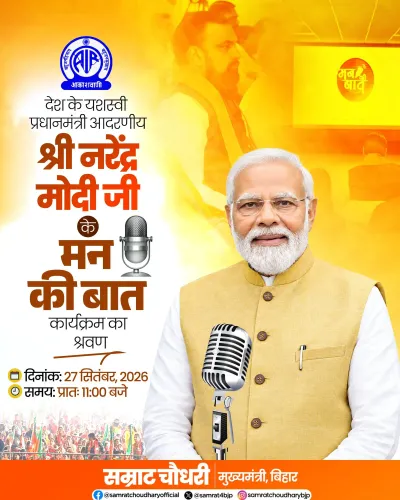
Bihar Chief Minister Samrat Choudhary amplified PM Modi's Mann Ki Baat appeal on 27 September 2026, urging citizens to self-enumerate in India's ongoing census, with over 32 crore families already registered in the first phase.
Key Takeaways
Bihar CM Samrat Choudhary shared PM Modi's census appeal on 27 September 2026 via X.
The post states the census first phase has covered data from more than 32 crore families across India.
Citizens can now self-enumerate by entering household details through a mobile application .
The Census of India is governed by the Census Act of 1948 and is conducted every decade; the last completed census was in 2011 .
Bihar's census participation directly affects central fund allocation, welfare scheme targeting, and future delimitation of parliamentary seats .
Every decade, India counts itself — and Bihar Chief Minister Samrat Choudhary wants every family in the state counted. On Sunday, 27 September 2026, Choudhary took to X to amplify a call from Prime Minister Narendra Modi, urging citizens to participate in the ongoing national census by registering their household data directly from their mobile phones.
Sharing a message attributed to the Prime Minister from his Mann Ki Baat programme, Choudhary posted in Hindi: 'Janganana hum sabka rashtriya dayitva hai' — 'The census is a national duty of all of us.' The post noted that the first phase of the census has reached a significant milestone, with data from more than 32 crore families already recorded across the country.
Self-Enumeration: Counting India From a Smartphone
The key push in this phase is self-enumeration — a digital-first option that allows citizens to enter their own and their family's details through a mobile application, reducing dependence on field enumerators visiting every door. This marks a departure from the paper-driven process that characterised previous rounds of the Census of India, which is governed by the Census Act of 1948 and is typically conducted every ten years.
The last fully completed decennial census was held in 2011. The current exercise, rolling out in phased form, has incorporated digital infrastructure as a central feature — reflecting a broader government push to leverage technology for large-scale data collection.
Why the Census Number Matters for Bihar
Bihar is one of India's most populous states, and census data directly determines the allocation of central funds, parliamentary seat delimitation, and the targeting of welfare schemes. Incomplete enumeration translates into under-representation — fewer resources and a blurrier picture of ground-level need. Choudhary's amplification of Modi's message is a direct appeal to residents not to let that happen.
'Your little time will make an important contribution to preparing the right picture of the country's future,' the post read. In a state where demographic data has historically shaped debates over development spending and political representation, that framing carries real weight.
With the self-enumeration window open and the first phase nearing completion, the clock is running. Every household that skips the mobile form is a data gap that policymakers will have to work around for the next ten years.
Point of View
Reinforcing the BJP's unified governance messaging ahead of what could be a data-heavy policy cycle. The emphasis on self-enumeration via mobile signals a deliberate shift in how the state wants to be seen: tech-forward, participatory, and administratively competent. For Bihar specifically, robust census data is not just administrative bookkeeping — it feeds directly into delimitation calculations that could reshape the state's political map. Framing participation as a 'national duty' deflects any perception of the exercise as a top-down bureaucratic imposition, turning it into a civic identity moment.
NationPress
27 Sept 2026
Frequently Asked Questions
What is the census self-enumeration process in India?
Self-enumeration allows citizens to register their own and their family's details through a government mobile application, without waiting for a field enumerator to visit their home. It is part of the current digital-first approach to the decennial Census of India.
Why is Bihar CM Samrat Choudhary talking about the census?
Choudhary shared a message from Prime Minister Modi's Mann Ki Baat programme on 27 September 2026, amplifying the national call for public participation in the ongoing census, which directly affects Bihar's resource allocation and political representation.
How many families have been counted in India's census so far?
According to the post shared by CM Samrat Choudhary, data from more than 32 crore families has already been recorded in the first phase of the current census.
When was the last Census of India completed?
The last fully completed decennial Census of India was conducted in 2011. The current census round is the next major enumeration exercise, now incorporating digital self-enumeration tools.
How does the census affect Bihar's development funds?
Census data is used by the central government to determine the allocation of funds, target welfare schemes, and conduct delimitation of parliamentary and assembly constituencies — making complete participation critical for Bihar's interests.