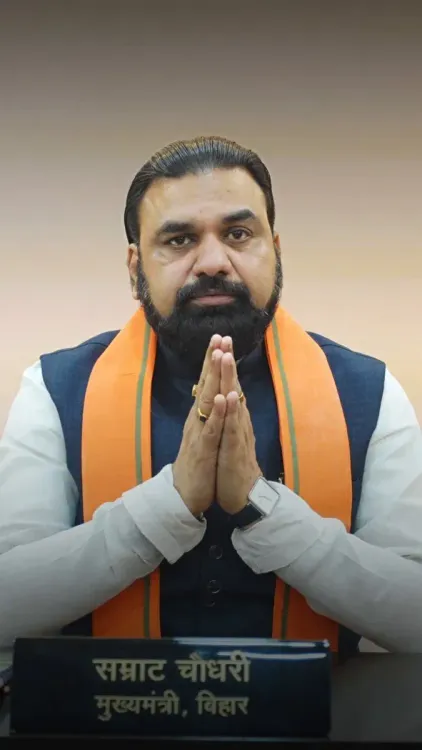
CM Samrat Choudhary extends Chhath Mahaparv greetings to Bihar
Synopsis
Bihar Chief Minister Samrat Choudhary greeted state residents on Chhath Mahaparv on 15 November 2026, invoking the blessings of Surya Dev and Chhathi Maiya and calling on the festival to inspire patience, faith, and new consciousness across Bihar.
Key Takeaways
Bihar Chief Minister Samrat Choudhary posted Chhath Mahaparv greetings on 15 November 2026 .
He invoked both the evening arghya (offered to the setting sun) and the dawn arghya (welcoming the rising sun).
Chhath Mahaparv is a four-day festival dedicated to Surya Dev and Chhathi Maiya , central to Bihari cultural identity.
CM Choudhary, a senior BJP leader, assumed office as Bihar Chief Minister in 2024 .
Bihar chief ministers have a long tradition of issuing public Chhath greetings, reflecting the festival's deep social and cultural roots in the state.
As the first rays of the sun touched Bihar's riverbanks and devotees gathered in millions for the most sacred arghya of the year, Bihar Chief Minister Samrat Choudhary extended heartfelt greetings on Chhath Mahaparv — the four-day festival that holds a place unlike any other in the state's cultural soul.
Posting on Sunday, 15 November 2026, CM Choudhary wrote: 'सूर्य की स्वर्णिम किरणों में आस्था का उजास हो, छठी मईया के आशीर्वाद से हर आंगन में खुशियों का वास हो' — 'May the golden rays of the sun illuminate faith, and may Chhathi Maiya's blessings fill every home with joy.' He invoked both the evening arghya — offered to the setting sun — and the dawn arghya welcoming the rising sun, expressing his hope that the festival would bring patience, faith, and new consciousness to all.
Bihar's biggest festival and what it means
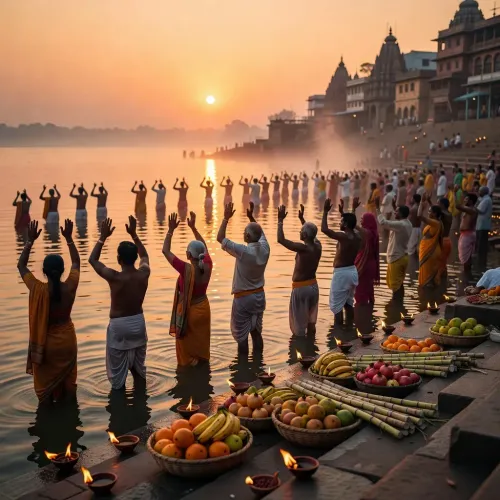
Chhath Mahaparv is a four-day Hindu festival dedicated to Surya Dev (the Sun God) and Chhathi Maiya, observed with extraordinary devotion across Bihar, Jharkhand, eastern Uttar Pradesh, and the Bihar diaspora worldwide. Devotees fast for days, stand waist-deep in rivers and ponds, and offer arghya — ritual water offerings — first to the setting sun and then to the rising sun at dawn. It is among the few major Hindu festivals with no idol worship at its centre; the sun itself is the deity.
In Bihar, Chhath is not merely religious observance — it is a collective identity. The sight of riverbanks packed with saffron-clad devotees, earthen lamps, and bamboo wicker baskets heaped with seasonal fruit is inseparable from what it means to be Bihari.
A Chief Minister's message, a state's reflection
Samrat Choudhary, who assumed office as Bihar Chief Minister in 2024 and leads the state as a senior BJP leader, closed his message with a prayer that 'the grace of Lord Suryadev and Chhathi Maiya remain always upon all residents of the state.' Bihar chief ministers have long used Chhath greetings as a moment of direct, unmediated connection with the state's population — a tradition that cuts across political lines precisely because Chhath itself does.
The festival's reach has also grown far beyond Bihar's borders. Chhath ghats now dot cities from Delhi to Mumbai, and the festival is observed wherever Bihari communities have settled — a living measure of one of India's largest internal migration stories.
When millions stand together facing the same horizon at the same hour, the sun rising over Bihar's rivers belongs to everyone. That, more than any policy or proclamation, is what this morning's message was anchored to.
Point of View
Leading a state where Chhath commands deeper mass participation than perhaps any other festival, this message is a reaffirmation of cultural alignment with his core constituency. The BJP's consolidation in Bihar has long drawn on its ability to position itself as the custodian of Bihar's distinct cultural pride, and Chhath — with its non-Brahminical, sun-facing, riverbank spirituality — sits at the heart of that identity. A Chief Minister who speaks the language of Chhathi Maiya is speaking directly to a Bihar that sees itself in this festival above all others.
NationPress
15 Nov 2026
Frequently Asked Questions
What is Chhath Mahaparv and why is it important in Bihar?
Chhath Mahaparv is a four-day Hindu festival dedicated to Surya Dev (the Sun God) and Chhathi Maiya. It is considered Bihar's most important festival, marked by riverbank rituals, rigorous fasting, and arghya — water offerings — to both the setting and rising sun.
What did Bihar CM Samrat Choudhary say for Chhath 2026?
CM Samrat Choudhary extended greetings on 15 November 2026, praying that Chhathi Maiya's blessings fill every home with joy and that Surya Dev's grace remain on all residents of Bihar. He expressed hope that the festival would bring patience, faith, and new consciousness.
Who is Samrat Choudhary and when did he become Bihar Chief Minister?
Samrat Choudhary is a senior BJP leader who became Bihar Chief Minister in 2024.
What is arghya in the context of Chhath Puja?
Arghya is a ritual water offering made by devotees standing in rivers or ponds — first to the setting sun on the evening of Chhath's main day, and again to the rising sun at dawn the following morning. It is the spiritual centrepiece of the festival.
Is Chhath Puja celebrated only in Bihar?
While Chhath originated in Bihar and remains most deeply observed there, it is now celebrated widely across Jharkhand, eastern Uttar Pradesh, Delhi, Mumbai, and wherever large Bihari diaspora communities have settled across India and abroad.