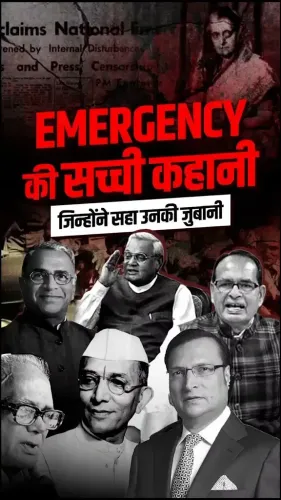
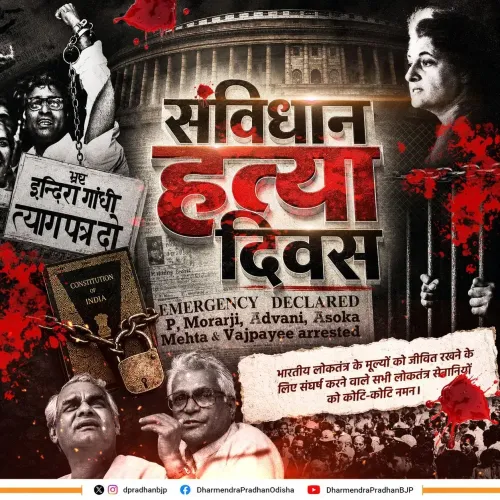
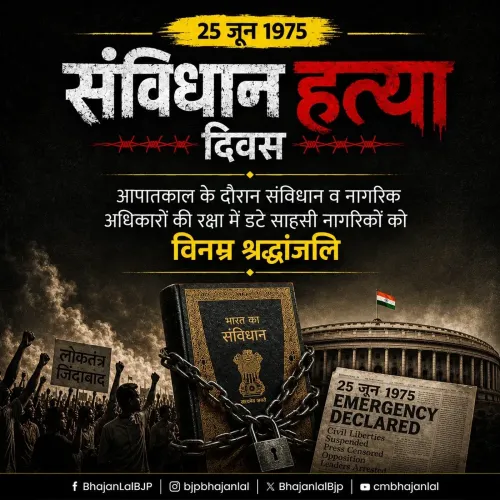
CM Samrat Choudhary marks Emergency anniversary as 'Samvidhan Hatya Diwas'
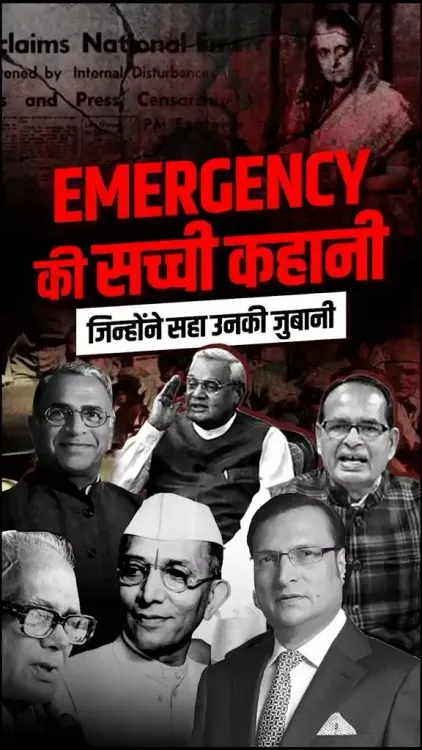
Synopsis
Bihar Chief Minister Samrat Choudhary marked the 51st anniversary of the 1975 Emergency on 25 June 2026, condemning it as 'Samvidhan Hatya Diwas' — Constitution Murder Day — and accusing Congress and Indira Gandhi of crushing fundamental rights and democratic institutions during the 21-month period.
Key Takeaways
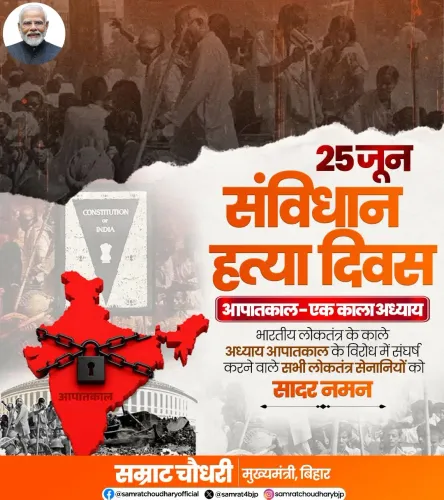
Bihar CM Samrat Choudhary posted on X on 25 June 2026 marking the Emergency anniversary as Samvidhan Hatya Diwas .
He called 25 June 1975 'the black day in Indian democratic history' when a single signature crushed constitutional rights.
He stated that during the 21-month Emergency , voices of lakhs of people were suppressed and dissent was criminalised.
He directly blamed Congress and Indira Gandhi for what he described as a 'dictatorial mindset' that shackled democracy.
The BJP has observed 25 June as Samvidhan Hatya Diwas annually, using it to contrast its record with Congress's historical actions.
The 1975 Emergency was declared under Article 352 and lasted until 1977 , suspending fundamental rights across India.
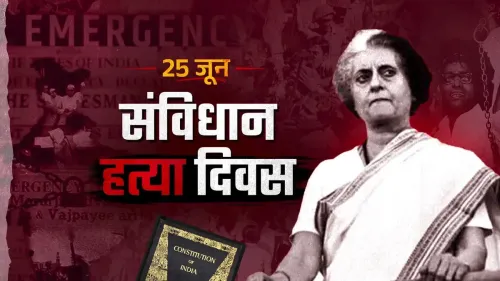
Bihar Chief Minister Samrat Choudhary on Thursday, 25 June 2026, marked the 51st anniversary of the declaration of the 1975 Emergency by condemning it as the darkest day in Indian democratic history, calling it an act of constitutional murder and invoking the hashtag #SamvidhanHatyaDiwas ('Constitution Murder Day') on X.
Context
In his post, Choudhary wrote that 25 June 1975 was 'the black day in the history of Indian democracy, when a single signature crushed the soul of the Constitution, the fundamental rights of citizens, and freedom of expression.' He added that during the 21 months of Emergency, 'the voices of lakhs of people were suppressed, democratic institutions were weakened, and dissent was made a crime.' He directly named Congress and Indira Gandhi, describing their 'dictatorial mindset' as having 'shackled democracy in chains.'
The post also carried a video and the twin hashtags #संविधान_हत्या_दिवस and #SamvidhanHatyaDiwas, framing the day as an ongoing civic reminder rather than a purely partisan occasion.
Policy Backdrop
The National Emergency was declared on 25 June 1975 by then-Prime Minister Indira Gandhi under Article 352 of the Constitution on grounds of 'internal disturbance.' It lasted 21 months, during which fundamental rights were suspended, press censorship was imposed, and thousands of political opponents were detained without trial.
The Bharatiya Janata Party has institutionalised the annual observance of 25 June as Samvidhan Hatya Diwas across its governments and party units. The commemoration serves as a recurring platform to contrast the BJP's stated commitment to democratic institutions with what it characterises as the Indian National Congress's historical record on civil liberties.
Stakeholders and Impact
For Bihar, a state that witnessed significant political upheaval during the Emergency — including the mass mobilisation led by Jayaprakash Narayan from Patna — the anniversary carries particular historical resonance. Civil society groups and opposition parties in the state have historically offered competing narratives about the period.
Congress has consistently pushed back against the BJP's framing, arguing that the Emergency was a constitutionally invoked provision and that subsequent democratic elections validated India's institutional resilience. The party's response to this year's commemorations is expected to follow a similar line.
What's Next
Statements such as Choudhary's are likely to feed into Bihar assembly proceedings and broader national political messaging in the months ahead, particularly as the BJP continues to use the Emergency's legacy as a campaign touchstone. Reactions from Congress leadership at the state and national level will be closely watched. The annual observance also signals the party's intent to keep constitutional accountability at the centre of its political identity heading into future electoral cycles.
Point of View
A state whose political identity is deeply intertwined with the Jayaprakash Narayan-led resistance to the Emergency, the messaging carries added historical weight beyond mere party signalling. The invocation of 'Samvidhan Hatya Diwas' as a civic duty rather than a partisan act is a deliberate rhetorical move to broaden the appeal beyond the BJP's core base. Taken together, such statements form part of a long-cycle narrative strategy that positions constitutional morality as the BJP's electoral differentiator heading into future contests.
NationPress
25 Jun 2026
Frequently Asked Questions
What is Samvidhan Hatya Diwas?
'Samvidhan Hatya Diwas' means 'Constitution Murder Day' and is observed on 25 June each year by the BJP to mark the anniversary of the declaration of the 1975 Emergency by then-Prime Minister Indira Gandhi , which suspended fundamental rights for 21 months .
What did Bihar CM Samrat Choudhary say about the 1975 Emergency?
Samrat Choudhary called 25 June 1975 the 'black day in Indian democratic history,' stating that a single signature crushed the Constitution's soul, citizens' fundamental rights, and freedom of expression, and that Congress and Indira Gandhi 's 'dictatorial mindset' shackled democracy.
When was the 1975 Emergency declared and how long did it last?
The National Emergency was declared on 25 June 1975 under Article 352 of the Constitution by Prime Minister Indira Gandhi on grounds of internal disturbance. It lasted 21 months , ending in 1977 .
Why does the BJP observe 25 June every year?
The BJP observes 25 June annually as Samvidhan Hatya Diwas to commemorate the suspension of democratic rights during the 1975 Emergency and to contrast its own governance record with what it characterises as the Congress 's historically anti-democratic actions.
What was the significance of the 1975 Emergency for Bihar?
Bihar was a major centre of resistance to the 1975 Emergency , with veteran socialist leader Jayaprakash Narayan launching a mass people's movement from Patna that became one of the most powerful challenges to Indira Gandhi 's government during that period.