Govt Restores Commercial LPG Supply After West Asia Crisis
Synopsis
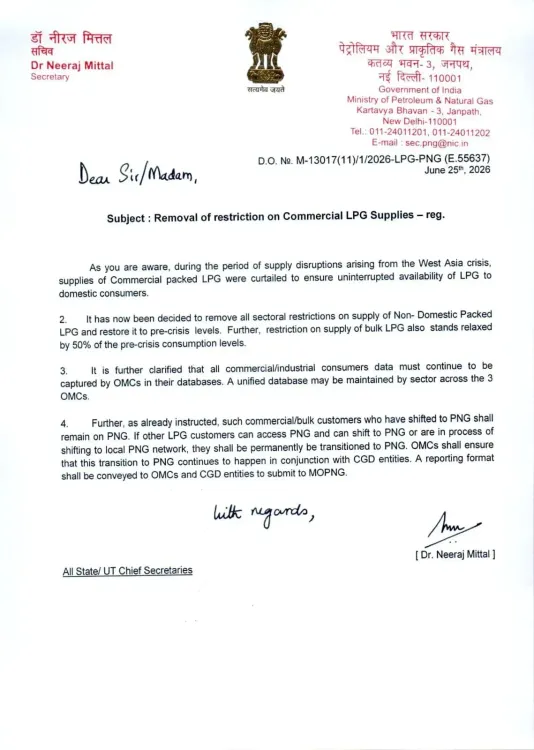
The Government of India has lifted restrictions on Non-Domestic Commercial Packed LPG and restored supplies to pre-crisis levels following a review of measures introduced during the West Asia crisis. Bulk LPG restoration is capped at 50 per cent for now, while PNG-connected consumers are advised to stay on pipeline gas as a long-term solution.
Key Takeaways
The Government of India has withdrawn all restrictions on Non-Domestic (Commercial) Packed LPG imposed during the West Asia crisis.
Commercial LPG supplies have been fully restored to pre-crisis levels .
Bulk LPG supplies will be restored only up to 50 per cent of pre-crisis consumption, with full restoration subject to further review.
Consumers with PNG (Piped Natural Gas) connectivity have been advised to continue shifting to PNG as a long-term energy solution.
The announcement follows a pattern established during the 2022 Russia-Ukraine energy shock, when India applied similar temporary commercial LPG curbs.
State-owned oil marketing companies, including IOCL , will operationalise the revised allocation framework at the distribution level.
The Chief Minister's Office of Assam on Thursday, June 25, 2026 shared a central government announcement stating that the Government of India has decided to restore commercial LPG supplies to pre-crisis levels, withdrawing temporary restrictions imposed in response to disruptions linked to the West Asia crisis.
Context
According to the announcement, restrictions on Non-Domestic (Commercial) Packed LPG have been fully withdrawn, and commercial LPG supplies have been restored to pre-crisis levels. Bulk LPG supplies may be restored up to 50 per cent of pre-crisis consumption levels, indicating a phased approach to full normalisation.
The announcement also carries a forward-looking advisory: consumers with access to Piped Natural Gas (PNG) connectivity are advised to continue their shift to PNG as a long-term solution, signalling that the government views pipeline gas as a structural alternative to cylinder dependence.
Policy Backdrop
India's LPG supply chain is heavily import-dependent, making it vulnerable to geopolitical shocks in West Asia, a primary source region. The Ministry of Petroleum and Natural Gas has historically intervened to prioritise domestic household supplies during periods of import constraint, temporarily curbing commercial and industrial allocations to protect retail consumers.
A similar pattern of temporary commercial LPG curbs was seen during the 2022 global energy price spike triggered by the Russia-Ukraine conflict. The current restoration follows that established template of crisis-period restriction followed by a structured rollback once supply pressures ease.
The City Gas Distribution programme, driven by bidding rounds from 2008 onward under the Petroleum and Natural Gas Regulatory Board, has steadily expanded PNG networks in urban India. The government's advice to PNG-connected consumers to stay on pipeline gas reflects this longer-term substitution strategy, aimed at reducing logistics costs and cylinder-supply bottlenecks in cities.
Stakeholders and Impact
The restoration of commercial LPG supplies will provide immediate relief to hotels, restaurants, commercial kitchens, and industrial users who were operating under constrained allocations. These establishments depend on commercial-grade packed LPG cylinders for cooking and process-heat requirements, and any supply shortfall directly affects operations and costs.
The 50 per cent cap on bulk LPG restoration means large industrial consumers will see only partial relief for now, with full normalisation contingent on further supply reviews by the Ministry of Petroleum and Natural Gas. State-owned oil marketing companies such as Indian Oil Corporation Ltd (IOCL) will be responsible for operationalising the revised allocation framework at the distribution level.
What's Next
The next key milestone will be the Ministry of Petroleum and Natural Gas's periodic review of bulk LPG quotas, which will determine whether the 50 per cent restoration ceiling is raised toward full pre-crisis levels. State-level updates on PNG network rollout — including in Assam — will also be closely watched, as the government's advisory to shift to PNG implies an expectation of expanding pipeline coverage.
The episode underscores India's recurring challenge of balancing short-term crisis management in energy supply with its structural goal of transitioning commercial and domestic consumers away from imported LPG and toward indigenous pipeline gas infrastructure.
Point of View
Capped at 50 per cent for bulk — reflects a calibrated approach that prioritises supply normalisation without fully abandoning crisis-era caution. The simultaneous advisory to PNG-connected consumers is not incidental: it signals the government's intent to use this disruption as a nudge toward structural pipeline dependency, reducing India's exposure to future import shocks. This episode fits a well-established pattern where West Asia or global energy crises become inflection points for accelerating domestic gas infrastructure policy. The key political test will be whether the bulk LPG cap is lifted swiftly enough to satisfy industrial lobbies, or whether it hardens into a de facto ceiling.
NationPress
23 Sept 2026
Frequently Asked Questions
Has the government restored commercial LPG supply in India?
Yes. The Government of India has fully restored commercial LPG supplies to pre-crisis levels and withdrawn restrictions on Non-Domestic (Commercial) Packed LPG that were introduced during the West Asia crisis.
What is the 50 per cent bulk LPG restoration limit?
Bulk LPG supplies — used by large industrial consumers — will be restored only up to 50 per cent of pre-crisis consumption levels for now, with full restoration subject to a future review by the Ministry of Petroleum and Natural Gas.
Why were commercial LPG supplies restricted in India?
Temporary restrictions were imposed in response to the West Asia crisis, which disrupted global energy supply chains and prompted the government to prioritise domestic household LPG supplies over commercial and industrial allocations.
What is PNG and why is the government advising a shift to it?
Piped Natural Gas (PNG) is natural gas supplied directly through pipelines to homes and businesses. The government views it as a long-term alternative to cylinder LPG because it reduces import dependence, lowers logistics costs, and provides a more stable supply.
Which companies will implement the restored LPG supply?
State-owned oil marketing companies, including Indian Oil Corporation Ltd (IOCL), are responsible for operationalising the revised commercial LPG allocation framework at the distribution level across India.