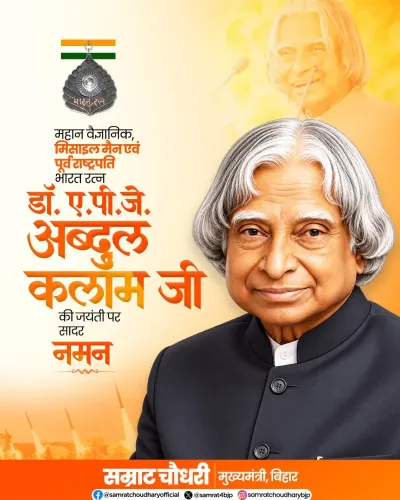
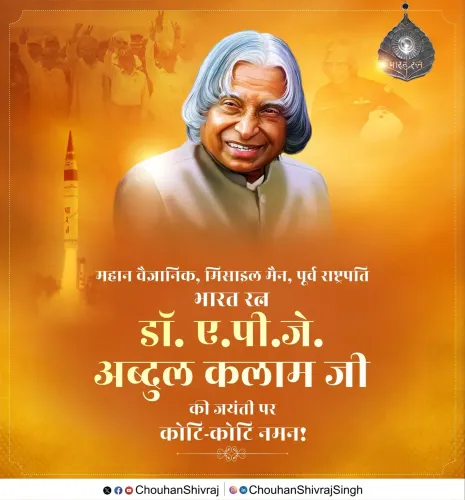
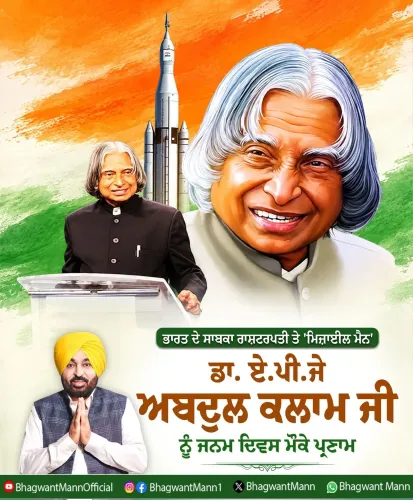
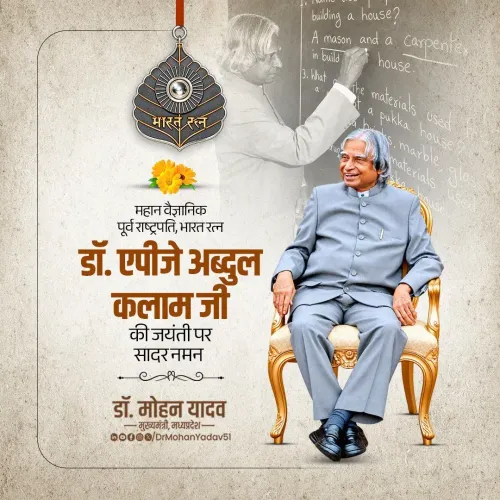
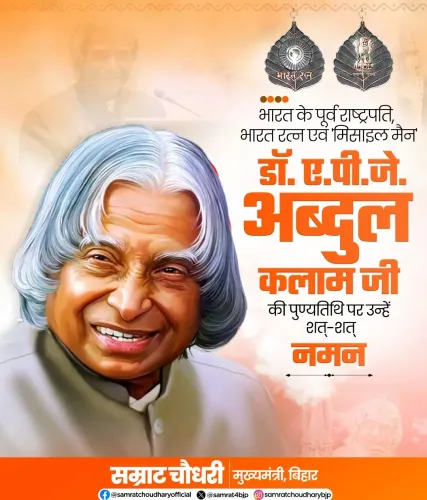
CM Samrat Choudhary pays tribute to Dr. Kalam on birth anniversary
Synopsis
Bihar Chief Minister Samrat Choudhary paid tribute to Dr. APJ Abdul Kalam on his birth anniversary, crediting the Bharat Ratna scientist-president with shaping India's strategic strength and inspiring crores of youth toward the Viksit Bharat dream.
Key Takeaways
Bihar CM Samrat Choudhary posted a tribute to Dr.
APJ Abdul Kalam on his birth anniversary, 15 October 2026 .
Kalam, born 15 October 1931 , led India's Agni and Prithvi missile programmes and served as President of India from 2002 to 2007 .
He was awarded the Bharat Ratna in 1997 and co-authored the 'India 2020' vision document in 1998 .
Choudhary explicitly linked Kalam's philosophy to the Viksit Bharat@2047 national development ambition.
BJP leaders have consistently commemorated Kalam on his birth anniversary since 2014 , weaving his legacy into the party's nation-building narrative.
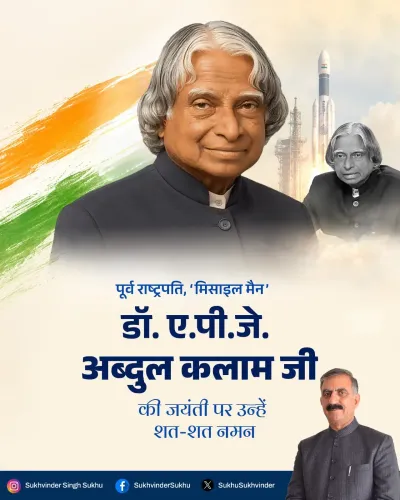
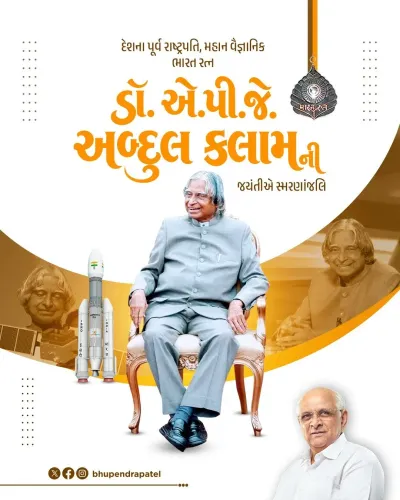
Some dreams, Bihar Chief Minister Samrat Choudhary wrote on 15 October 2026, do not merely fill the night — they carry the power to change the destiny of a nation. On the birth anniversary of Dr. APJ Abdul Kalam, India's beloved 'Missile Man' and former President, Choudhary turned to X to honour a life that reshaped India's scientific and strategic imagination.
Posting in Hindi, the Chief Minister wrote: 'कुछ सपने केवल देखे नहीं जाते, वे एक राष्ट्र की तकदीर बदलने का सामर्थ्य रखते हैं' — 'Some dreams are not merely dreamed; they carry the power to change the destiny of a nation.' He credited Kalam's scientific genius with giving India's strategic strength a new direction, and his philosophy with igniting 'self-confidence, innovation, and a resolve for nation-building in crores of young people.'
From Rameswaram to Rashtrapati Bhavan — the arc of Kalam's legacy
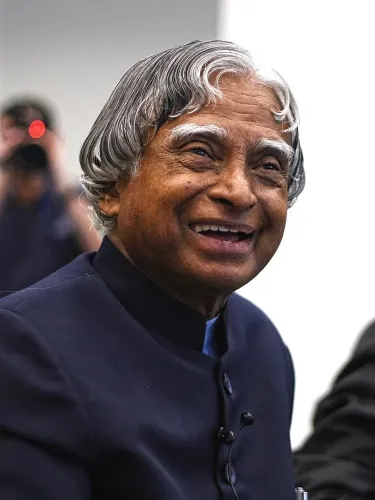
Dr. Avul Pakir Jainulabdeen Abdul Kalam, born 15 October 1931 in Rameswaram, Tamil Nadu, rose from a modest newspaper-vending childhood to lead India's most consequential defence-technology programmes. As chief architect of the Agni and Prithvi ballistic missile series, he transformed the Defence Research and Development Organisation (DRDO) into a credible indigenous force. India's 1998 Pokhran-II nuclear tests — which announced India's arrival as a declared nuclear power — carried his scientific fingerprints.
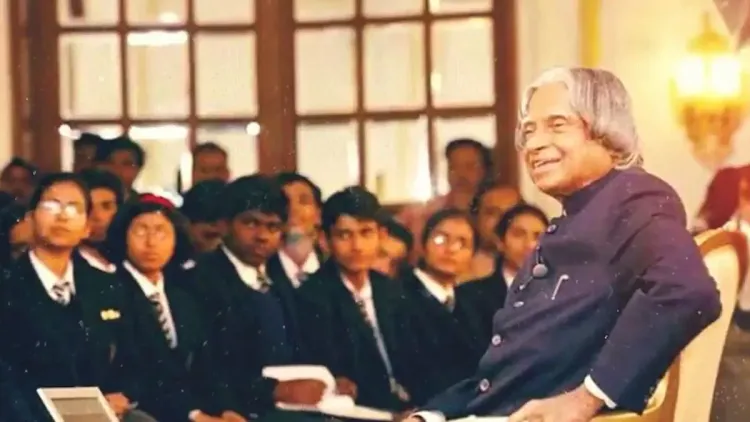
He served as President of India from 2002 to 2007, widely remembered as the 'People's President' for his unmatched accessibility to students and youth. The Bharat Ratna, India's highest civilian honour, was conferred on him in 1997. His 'India 2020' vision document, co-authored in 1998, laid out technology-driven targets for national development — a blueprint that continues to echo in contemporary policy language.
Kalam, Viksit Bharat, and the BJP's youth narrative
Choudhary's tribute lands precisely within a well-established political grammar. Since 2014, BJP leaders have consistently invoked Kalam's legacy on 15 October to stitch together his scientific nationalism with the ruling party's own Viksit Bharat@2047 vision — the ambition to make India a fully developed nation by its centenary of independence.
The Chief Minister made the link explicit, writing that 'the youth power inspired by his ideas is the greatest force to realise the dream of a Viksit Bharat.' It is a framing that positions Kalam not merely as a historical figure but as a living intellectual sponsor of contemporary development ambitions — a recurring motif in BJP-governed states and at the Centre alike.
For Bihar — a state Choudhary leads and that is itself mid-journey in a long development arc — the invocation carries particular resonance. Kalam's central argument, that aspiration matched with relentless effort defeats circumstance, maps directly onto a political message of transformation that Choudhary's administration is eager to project.
As the nation observes Kalam's birth anniversary, the question his legacy keeps posing is urgent as ever: has the India he dreamed of caught up with the dreams he left behind?
Point of View
Broadly beloved anchor for the Viksit Bharat@2047 narrative, allowing leaders to simultaneously honour a non-partisan icon and reinforce the government's development agenda. The choice to emphasise youth self-confidence and innovation — rather than, say, Kalam's interfaith identity — is deliberate; it keeps the tribute aspirational and forward-looking rather than retrospective. For a Bihar Chief Minister navigating a state with a young median population and persistent development deficits, invoking Kalam doubles as both inspiration and political signalling about ambition. The broader pattern suggests these anniversaries are increasingly structured political moments, not spontaneous homages.
NationPress
15 Oct 2026
Frequently Asked Questions
Why is 15 October celebrated in India?
15 October is observed as World Students' Day in India to mark the birth anniversary of Dr. APJ Abdul Kalam , born on this date in 1931 in Rameswaram, Tamil Nadu. The day honours his lifelong dedication to inspiring students and youth across the country.
What is Dr. APJ Abdul Kalam famous for?
Dr. Kalam is best known as the 'Missile Man of India' for leading the development of the Agni and Prithvi ballistic missiles. He also served as President of India from 2002 to 2007 and was awarded the Bharat Ratna in 1997.
What is the Viksit Bharat vision that BJP leaders connect to Kalam?
Viksit Bharat@2047 is the Indian government's ambition to transform India into a fully developed nation by 2047 , the centenary of independence. BJP leaders draw a direct line from Kalam's 'India 2020' technology-development vision to this contemporary goal.
Who is Samrat Choudhary?
Samrat Choudhary is the Chief Minister of Bihar and a senior leader of the Bharatiya Janata Party (BJP) .
What was Dr. Kalam's 'India 2020' vision?
Co-authored in 1998 , the 'India 2020' document was a technology-driven roadmap outlining targets for national development — spanning agriculture, education, infrastructure, and strategic capability — that Kalam envisioned India achieving by the year 2020.