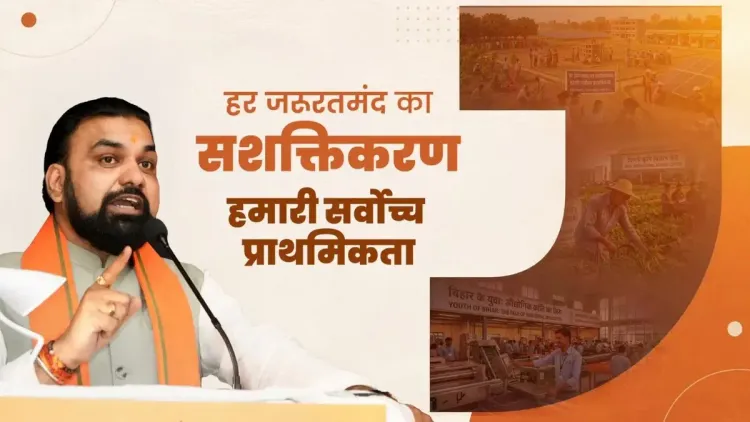
CM Samrat Choudhary reaffirms Bihar govt's push for inclusive social justice
Synopsis
Bihar Chief Minister Samrat Choudhary on 7 August 2026 reaffirmed his government's commitment to inclusive social justice for Dalits, OBCs, Extremely Backward Classes and EWS, anchoring the pledge in PM Modi's 'Sabka Saath, Sabka Vikas' vision.
Key Takeaways
Bihar CM Samrat Choudhary posted on 7 August 2026 reaffirming inclusive welfare for all marginalised groups.
He named Dalits, OBCs, Extremely Backward Classes , and EWS general category as equal beneficiaries of his government's commitment.
The post explicitly invokes PM Narendra Modi's 'Sabka Saath, Sabka Vikas' slogan, first introduced during the 2014 Lok Sabha campaign .
The inclusion of EWS echoes the 103rd Constitutional Amendment (2019) , which granted 10% reservation to economically weaker sections.
The statement positions the Bihar government as the ground-level delivery arm of the BJP's cross-caste inclusive development narrative.
Every section of society — Dalit, backward, extremely backward, or economically weak — deserves a fair shot at progress. That is the core argument Bihar Chief Minister Samrat Choudhary made on Friday, 7 August 2026, in a pointed post on X that framed his government's welfare agenda squarely within Prime Minister Narendra Modi's 'Sabka Saath, Sabka Vikas' philosophy.
What Choudhary said — and what it means
Writing in Hindi, the Chief Minister declared: 'Saamaajik nyaay ka arth hai, samaaj ke har varg ke zarooratmand vyakti ko aage badhne ka avsar mile' — 'Social justice means every needy person from every section of society must get the opportunity to move ahead.' He explicitly named Dalits, Other Backward Classes (OBCs), Extremely Backward Classes (EBCs), and the Economically Weaker Section (EWS) of the general category as communities his government is committed to carrying forward with rights, dignity, and opportunity.
The deliberate inclusion of EWS alongside traditional reservation beneficiaries is significant. It echoes the logic behind the 103rd Constitutional Amendment of 2019, which introduced a 10 per cent reservation for economically weaker sections in the general category — a move that extended the reservation framework beyond caste to economic disadvantage for the first time.
Bihar's social arithmetic and the BJP's inclusive-development pitch
Bihar's politics has long been defined by caste-based mobilisation, with regional parties building durable coalitions around specific jati identities. The BJP's counter-narrative — anchored in 'Sabka Saath, Sabka Vikas', a slogan Modi introduced during the 2014 Lok Sabha campaign — argues that welfare must cross caste lines and reach the economically vulnerable regardless of category. Choudhary's post is a textbook articulation of that argument, pitched directly at Bihar's complex social landscape.
The practical expression of this philosophy runs through centrally sponsored schemes covering scholarships, housing, and credit access that are designed to serve multiple beneficiary categories simultaneously — Dalit, OBC, EBC, and EWS — rather than ring-fencing benefits for a single group.
The political stakes in taking 'Sabka Vikas' to the ground
Choudhary's framing — 'dharaatal par utaarne ka maarg', 'the path to bringing the resolve down to the ground' — is a signal that the Bihar government intends to position itself as the delivery arm of Modi's inclusive vision at the state level. In a state where welfare credibility is an electoral currency, the ability to show that schemes actually reach EBCs and EWS households, not just headline beneficiaries, will be the real test of that commitment.
Watch for state-level policy announcements on reservations, development packages, or scheme expansions targeting these four categories in the months ahead — that is where the rhetoric meets the register.
Point of View
Sabka Vikas' brand at a moment when regional caste-coalition parties remain formidable opponents in the state. By explicitly bundling EWS with Dalit and OBC beneficiaries, he signals that the BJP's social justice frame is deliberately cross-cutting, not caste-exclusive. The real test will be whether state-level scheme delivery data backs the rhetoric — in Bihar, welfare credibility is earned ward by ward, not in X posts. If the government follows this statement with concrete EBC and EWS outreach, it could meaningfully dent the caste-arithmetic advantage of rival regional parties.
NationPress
7 Aug 2026
Frequently Asked Questions
What did Bihar CM Samrat Choudhary say about social justice?
On 7 August 2026, Choudhary stated that social justice means every needy person from every section of society — Dalit, OBC, Extremely Backward Class, or EWS general category — must get the opportunity to progress, and pledged his government's commitment to rights, dignity, and opportunity for all.
What is 'Sabka Saath, Sabka Vikas' and who introduced it?
'Sabka Saath, Sabka Vikas' — meaning 'Together with all, development for all' — is a governance slogan introduced by Prime Minister Narendra Modi during the 2014 Lok Sabha election campaign as the BJP's core inclusive development philosophy.
What is the EWS reservation and how does it relate to Choudhary's statement?
The Economically Weaker Section (EWS) reservation — a 10 per cent quota for economically disadvantaged individuals in the general category — was introduced by the 103rd Constitutional Amendment in 2019. Choudhary's explicit mention of EWS alongside Dalit and OBC communities reflects the BJP's broader framing of social justice as extending beyond caste to economic vulnerability.
Who are the Extremely Backward Classes (EBCs) in Bihar?
Extremely Backward Classes are a sub-category within the broader OBC framework in Bihar, comprising communities considered more socially and economically disadvantaged than mainstream OBCs. They are a significant political constituency in the state.
Why is inclusive welfare messaging politically important in Bihar?
Bihar has historically been shaped by caste-based political mobilisation, with regional parties building coalitions around specific caste groups. The BJP's cross-caste inclusive development narrative — covering Dalits, OBCs, EBCs, and EWS simultaneously — is its primary counter-strategy to challenge those entrenched caste coalitions.