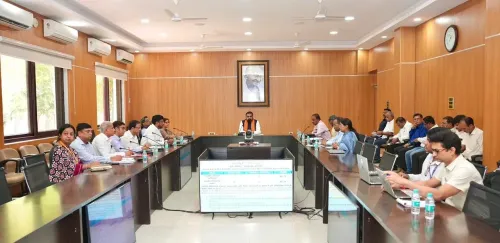
CM Samrat Choudhary inspects new STEM labs at Saran school

Synopsis
Bihar CM Samrat Choudhary visited Swargiya Dalan Singh Higher Secondary School in Manjhi, Saran, on 13 November 2026, paying tribute to the late Dalan Singh and inspecting four new labs — Chemistry, Biology, ISM, and Astronomy-cum-Robotics — built under the Kayakalp Abhiyan school upgrade campaign.
Key Takeaways
Bihar CM Samrat Choudhary visited Swargiya Dalan Singh Higher Secondary School in Manjhi, Saran district on 13 November 2026 .
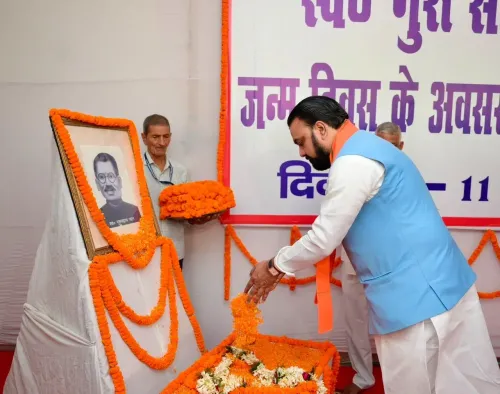
He offered floral tribute at the statue of the late Dalan Singh , after whom the school is named.
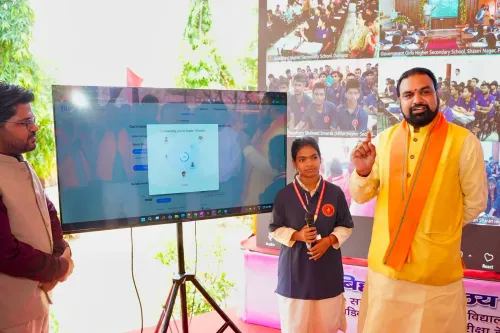
He inspected four new laboratories — Chemistry, Biology, ISM, and Astronomy-cum-Robotics — developed under the Kayakalp Abhiyan .
The Kayakalp Abhiyan is a Bihar government campaign focused on upgrading school infrastructure, particularly STEM facilities.
The Astronomy-cum-Robotics lab at a block-level school marks a rare expansion of advanced STEM access to rural Bihar.
A garland placed on a stone memorial, then a walk through rooms where students now conduct chemistry experiments and program robots — Bihar Chief Minister Samrat Choudhary turned a district school visit into a statement about what state-funded modernisation looks like on the ground. On Thursday, 13 November 2026, he travelled to Manjhi in Saran district to pay tribute at the Swargiya Dalan Singh Higher Secondary School and inspect its newly developed laboratories.
Choudhary first garlanded the statue of Swargiya Dalan Singh — the late individual in whose memory the school stands — offering his respects before moving on to the facility review. He wrote on X: 'स्व० दलन सिंह जी की प्रतिमा पर माल्यार्पण कर श्रद्धांजलि अर्पित की' ('I offered floral tribute at the statue of the late Dalan Singh ji'), framing the visit as both a moment of remembrance and a ground-level inspection.
Four new labs under the Kayakalp Abhiyan
The centrepiece of the visit was the inspection of four laboratories developed under the state government's Kayakalp Abhiyan — a school infrastructure upgrade campaign. The new facilities include a Chemistry lab, a Biology lab, an ISM (Indian System of Medicine) lab, and, notably, an Astronomy-cum-Robotics lab. That last combination — stargazing and coding under the same roof at a district school — signals an ambition that goes well beyond the basics.
The Kayakalp Abhiyan has focused on upgrading physical and scientific infrastructure at government schools across Bihar. Chief ministerial visits to district campuses like this one serve a dual purpose: they honour local legacy figures, and they put a spotlight on scheme delivery at the block level, where implementation often determines whether a campaign succeeds or quietly stalls.
Saran district's signal moment
Saran, one of Bihar's more densely populated districts, has historically lagged on educational infrastructure relative to urban centres. A functioning Astronomy-cum-Robotics lab at a block-level school in Manjhi is precisely the kind of concrete deliverable that STEM-access advocates have argued should become the norm, not the exception, in rural Bihar.
The students who now have access to these labs — particularly the robotics and astronomy facility — stand to gain exposure to disciplines that rarely reach government schools in smaller towns. Whether the Kayakalp Abhiyan scales this model across more of Bihar's roughly 75,000-plus government schools is the question that will define the campaign's real legacy.
Point of View
Biology and now robotics labs signals that the current dispensation is positioning school modernisation as a visible pillar of its development record. For a state that ranks near the bottom on learning outcomes, lab infrastructure is necessary but not sufficient — the deeper test is whether trained teachers and sustained budgets follow the ribbon-cutting. If Saran's new labs become a replicable template rather than a showcase anomaly, the Abhiyan could meaningfully shift Bihar's STEM baseline at the block level.
NationPress
12 Nov 2026
Frequently Asked Questions
What is the Kayakalp Abhiyan in Bihar?
The Kayakalp Abhiyan is a Bihar government school infrastructure upgrade campaign that develops modern facilities — including science and robotics labs — at government schools across the state.
What labs were inaugurated at the Saran school?
Four laboratories were inspected at Swargiya Dalan Singh Higher Secondary School in Manjhi: a Chemistry lab, a Biology lab, an ISM lab, and an Astronomy-cum-Robotics lab.
Where is Swargiya Dalan Singh Higher Secondary School located?
The school is located in Manjhi, a block in Saran district, Bihar.
Why did CM Samrat Choudhary visit the school in Saran?
He visited to pay floral tribute at the statue of late Dalan Singh, after whom the school is named, and to inspect the four new laboratories built under the Kayakalp Abhiyan.
Does Bihar have robotics labs in government schools?
Under the Kayakalp Abhiyan, at least one Astronomy-cum-Robotics lab has been developed at Swargiya Dalan Singh Higher Secondary School in Manjhi, Saran — marking an expansion of advanced STEM facilities to block-level government schools in Bihar.