CM Samrat Choudhary Hails 12 Years of Modi's Security Vision
Synopsis
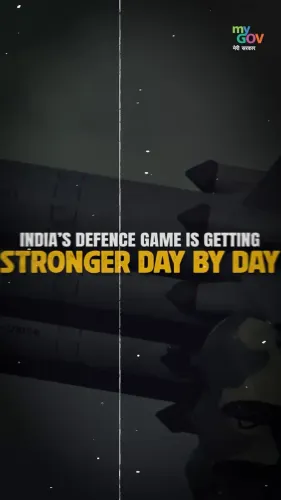
Bihar Chief Minister Samrat Choudhary marked 12 years of PM Modi's security and defence governance on June 17, 2026, highlighting fenced borders, defence modernisation, and the Atmanirbhar Bharat push under the hashtag #12YearsOfSurakshitBharat.
Key Takeaways
Bihar Chief Minister Samrat Choudhary posted on June 17, 2026 marking 12 years of PM Modi's defence and security governance.
The post invokes #12YearsOfSurakshitBharat and cites 'fenced borders' and a 'self-reliant, modernised defence force' as key outcomes.
The Atmanirbhar Bharat defence initiative, launched in 2020 , introduced negative import lists and raised FDI caps to boost domestic production.
Physical border fencing along the India-Pakistan and India-Myanmar frontiers and infrastructure in Ladakh and Arunachal Pradesh are among the cited policy pillars.
The surgical strikes of September 2016 are widely referenced within BJP circles as marking a shift to proactive counter-terror doctrine.
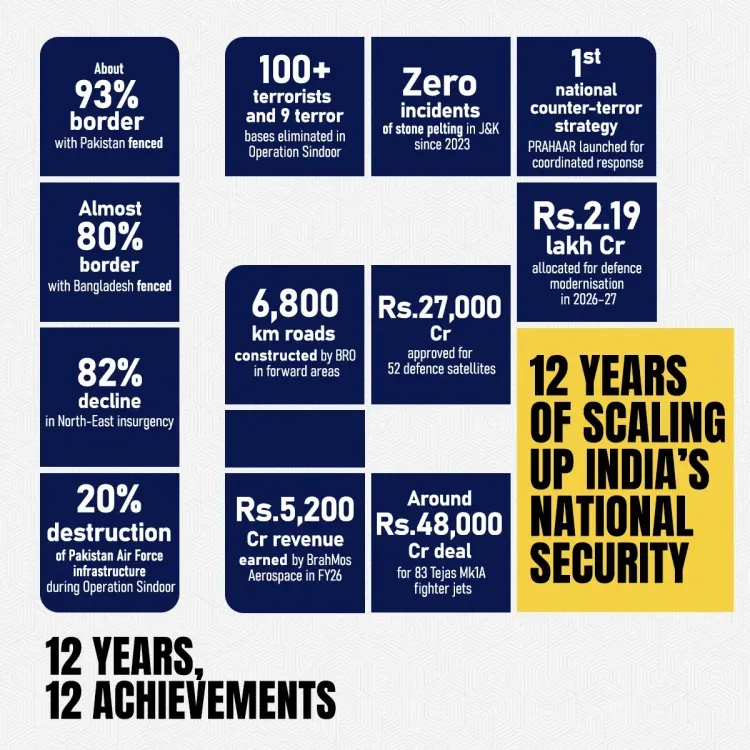
An official enumeration of the referenced 12 achievements had not been released at the time of the post.
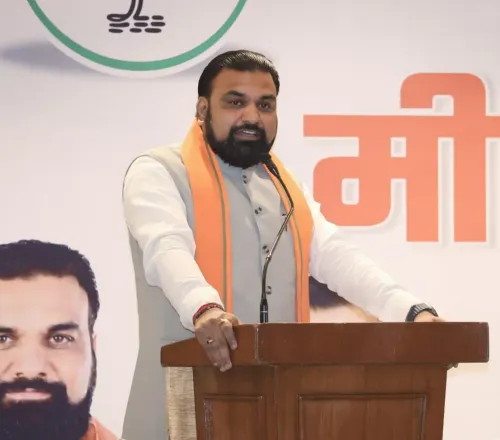
Bihar Chief Minister Samrat Choudhary on Wednesday, June 17, 2026, took to X to mark what he described as 12 years of achievements under Prime Minister Narendra Modi's security and defence doctrine, invoking the hashtag #12YearsOfSurakshitBharat — broadly translating to '12 Years of a Secure India.'
Context
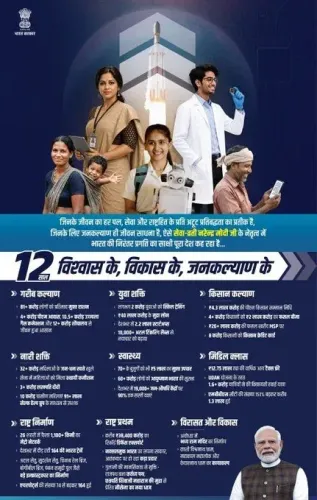
Choudhary's post frames the 12-year period since May 2014 as a transformative era in India's national security posture, citing 'fenced borders' and a 'self-reliant, modernised defence force' as defining markers. The post declares: 'Naya Bharat is not just a slogan; it is the story of a nation that acts decisively, defends fearlessly and rises confidently.' While the post references a set of 12 specific achievements, it does not enumerate them individually.
The statement comes as the BJP and its leaders across states have been marking the party's governance milestones ahead of significant political calendars, with defence and border security consistently positioned as flagship achievements of the Modi government.
Policy Backdrop
The reference to 'fenced borders' points to a sustained programme of physical border infrastructure along the India-Pakistan and India-Myanmar frontiers, complemented by accelerated road and tunnel construction in Ladakh and Arunachal Pradesh. These projects have been central to the government's argument that it has hardened India's territorial perimeter in ways previous administrations did not.
The 'self-reliant' framing echoes the Atmanirbhar Bharat initiative in defence production, launched in 2020, which introduced negative import lists to push domestic manufacturing and raised foreign direct investment caps in the sector. The share of domestic procurement in the defence capital budget has risen progressively since then. The surgical strikes of September 2016 across the Line of Control are also widely cited within BJP circles as evidence of a shift from reactive to proactive counter-terror doctrine.
The Indian Armed Forces have simultaneously undergone structural reforms, including the creation of theatre commands and the induction of indigenously developed platforms, as part of a broader modernisation drive that the government has championed as reducing strategic dependence on foreign suppliers.
Stakeholders and Impact
The constituencies most directly affected by the policies Choudhary references are border districts across Jammu and Kashmir, Ladakh, Arunachal Pradesh, and the Northeast, where infrastructure investment has had tangible civilian as well as military consequences. Residents of these regions have seen improved road connectivity and, in several cases, economic activity linked to defence-related construction.
For the Indian defence industry — both public sector undertakings and a growing private sector base — the Atmanirbhar push has opened procurement pipelines that were previously dominated by foreign original equipment manufacturers. Veterans' groups and serving personnel have also been stakeholders in debates over the pace and direction of modernisation.
What's Next
Political observers will watch for whether the BJP releases an official compilation detailing the 12 achievements alluded to in the hashtag campaign, particularly as the party builds its communications strategy ahead of Independence Day 2026. The next Union Budget cycle is also expected to carry fresh announcements on defence indigenisation targets, which will test whether the policy trajectory Choudhary celebrates continues at the same pace. As a senior BJP leader and Bihar Chief Minister, Choudhary's amplification of the national security narrative also signals that the party intends to make defence credibility a mobilising theme in state-level political discourse, not just at the Centre.
Point of View
Designed to tie Bihar's political identity to the Centre's security credentials ahead of what is shaping up as a defence-heavy BJP communications cycle in 2026. The invocation of 'Naya Bharat' alongside border fencing and Atmanirbhar defence production is consistent with a broader BJP strategy of converting policy outcomes into electoral idiom. Notably, the post avoids specifics — no project names, no statistics — which gives it rhetorical flexibility but also insulates it from factual scrutiny. The hashtag campaign suggests a coordinated party-wide effort, with state leaders playing relay roles in a message that originates at the national level.
NationPress
18 Sept 2026
Frequently Asked Questions
What is #12YearsOfSurakshitBharat?
#12YearsOfSurakshitBharat is a BJP hashtag campaign marking 12 years of the Modi government's defence and security governance since May 2014, highlighting achievements such as border fencing, defence modernisation, and the Atmanirbhar Bharat initiative.
What did Bihar CM Samrat Choudhary say about Modi's defence record?
Bihar Chief Minister Samrat Choudhary said that India has built a security doctrine shaped by PM Modi's vision, citing fenced borders and a self-reliant, modernised defence force, and called 'Naya Bharat' the story of a nation that 'acts decisively, defends fearlessly and rises confidently.'
What is the Atmanirbhar Bharat defence initiative?
Launched in 2020, the Atmanirbhar Bharat defence initiative introduced negative import lists to restrict foreign procurement and raised FDI caps in the sector to promote domestic manufacturing by Indian public and private defence companies.
What are the surgical strikes referenced in BJP's defence narrative?
The surgical strikes of September 2016 were cross-border operations conducted by the Indian Army across the Line of Control in response to a militant attack, widely cited by the BJP as evidence of a shift from a reactive to a proactive counter-terror posture.
What border infrastructure has India built since 2014?
Since 2014, India has advanced physical border fencing along the India-Pakistan and India-Myanmar frontiers and accelerated road and tunnel construction in Ladakh and Arunachal Pradesh to improve both military mobility and civilian connectivity in border regions.