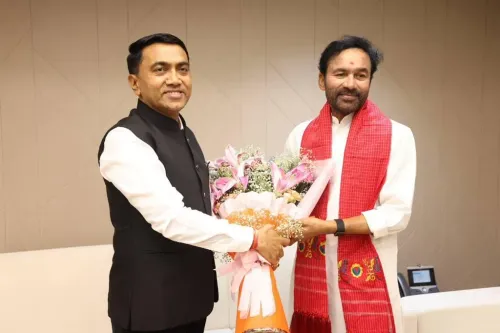
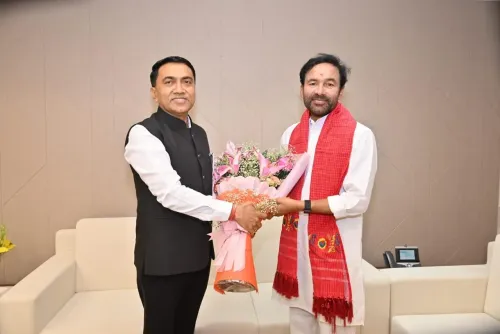
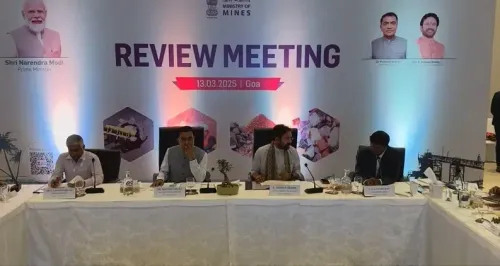
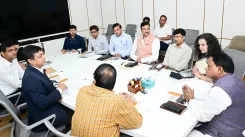
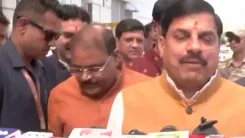
CM Sawant at Mining Ministers' Conference, Goa
Synopsis
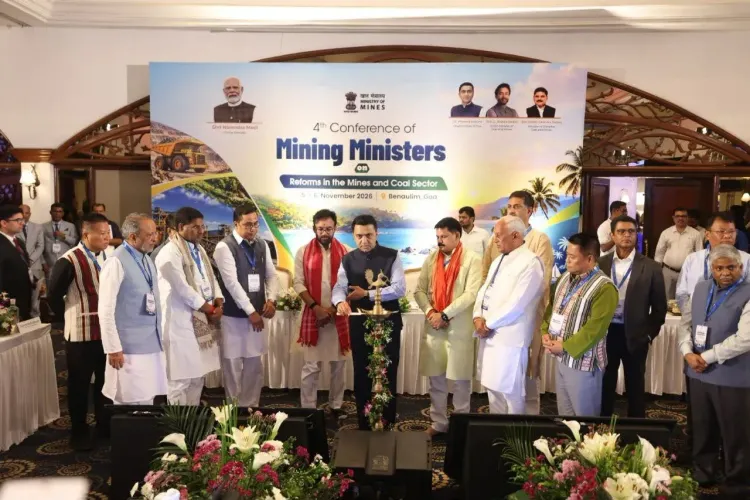
Goa CM Pramod Sawant attended the 4th Mining Ministers' Conference in Benaulim on 5 November 2026, where Union Minister G. Kishan Reddy launched the 9th Tranche of Critical Mineral Auctions, Exploration Licence Blocks, and digital tools MIDPAS-EKAM and ANVESH, as Sawant renewed his government's commitment to transparent, sustainable mining revival.
Key Takeaways
Kishan Reddy launched four key initiatives at the 4th Mining Ministers' Conference in Benaulim, Goa on 5 November 2026 .
The 9th Tranche of Critical Mineral Auctions and 3rd Tranche of Exploration Licence Blocks aim to reduce India's import dependence in strategic minerals for EVs, electronics and renewables.
New digital tools — the MIDPAS-EKAM Mobile App and ANVESH Mining Analytics Dashboard — are designed to bring technology-driven transparency to state mining departments.
Goa CM Pramod Sawant reiterated the state government's commitment to restarting iron ore mining on priority, with sustainability and transparency as guiding principles.
Mines ministers from multiple states participated, reflecting the centre-state cooperative framework that has underpinned mining reforms since the MMDR Amendment Act of 2015 .
Goa's adoption of digital platforms and progress on pending clearances will be the key indicators of follow-through on the conference's commitments.
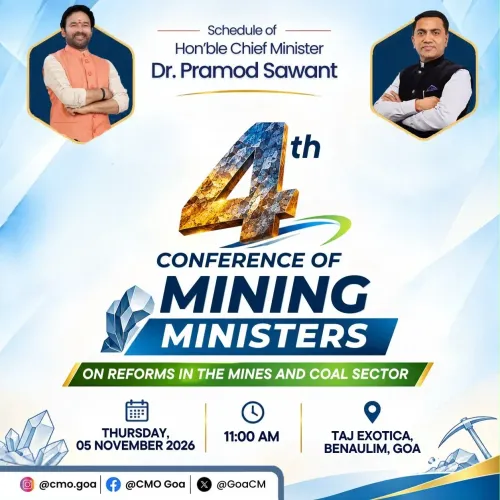
A coastal state better known for beaches than boardrooms took centre stage in India's mining reform story on Thursday, 5 November 2026, as Goa Chief Minister Pramod Sawant attended the 4th Conference of Mining Ministers on Reforms in the Mines and Coal Sector in Benaulim, Goa — reiterating his government's push to restart iron ore operations while the Centre rolled out a fresh wave of digital and auction-based tools for the sector.
What the Centre launched at Benaulim
Union Minister for Coal and Mines G. Kishan Reddy used the conference to unveil several key initiatives in one sweep: the 9th Tranche of Critical Mineral Auctions, the 3rd Tranche of Exploration Licence Blocks, the MIDPAS-EKAM Mobile App, and the ANVESH Mining Analytics Dashboard. Union Minister of State for Mines Satish Dubey and mines ministers from multiple states were also present, making the gathering a rare full-house of centre-state mining leadership.
Each initiative marks a step further down a reform path India has been walking since the MMDR Amendment Act of 2015, which replaced discretionary allocations with mandatory transparent auctions. The National Mineral Policy 2019 doubled down on sustainability and digital governance — and the ANVESH dashboard and EKAM app represent the latest technology layer on that foundation.
Critical minerals and the self-reliance imperative
The 9th Tranche of Critical Mineral Auctions is the headline number here. Critical minerals — think lithium, cobalt, graphite, and rare earths — sit at the nerve centre of India's ambitions in electric vehicles, electronics, and renewable energy. Import dependence in this space is a strategic vulnerability, and successive tranches of auctions are the government's answer to building a domestic supply chain from the ground up. The exploration licence blocks in the 3rd Tranche extend that effort upstream, opening new ground for discovery before extraction even begins.
Goa's mining revival: Sawant's standing commitment
Goa has a complicated relationship with its own mineral wealth. Iron ore mining was once a cornerstone of the state's economy, sustaining thousands of families, before a series of legal challenges and regulatory suspensions curtailed operations significantly. CM Sawant, at the conference, 'reiterated the government's commitment to restarting mining operations on priority, ensuring sustainability, transparency and responsible mining practices.'
The phrasing is deliberate — 'priority' signals urgency for miners and their families; 'sustainability and transparency' signals reassurance to courts, environmental bodies, and civil society that the restart will not repeat past controversies. Goa has historically been the sand in the oyster of India's mining policy debates, so its chief minister speaking from the same platform as the Union minister carries symbolic weight beyond the state's own numbers.
Centre-state coordination as the new normal
The conference format itself — mining ministers from across states convened by the Centre — reflects the cooperative federalism model that India's mining reforms have leaned on since 2015. Minerals are a concurrent subject, and reforms only move as fast as states adopt them. Digital tools like ANVESH and MIDPAS-EKAM are designed to give state departments real-time analytics and mobile access to approvals and data, reducing the information asymmetry that has historically slowed clearances.
Whether Goa's mining departments adopt these platforms — and how quickly the state secures the pending environmental and regulatory clearances needed for resumed operations — will be the real test of the commitments made at Benaulim. The conference has set the direction; the drill bits still need to follow.
Point of View
Using successive tranches of critical mineral auctions to chip away at strategic import dependence. For Goa, the gathering is politically significant — CM Sawant is threading a needle between the urgency of economic revival for mining-dependent communities and the legal and environmental guardrails that have constrained the sector for years. The Centre's deployment of analytics tools like ANVESH reflects a broader bet that digital governance can accelerate clearances and reduce the discretionary delays that have plagued state-level approvals. How quickly that bet pays off in a state as litigated as Goa will be a bellwether for the rest of the reform agenda.
NationPress
5 Nov 2026
Frequently Asked Questions
What was launched at the 4th Mining Ministers' Conference in Goa?
Union Minister G. Kishan Reddy launched the 9th Tranche of Critical Mineral Auctions, the 3rd Tranche of Exploration Licence Blocks, the MIDPAS-EKAM Mobile App, and the ANVESH Mining Analytics Dashboard at the conference held in Benaulim, Goa on 5 November 2026.
Why did Goa Chief Minister Pramod Sawant attend the Mining Ministers' Conference?
CM Pramod Sawant attended to represent Goa and reiterate his government's commitment to restarting iron ore mining operations with sustainability, transparency and responsible practices as guiding principles.
What are critical mineral auctions in India?
Critical mineral auctions are a central government programme that allocates mining blocks for minerals such as lithium, cobalt and rare earths — essential for EVs, electronics and renewables — through transparent bidding to reduce India's import dependence.
What is the ANVESH Mining Analytics Dashboard?
ANVESH is a newly launched mining analytics platform designed to give state mining departments real-time data and governance insights, part of India's push for technology-driven transparency in the sector.
What is Goa's history with iron ore mining?
Iron ore mining was historically a major pillar of Goa's economy, supporting thousands of families, but the sector faced significant curtailment due to legal challenges and regulatory suspensions in past years. The state government has been pushing to revive operations in a legally compliant and sustainable manner.