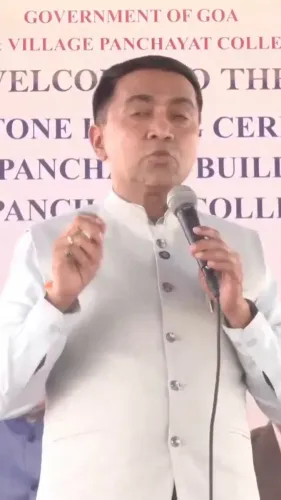
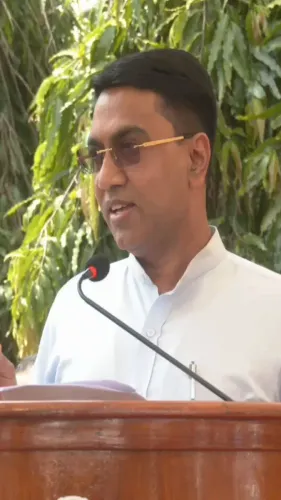
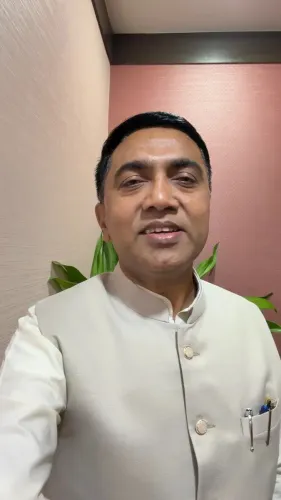
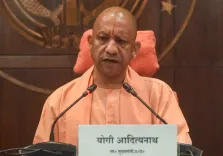
CM Sawant attacks Congress over freedom of speech stance
Synopsis
Goa Chief Minister Pramod Sawant accused Congress of hypocrisy on freedom of speech on October 9, 2026, alleging that 'today's developments' reveal the party's use of threats and intimidation over democratic dialogue.
Key Takeaways
Goa CM Pramod Sawant posted a sharp public attack on Congress on October 9, 2026 .
He accused Congress of being a 'self-proclaimed torchbearer of Freedom of Speech' whose actions contradict its stated values.
Sawant alleged that political differences were being met with 'threats, intimidation or violence' rather than democratic debate.
The post referenced unspecified 'today's developments' and included a video, suggesting a response to a specific incident.
Sawant has served as Goa Chief Minister since March 2019 , representing the BJP in the coastal state.
A sharp political broadside landed on Friday, October 9, 2026, when Goa Chief Minister Pramod Sawant accused the Congress party of hypocrisy on one of democracy's most foundational principles — freedom of speech — citing what he described as 'today's developments' as evidence that the party's stated values ring hollow.
The charge: convenience over conviction
Sawant pulled no punches. 'Congress, the self-proclaimed torchbearer of Freedom of Speech, stands exposed today,' he wrote, framing the attack not as routine political rivalry but as a values failure. His core argument: that a party which publicly champions open expression cannot, in the same breath, resort to 'threats, intimidation or violence' when confronted with political differences.
The post does not name a specific incident, but its phrasing — 'today's developments' — signals a response to a concrete episode rather than a general critique. With a video attached to the post, Sawant appears to be amplifying visual evidence to back the allegation, a tactic increasingly common in digital-era political combat.
The principle Sawant invoked — and why it lands differently now
The phrase 'Freedom of Speech cannot be a matter of convenience' is the rhetorical core. It turns one of Congress's own long-standing campaign themes — defending civil liberties against the ruling BJP — back on the party itself. In Indian political discourse, freedom of expression has been a live battleground for years, with both major national formations trading accusations of selective outrage.
By framing physical intimidation as the antithesis of democratic debate, Sawant is drawing a clear moral line: disagreement belongs in deliberation halls, not in confrontations on the street. 'Political differences must be answered through dialogue and democratic debate — not threats, intimidation or violence,' he wrote.
Sawant's political context in Goa
Pramod Sawant has led Goa as Chief Minister since March 2019, consolidating BJP's hold on the coastal state through successive elections. His willingness to carry the national party's political messaging — and escalate it — reflects a broader BJP strategy of using state-level leaders to amplify attacks on Congress credibility at pivotal moments.
Without verified details of the specific triggering incident, the full factual picture remains incomplete. But the political intent is unambiguous: recast Congress as the aggressor against the very freedoms it claims to defend.
In Indian politics, few attacks sting more than being caught contradicting your own principles. Sawant's post lands that charge — and now the Congress must answer it.
Point of View
Particularly on civil-liberties claims, knowing that charges of hypocrisy are harder to rebut than direct policy disagreements. The invocation of 'dialogue and democratic debate' as the correct channel for political differences is also a deliberate framing: it positions the BJP as the institutional actor and Congress as the disruptor. Without the specific triggering incident confirmed, however, the charge is powerful rhetoric — but its factual foundation cannot yet be independently assessed.
NationPress
9 Oct 2026
Frequently Asked Questions
What did Goa CM Pramod Sawant say about Congress and freedom of speech?
Sawant accused Congress of hypocrisy, saying the party claims to champion freedom of speech but has resorted to 'threats, intimidation or violence' rather than democratic dialogue to handle political differences.
What incident prompted Pramod Sawant's attack on Congress?
Sawant's post references 'today's developments' on October 9, 2026, but does not name a specific incident. A video was attached to the post, suggesting he was responding to a concrete event whose details have not been verified.
Who is Pramod Sawant?
Pramod Sawant is the Chief Minister of Goa and a senior BJP leader. He has held the position since March 2019.
Why is freedom of speech a sensitive topic in Indian politics?
Freedom of expression has been a recurring flashpoint in India, with both Congress and BJP trading accusations of selectively protecting or suppressing speech depending on who is in power at the Centre or in states.
What is BJP's political strategy in using state CMs to attack Congress?
The BJP frequently uses state chief ministers to amplify national-level messaging, particularly on Congress credibility issues, as it allows the party to project a unified ideological front while keeping central leadership above the immediate fray.