CM Sawant Extends Vat Purnima Wishes to Goa
Synopsis
Goa Chief Minister Pramod Sawant marked Vat Purnima on 29 June 2026 with a Marathi message praying for lives as magnificent as the banyan tree and happiness that multiplies like its aerial roots, reaching out to the state's Marathi-speaking Hindu communities.
Key Takeaways
Goa Chief Minister Pramod Sawant posted Vat Purnima greetings on 29 June 2026 .
The message was written in Marathi , reflecting outreach to Goa's Marathi-speaking communities.
Vat Purnima falls on the full moon of the Hindu month of Jyeshtha and is widely observed in Goa, Maharashtra, and parts of Karnataka and Gujarat .
The festival centres on married women fasting and praying around the banyan tree for their husbands' longevity, rooted in the legend of Savitri and Satyavan .
CM Sawant's greetings align with the BJP -led state government's consistent practice of marking culturally significant Hindu festivals.
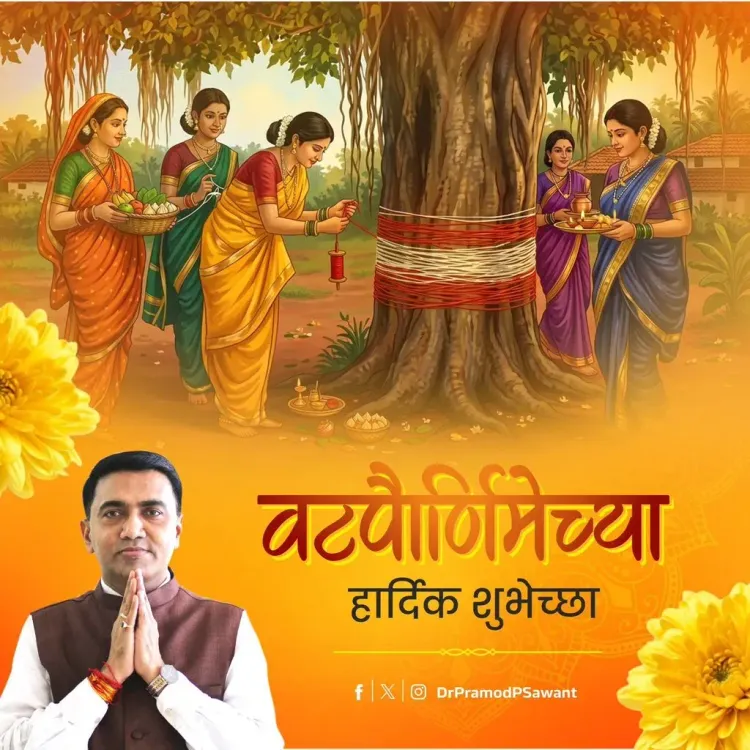
Goa Chief Minister Pramod Sawant on Monday, 29 June 2026 extended warm greetings to the people of Goa on the occasion of Vat Purnima, offering prayers for a life as grand and uplifting as the banyan tree and for happiness to multiply like its aerial roots.
In his post on X, CM Sawant wrote in Marathi: 'वटवृक्षाप्रमाणे भव्य, उन्नत जीवन मिळो, पारंब्याप्रमाणे सुख वाढत राहो' — meaning, 'May life be as magnificent and elevated as the banyan tree; may happiness keep growing like its hanging roots.' The message carried the spirit of the festival's central prayer for longevity, prosperity, and familial well-being.
Context
Vat Purnima is a significant Hindu festival observed primarily by married women in Maharashtra, Goa, and parts of Karnataka and Gujarat. It falls on the full moon day (Purnima) of the Hindu month of Jyeshtha, which in 2026 corresponds to 29 June. Women observe fasts, tie threads around a banyan (vat) tree, and pray for the long life and well-being of their husbands, drawing from the legend of Savitri who won back her husband Satyavan from the god of death through devotion and resolve.
The banyan tree holds deep symbolic weight in Indian culture — its expansive canopy and aerial roots (parambya in Marathi) represent shelter, continuity, and the interconnectedness of family bonds. CM Sawant's choice of these precise metaphors aligns closely with the festival's traditional imagery.
Policy Backdrop
As Chief Minister of Goa and a senior leader of the Bharatiya Janata Party (BJP), Pramod Sawant has consistently used public platforms to mark festivals that hold cultural significance for Goa's Hindu communities, reinforcing the state government's engagement with local religious and cultural traditions. Goa's population includes a substantial Marathi-speaking Hindu community for whom Vat Purnima is a deeply observed occasion.
The post, written in Marathi rather than English or Konkani, reflects a deliberate outreach to the Marathi-speaking demographic within the state, a constituency that carries electoral and cultural weight in Goa's politics.
Stakeholders and Impact
The message is directed at the people of Goa, particularly married women and families observing the fast on Vat Purnima. By extending greetings in Marathi, the Chief Minister signals cultural solidarity with communities that celebrate this festival as a core part of their identity.
Such public acknowledgements by elected leaders on religious occasions are a standard and widely practised form of political communication in India, serving to reinforce the government's connection with diverse cultural groups within the state.
What's Next
With the Vat Purnima observance falling on a working weekday in 2026, state authorities in Goa are expected to facilitate community gatherings and temple functions associated with the festival. CM Sawant's public message is likely to be followed by similar outreach as the calendar of Hindu festivals continues through the monsoon season, reflecting the government's ongoing engagement with cultural occasions significant to Goa's communities.
Point of View
Consistent engagement with the festival calendar is part of a broader strategy of cultural governance that reinforces the party's identity as a custodian of Hindu traditions. Such messaging, routine as it appears, cumulatively shapes the government's image ahead of any electoral cycle.
NationPress
29 Jun 2026
Frequently Asked Questions
What is Vat Purnima and why is it celebrated?
Vat Purnima is a Hindu festival observed by married women who fast and pray around a banyan tree for their husbands' long life and well-being. It is based on the legend of Savitri, who through devotion won back her husband Satyavan from the god of death, and falls on the full moon of the Hindu month of Jyeshtha.
When is Vat Purnima in 2026?
Vat Purnima in 2026 falls on 29 June, corresponding to the Purnima (full moon) of the Hindu month of Jyeshtha.
Which states celebrate Vat Purnima?
Vat Purnima is primarily celebrated in Maharashtra, Goa, and parts of Karnataka and Gujarat, where it holds deep cultural and religious significance for Hindu communities.
Why did CM Pramod Sawant write his Vat Purnima message in Marathi?
CM Sawant posted in Marathi to connect with Goa's significant Marathi-speaking Hindu community, for whom Vat Purnima is a major festival. The choice of language reflects targeted cultural outreach to this constituency.
What does the banyan tree symbolise in Vat Purnima?
The banyan tree, or vat vriksha, symbolises longevity, shelter, and the continuity of family bonds. Its aerial roots, called parambya in Marathi, represent the spreading of happiness and prosperity across generations, which is why women tie threads around it during the festival.