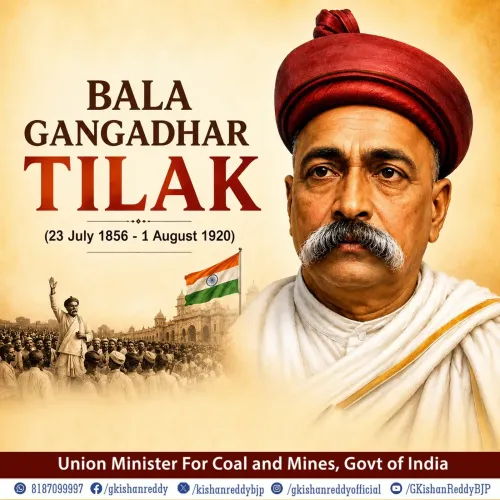
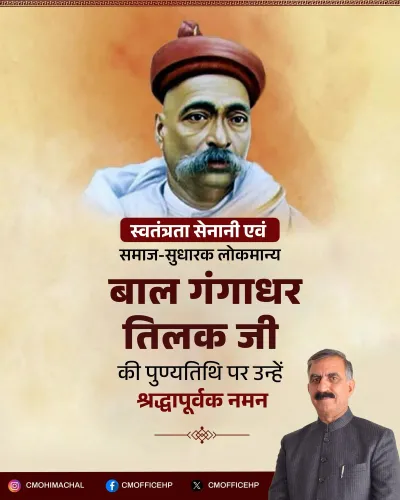
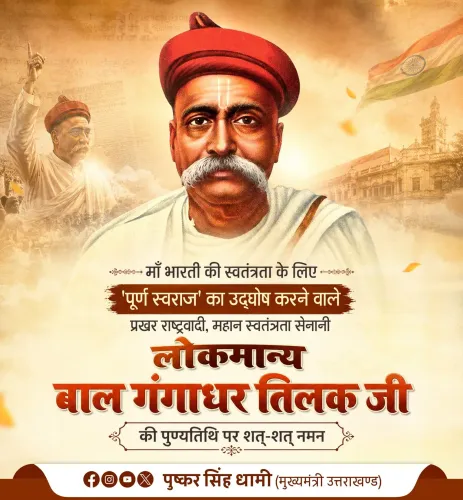
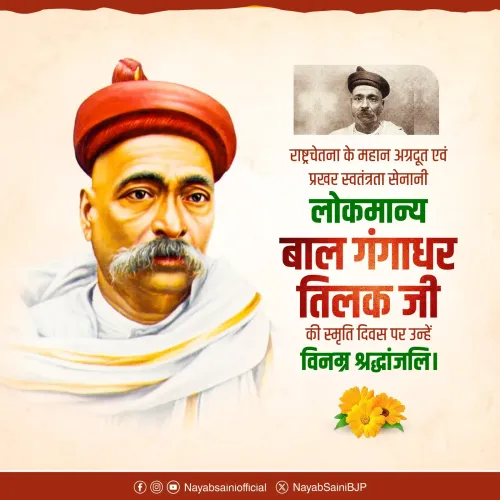
CM Sawant pays tribute to Lokmanya Tilak on Punyatithi
Synopsis
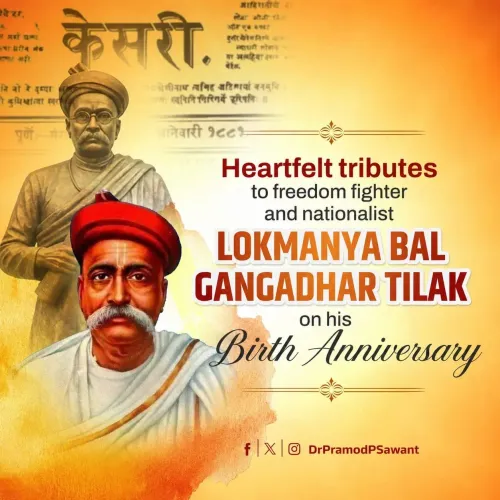
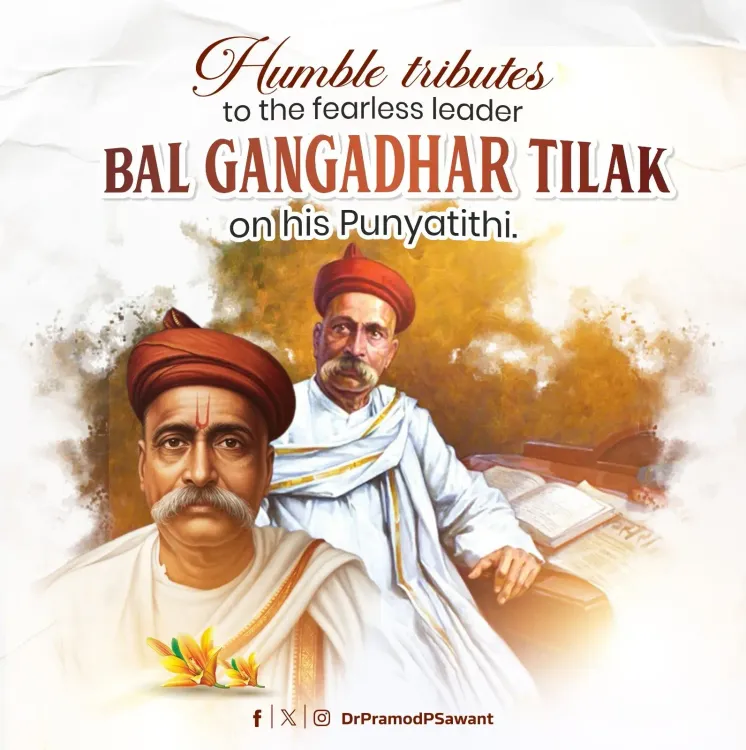
On August 1, Goa Chief Minister Pramod Sawant paid tribute to Lokmanya Bal Gangadhar Tilak on his Punyatithi, invoking the iconic 'Swaraj is my birthright' declaration that galvanised India's independence movement.
Key Takeaways
Goa CM Pramod Sawant posted a tribute to Bal Gangadhar Tilak on his Punyatithi, August 1 .
Tilak is remembered as Lokmanya , meaning 'accepted by the people', for his mass mobilisation during the freedom struggle.
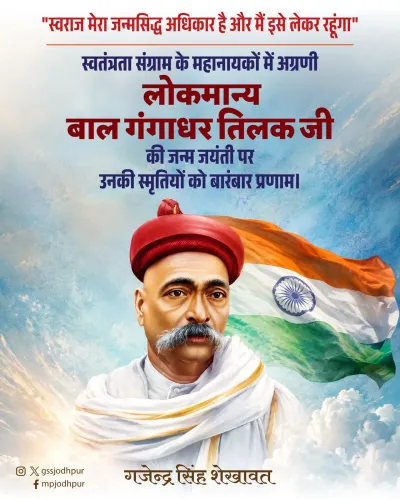
His declaration 'Swaraj is my birthright, and I shall have it' is among the most cited slogans of India's independence movement.
Tilak died on August 1, 1920 , in Bombay ; his funeral drew an estimated two lakh mourners.
Indian political leaders across parties observe this anniversary annually as part of a shared nationalist commemorative tradition.
A century after his death, Bal Gangadhar Tilak's defiant cry still echoes through Indian public life. On Saturday, August 1 — Tilak's Punyatithi — Goa Chief Minister Pramod Sawant paid homage to the nationalist icon, invoking the slogan that once shook an empire: 'Swaraj is my birthright, and I shall have it.'
The man behind the rallying cry
Bal Gangadhar Tilak, revered across India as Lokmanya — 'accepted by the people' — was among the earliest voices demanding complete independence from British rule, not mere administrative reform. A scholar, journalist, and mass mobiliser, he understood that freedom movements needed cultural roots as much as political arguments. He institutionalised the Ganesh Chaturthi festival as a public gathering that cut across caste lines, and turned the Shivaji Jayanti into a platform for nationalist sentiment — tools of mass consciousness at a time when large assemblies were otherwise suppressed. His declaration — 'Swaraj is my birthright, and I shall have it' — was not merely a slogan. It reframed the independence struggle as a matter of inherent right rather than colonial concession, shifting the psychological ground beneath an entire generation of freedom fighters.Why August 1 is marked every year
Tilak died on August 1, 1920, in Bombay. His passing drew an estimated two lakh people to his funeral — a measure of the hold he had on the public imagination. Mahatma Gandhi called him 'the maker of modern India.' Every year on this date, political leaders across the spectrum pay tribute, affirming a shared nationalist inheritance that transcends party lines. CM Sawant's post fits that broader pattern — a ritual of remembrance that keeps the freedom struggle's vocabulary alive in contemporary political discourse. For BJP leaders in particular, Tilak holds a resonant place: a Hindu nationalist intellectual who fused cultural identity with the demand for self-rule. Tilak's legacy endures not as a museum exhibit but as a live political reference — his words still quoted, his anniversaries still observed, his defiance still useful to those who invoke it.Point of View
Tilak carries particular salience — his fusion of Hindu cultural assertion with anti-colonial nationalism prefigures themes the party emphasises today. These annual posts are low-stakes in news terms but high-value in political identity-building, reinforcing the party's claim to a nationalist lineage. The consistency of such tributes across the political spectrum also reflects how deeply the freedom struggle remains the foundational legitimising narrative of Indian democracy.
NationPress
15 Sept 2026
Frequently Asked Questions
When is Bal Gangadhar Tilak's Punyatithi?
Bal Gangadhar Tilak's Punyatithi falls on August 1 every year, marking the anniversary of his death in 1920 in Bombay.
What does 'Swaraj is my birthright' mean?
The phrase 'Swaraj is my birthright, and I shall have it' was Tilak's declaration that self-rule was an inherent right of Indians, not a privilege to be granted by British rulers — it became a defining slogan of the independence movement.
Why is Bal Gangadhar Tilak called Lokmanya?
Lokmanya means 'accepted by the people' in Sanskrit. The title was conferred on Tilak in recognition of his extraordinary popular following and his role as a mass leader during the freedom struggle.
What did Pramod Sawant say about Tilak?
Goa CM Pramod Sawant described Tilak as a 'fearless leader' who 'awakened the spirit of nationalism and inspired millions to join India's freedom movement,' quoting his iconic Swaraj declaration.
What is Bal Gangadhar Tilak known for?
Tilak is known for popularising the Ganesh Chaturthi and Shivaji Jayanti festivals as tools of mass nationalist mobilisation, for his journalism, and for being one of the earliest leaders to demand complete independence from British rule.