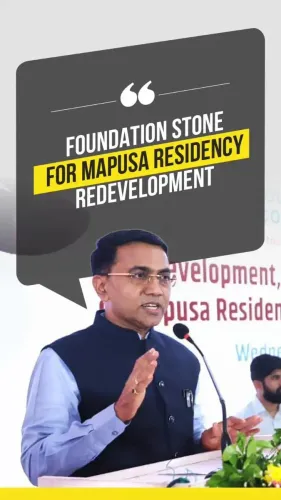
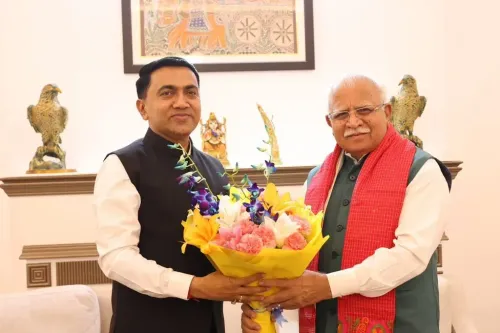
CM Sawant joins national conference on Goa's architectural heritage
Synopsis
Goa Chief Minister Pramod Sawant joined Union Minister Gajendra Singh Shekhawat at the GSIDC-organised National Conference on Goan Architecture and Sustainability in New Delhi on 31 July 2026, framing Goa as a future 'living laboratory' of heritage-rooted, climate-responsive design.
Key Takeaways
The National Conference on Goan Architecture and Sustainability was inaugurated in New Delhi on 31 July 2026 , organised by the Goa State Infrastructure Development Corporation (GSIDC) .
Union Minister for Tourism and Culture Gajendra Singh Shekhawat presided over the ceremony; Goa MP Sadanand Shet was also present.
The conference brought together architects, planners, conservationists, engineers, policymakers, academics, and students.
CM Sawant anchored the event in PM Modi's Vikas Bhi, Virasat Bhi philosophy, linking heritage preservation with sustainable development.
Key focus areas include heritage conservation, climate-responsive design, green public infrastructure, and modern construction technologies.
Sawant described Goa's goal as becoming a 'living laboratory of sustainable architecture' under the Swayampurna Goa vision.
From New Delhi, Goa Chief Minister Pramod Sawant stepped into a room full of architects, conservationists, engineers, and students on Friday, 31 July 2026 — all gathered around a single, urgent question: how does one of India's most architecturally distinct states grow without losing the identity that makes it irreplaceable?
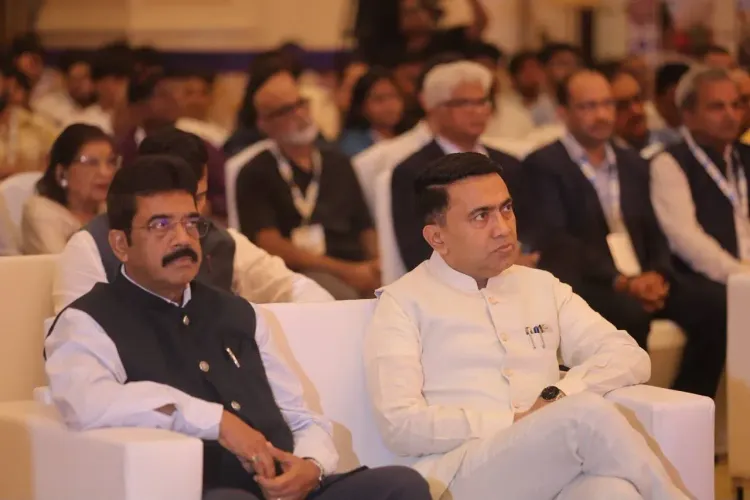
Sawant joined the inauguration of the National Conference on Goan Architecture and Sustainability in New Delhi, an event organised by the Goa State Infrastructure Development Corporation (GSIDC). The ceremony was presided over by Union Minister for Tourism and Culture Gajendra Singh Shekhawat, with Goa MP Sadanand Shet also present.
What the conference brought together
The gathering pulled in a cross-section rarely seen under one roof — architects and urban planners alongside heritage conservationists, civil engineers, policymakers, academics, and students. The deliberate breadth signals that GSIDC is treating this not as a ceremonial exercise but as a working consultation, drawing expertise from multiple disciplines before translating ideas into brick, concrete, and laterite stone.
Sawant framed the event squarely within Prime Minister Narendra Modi's 'Vikas Bhi, Virasat Bhi' ('Development Too, Heritage Too') philosophy — a formulation that has guided central policy since 2014, when the Swadesh Darshan scheme first tied heritage tourism circuits to sustainability outcomes. The Chief Minister described Goa's ambition as becoming 'a living laboratory of sustainable architecture, where tradition and technology come together.'
Heritage conservation meets climate-responsive design
The pillars Sawant outlined — heritage conservation, climate-responsive design, green public infrastructure, and modern technologies — reflect a deliberate policy stack. Goa's vernacular architecture, shaped by centuries of coastal climate and layered cultural influence, already embeds passive-cooling logic: deep verandas, sloping tiled roofs, and laterite walls that breathe. The challenge is codifying those principles into contemporary construction standards without reducing them to aesthetic pastiche.
Indian states have increasingly pursued this synthesis under central guidance, but Goa occupies a specific pressure point: rapid tourism-driven construction has long threatened its built heritage. A structured framework emerging from GSIDC — the state agency that executes public infrastructure projects — could set enforceable design benchmarks rather than aspirational guidelines.
The 'Swayampurna Goa' thread
Sawant closed his remarks with a reference to Swayampurna Goa — a self-reliance vision the state government has used as an organising frame across sectors. Linking architectural sustainability to that broader agenda positions the conference's output as more than cultural policy; it becomes an economic and environmental argument for why Goa's built environment must be treated as a strategic asset.
The real test will come in the follow-up: whether GSIDC translates the conference's deliberations into concrete project guidelines and enforceable design standards. If it does, Goa could offer a replicable model for heritage-sensitive development that other coastal and historically rich Indian states are watching closely.
Point of View
The state signals it is seeking central alignment — and possibly central funding — for its architectural sustainability agenda. The 'Vikas Bhi, Virasat Bhi' framing is politically astute: it positions heritage conservation not as a brake on growth but as a pillar of it, insulating the policy from the usual development-versus-culture binary. The real indicator of intent will be whether GSIDC publishes binding design standards in the months ahead.
NationPress
31 Jul 2026
Frequently Asked Questions
What is the National Conference on Goan Architecture and Sustainability?
It is a conference organised by the Goa State Infrastructure Development Corporation (GSIDC) to deliberate on sustainable building practices rooted in Goa's architectural heritage, bringing together architects, planners, conservationists, engineers, policymakers, academics, and students.
Who inaugurated the Goa architecture conference in New Delhi?
Union Minister for Tourism and Culture Gajendra Singh Shekhawat presided over the inauguration, with Goa Chief Minister Pramod Sawant and Goa MP Sadanand Shet also present.
What does 'Vikas Bhi, Virasat Bhi' mean and how does it relate to Goa?
'Vikas Bhi, Virasat Bhi' translates to 'Development Too, Heritage Too' — a philosophy promoted by Prime Minister Narendra Modi that links economic development with cultural preservation. Goa CM Sawant has used it to frame the state's commitment to sustainable architecture that honours its historical built environment.
What is GSIDC and what role does it play in Goa's infrastructure?
The Goa State Infrastructure Development Corporation (GSIDC) is the state government agency responsible for executing public infrastructure projects in Goa, including those incorporating heritage design principles and green building standards.
What is Swayampurna Goa?
Swayampurna Goa is a self-reliance vision articulated by the Goa state government as an overarching development framework. CM Sawant linked it to the architecture conference, positioning sustainable built infrastructure as central to Goa's long-term economic and environmental resilience.