CM Sawant urges Goa farmers to tap Soil Health Cards, KCC
Synopsis
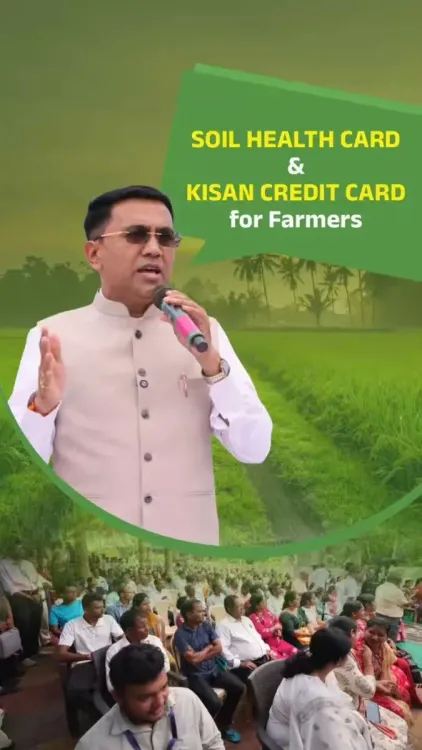
Goa Chief Minister Pramod Sawant urged farmers on October 13, 2026 to fully use Soil Health Cards and Kisan Credit Cards, central schemes aimed at improving soil management and easing credit access, as the rabi season approaches.
Key Takeaways
Goa CM Pramod Sawant appealed to farmers on October 13, 2026 to utilise the Soil Health Card and Kisan Credit Card schemes.
The Soil Health Card scheme was launched in 2015 to provide soil nutrient reports and fertilizer guidance to farmers.
The Kisan Credit Card was first introduced in 1998 and has since been upgraded with higher credit limits and digital features.
Sawant framed both schemes as tools of 'Kisan Shakti' — farmer empowerment — attributing them to PM Narendra Modi's leadership.
Small and marginal farmers in Goa remain the primary target audience for improving scheme saturation.
The appeal comes ahead of the rabi sowing season , a key window for farmers to access credit and plan input use.
With the rabi season approaching, Goa Chief Minister Pramod Sawant on Tuesday, October 13, 2026 called on the state's farming community to actively use two flagship central schemes — the Soil Health Card and the Kisan Credit Card (KCC) — framing them as the twin engines of what he called 'Kisan Shakti' (farmer empowerment).
What Sawant is asking Goan farmers to do
The Chief Minister's appeal was direct: stop leaving benefits on the table. 'These initiatives empower our Kisan Shakti with better soil management, easier access to credit and the means to build a more productive agricultural sector,' Sawant wrote, attributing both tools to the leadership of Prime Minister Narendra Modi.
The Soil Health Card scheme, launched in 2015, gives individual farmers a report on the nutrient status of their soil along with fertilizer recommendations — cutting input costs and guiding precision farming. The Kisan Credit Card, a short-term credit facility first introduced in 1998 and progressively upgraded with higher limits and digital features, allows farmers to draw institutional credit for cultivation and allied activities without navigating cumbersome loan procedures.
Why uptake still lags in states like Goa
Despite the schemes' age and reach, awareness and saturation gaps persist — particularly among small and marginal farmers who stand to gain the most. Goa, with its relatively small agricultural base compared to larger states, faces a last-mile challenge: converting awareness into active card-holding and soil-test participation. Sawant's public nudge is a signal that uptake in the state has room to grow ahead of the sowing season.
Across BJP-governed states, amplifying central agricultural schemes is a consistent messaging strategy — one that simultaneously highlights Modi government deliverables and pushes state machinery to meet distribution targets. Watching whether Goa's agriculture department follows this post with ground-level drives will tell the real story.
The case for soil testing and institutional credit
The argument is straightforward: a farmer who knows their soil's nutrient profile wastes less money on unnecessary fertilizers. A farmer with a KCC borrows from a bank at regulated rates rather than from a moneylender at punishing ones. Together, the two schemes attack agriculture's two oldest problems — poor input decisions and debt traps — with documented, scalable tools. The question Sawant is implicitly raising: how many of Goa's farmers are still outside that safety net?
As the cropping calendar turns, the push from Panaji is clear — and the measure of its success will come in enrollment numbers, not posts.
Point of View
Making the appeal operationally relevant rather than purely rhetorical. The deeper policy question is whether social-media outreach translates to measurable enrollment gains, or whether Goa's agriculture department needs ground-level camps to close the gap. If uptake numbers improve this rabi cycle, expect Sawant to cite them as a governance win ahead of any electoral calendar.
NationPress
13 Oct 2026
Frequently Asked Questions
What is the Soil Health Card scheme and who can apply?
The Soil Health Card scheme, launched in 2015 , provides farmers with a report on their soil's nutrient status along with fertilizer recommendations. Any farmer in India can apply through their local agriculture department or Common Service Centre.
How does a Kisan Credit Card help farmers?
A Kisan Credit Card (KCC) gives farmers access to short-term institutional credit at regulated interest rates for cultivation, post-harvest expenses, and allied activities, helping them avoid high-interest informal loans.
When was the Kisan Credit Card first introduced?
The Kisan Credit Card was first introduced in 1998 and has been revised multiple times since to include higher credit limits and digital payment features.
Why is Goa CM Pramod Sawant promoting these central schemes?
CM Pramod Sawant is urging Goan farmers to use Soil Health Cards and Kisan Credit Cards to improve soil management and access affordable credit, particularly as the rabi sowing season approaches.
How can farmers in Goa get a Kisan Credit Card?
Farmers in Goa can apply for a Kisan Credit Card through any scheduled commercial bank, regional rural bank, or cooperative bank by submitting land records and basic identity documents.