CM Bhajan Lal Hits Congress Over EVM Blame After Ballot Losses
Synopsis
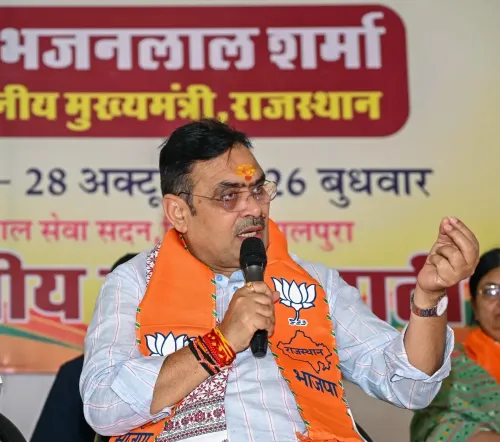
Rajasthan CM Bhajan Lal Sharma challenged Congress on October 28, 2026, pointing to zero wins from 28 paper-ballot MLC seats across four states as proof that the party's electoral woes stem from leadership failures, not voting machines.
Key Takeaways
Rajasthan Chief Minister Bhajan Lal Sharma directly attacked Congress on October 28, 2026 over its repeated EVM criticism.
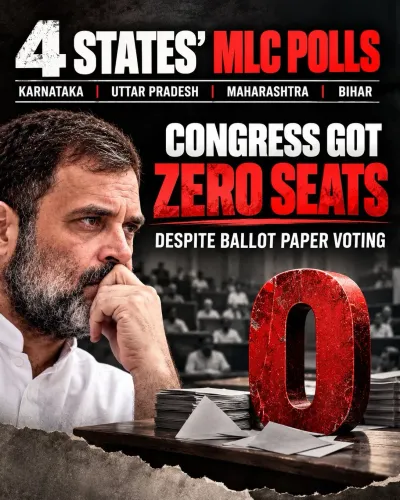
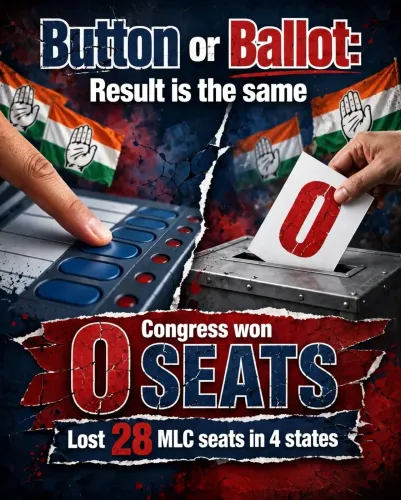
Congress reportedly won zero of 28 MLC seats contested via paper ballots in Uttar Pradesh, Maharashtra, Bihar, and Karnataka .
Sharma argued that losses on paper ballots expose the EVM blame narrative as politically motivated deflection.
The CM called Congress's refusal to self-introspect 'राजनीतिक कायरता' — 'political cowardice.' The BJP has consistently defended EVM integrity against opposition challenges that date back to at least 2014 .
Any formal response from the Election Commission of India or Congress will set the tone for upcoming state and council polls.
When the same opposition that questions voting machines loses on paper ballots too, the argument collapses under its own weight. Rajasthan Chief Minister Bhajan Lal Sharma made exactly that point on Wednesday, October 28, 2026, firing a sharp broadside at the Indian National Congress after the party reportedly won zero of 28 MLC seats contested via paper ballots across Uttar Pradesh, Maharashtra, Bihar, and Karnataka.
Zero on the Paper Ballot — The Number Congress Cannot Explain Away
Sharma's post cuts straight to the core of the EVM controversy that has simmered in Indian politics since 2014. His argument, translated from Hindi: 'चुनाव बैलेट पेपर से हों या EVM से, जब जनता ही आपसे दूरी बना ले' — 'Whether elections are on ballot paper or EVM, when the public itself distances itself from you, blaming the system does not change the mandate.' The 28 MLC seats in four states, all decided by paper ballot, returned a reported zero Congress victories — a data point Sharma called 'the freshest example' of the party's disconnect with voters.
The MLC (Member of Legislative Council) elections are conducted for upper-house seats in states that maintain bicameral legislatures. These contests are widely watched precisely because their paper-ballot format removes any technical objection to the result — making the outcome a clean test of political support on the ground.
The EVM Debate That Refuses to Die
Congress and several other opposition parties have periodically raised doubts about Electronic Voting Machines following successive defeats — in state assemblies, national elections, and now council polls. The pattern stretches back over a decade, with each loss followed by demands for a return to paper ballots or for greater machine scrutiny. The Election Commission of India has consistently defended EVM integrity, pointing to multiple layers of technical and procedural safeguards.
Sharma's post escalates the rhetoric in pointed terms. He argues that instead of questioning electoral machinery, Congress should interrogate its own 'leadership, policies, and shrinking voter base.' He labels the blame-the-system reflex 'राजनीतिक कायरता' — 'political cowardice' — and invokes democratic propriety: 'Respecting the people's mandate is democratic dignity.'
A Pattern of BJP Counter-Punching on Electoral Integrity
This post fits a well-established playbook. After poor showings at the ballot box, opposition EVM complaints draw swift BJP rebuttals — often from senior leaders in states where the losses occurred or were most visible. Sharma, as a BJP Chief Minister whose own party won Rajasthan's assembly election in late 2023, carries particular authority to make this argument: his party's win came via the very machines now being questioned.
The broader political stakes are real. Congress's ability to rebuild as a credible national opposition depends on honest internal reckoning — a point Sharma presses hard. 'The truth,' he writes, 'is that Congress should look for the reasons for its defeats not in EVMs, but in its own leadership, policies, and shrinking support base.'
Whether Congress responds formally — or whether the Election Commission weighs in on the ballot-paper results — will shape the next round of this perennial debate. But the arithmetic of zero wins from 28 paper-ballot seats is now on the table, and no amount of technical objection makes it go away.
Point of View
The party counters with evidence of losses in non-EVM formats to reframe the debate as one of political accountability rather than technical credibility. The zero-wins figure from four states, if accurate, is a genuinely damaging data point for Congress — it strips away the technical fig leaf and forces the conversation back to ground-level voter trust. For the BJP, keeping Congress on the defensive over introspection rather than process suits a long-term narrative: that the opposition's fundamental problem is leadership and relevance, not machinery. The durability of this exchange across multiple electoral cycles suggests neither party expects resolution — only recurring advantage whenever results land.
NationPress
29 Oct 2026
Frequently Asked Questions
Why is Bhajan Lal Sharma criticising Congress over paper ballots?
He argues that Congress winning zero of 28 MLC seats decided by paper ballots — not EVMs — proves the party's defeats reflect voter rejection, not electoral fraud.
What are MLC elections and why were they held on paper ballots?
MLC stands for Member of Legislative Council — upper-house seats in states with bicameral legislatures. Some MLC contests are conducted via paper ballots, making them a direct test of political support free from EVM-related objections.
Which states held the 28 MLC seat elections Sharma mentioned?
According to Sharma's post, the elections were held across Uttar Pradesh, Maharashtra, Bihar, and Karnataka.
Has Congress responded to Sharma's EVM criticism?
As of the time of Sharma's post, no formal Congress response has been reported, though the party has historically maintained its concerns about EVM integrity across multiple electoral cycles.
How long has the EVM controversy been running in Indian politics?
Opposition parties including Congress have raised EVM integrity concerns periodically since at least 2014, following successive defeats in state and national elections.