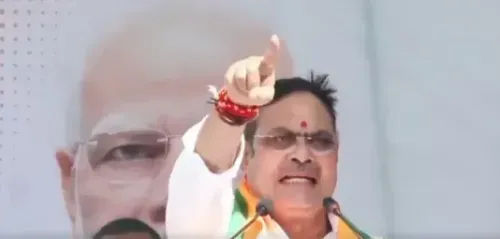
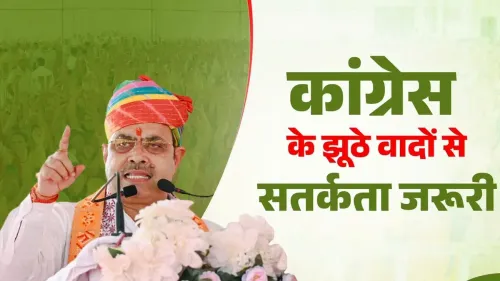
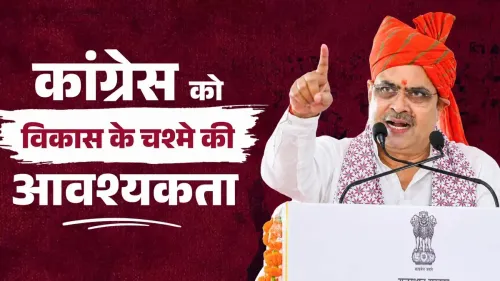
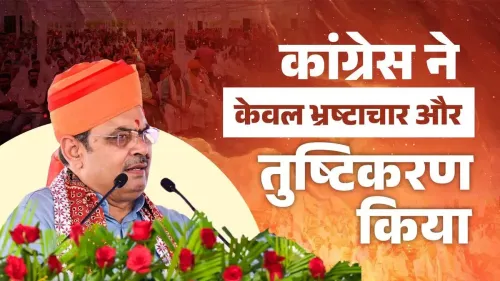
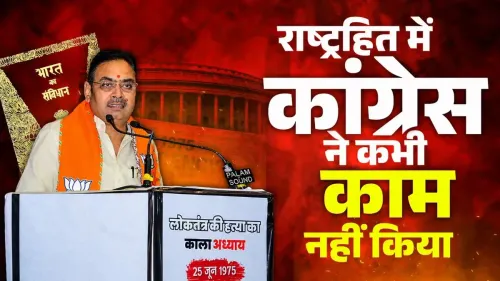
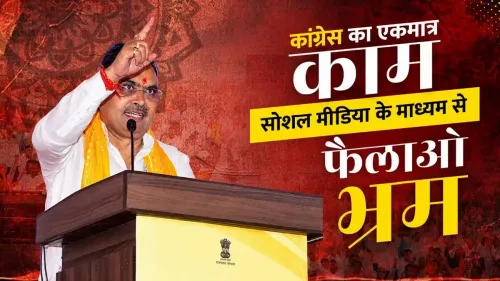
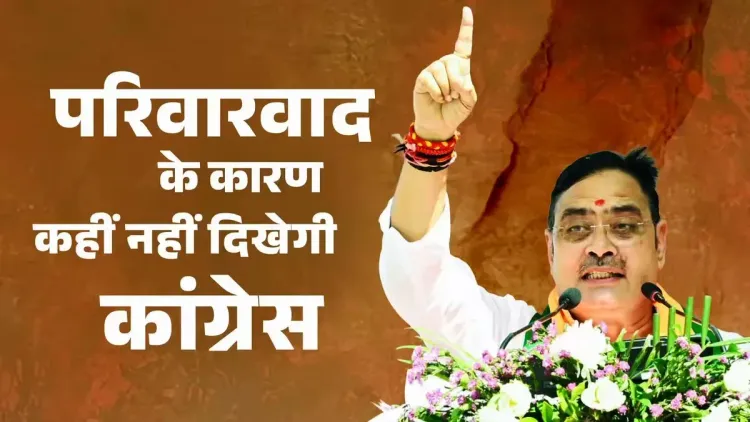
CM Bhajan Lal Sharma attacks Congress over dynastic politics
Synopsis
Rajasthan Chief Minister Bhajan Lal Sharma declared on November 3, 2026 that Congress has fully lost its public connect and remains mired in dynastic politics, appeasement and corruption — extending BJP's long-running national framing of its principal rival.
Key Takeaways
Rajasthan CM Bhajan Lal Sharma posted a sharp attack on Congress on November 3, 2026 .
He accused Congress of being wholly disconnected from the people and of practising 'parivarvaad' (dynastic politics), 'tushtikarana' (appeasement) and 'bhrashtachar' (corruption).
BJP has deployed this three-point framing against Congress consistently since 2014 at both national and state levels.
Sharma leads a BJP government in Rajasthan formed after its December 2023 assembly election victory over Congress under Ashok Gehlot.
No new policy announcement accompanied the post; it is an explicit partisan political statement.
Congress has not formally responded to this specific post.
Rajasthan Chief Minister Bhajan Lal Sharma sharpened his political offensive against the Congress on Tuesday, November 3, 2026, declaring that the opposition party has entirely lost its connection with the people — and that its politics remains trapped in a cycle of dynastic rule, appeasement, and corruption.
Posting in Hindi on X, Sharma wrote: 'Kांग्रेस का जनता से जुड़ाव पूरी तरह खत्म हो चुका है' — 'Congress has completely lost its connection with the people. Even today, its politics revolves around dynastic politics, appeasement and corruption.' The statement carries no accompanying policy announcement; it is a direct political strike.
The three-word arsenal BJP keeps sharpening
The trio — 'parivarvaad' (dynastic politics), 'tushtikarana' (appeasement) and 'bhrashtachar' (corruption) — is not new vocabulary for BJP. Since 2014, these three charges have functioned as the party's national-level framing against Congress, appearing in campaign speeches, parliamentary debates, and social-media posts with clockwork regularity. What gives Sharma's iteration its edge is the Rajasthan context: his government is barely three years old, built on the wreckage of a Congress administration led by former Chief Minister Ashok Gehlot that BJP spent years painting with precisely these colours.
In the December 2023 Rajasthan assembly elections, BJP won a clear majority, ending Congress's tenure and installing Sharma as Chief Minister. The electoral verdict gave the BJP a mandate — and a storyline — it continues to press in public messaging.
Rajasthan's partisan battlefield
Rajasthan has historically swung between Congress and BJP in near-alternating cycles, making it one of India's most closely watched political barometers. The Congress, which governed the state under Gehlot before 2023, remains the principal opposition in the assembly. Sharma's broadside is therefore as much a signal to Rajasthan's electorate as it is a contribution to the national BJP chorus ahead of any future electoral cycle.
The state's political temperature tends to run high between election cycles precisely because both parties know Rajasthan can flip. Every rhetorical salvo from the CM's office doubles as a reminder to voters of why they chose to flip it the last time.
Congress spokespersons are yet to formally respond to this specific post — but the party has consistently pushed back against what it calls BJP's 'politics of distraction' whenever similar salvos land.
In a political climate where the same charges fly in both directions, the real question is not who fires first — it is whether the voters of Rajasthan, the next time they walk into a polling booth, decide the argument has been won.
Point of View
Which sharpens the contrast. For a state that has historically alternated between the two parties, keeping these charges alive between elections is a deliberate strategy to prevent voter nostalgia from rebuilding Congress's credibility. The absence of any new triggering event suggests this is ambient political maintenance rather than a response to a specific Congress move — which itself tells us something about how confidently BJP now manages the Rajasthan narrative.
NationPress
3 Nov 2026
Frequently Asked Questions
What did Rajasthan CM Bhajan Lal Sharma say about Congress?
Sharma said Congress has completely lost its connection with the people and that its politics still revolves around dynastic rule, appeasement and corruption.
What does 'parivarvaad' mean in Indian politics?
'Parivarvaad' means dynastic politics — the practice of political parties centering power around a single family. BJP routinely uses the term to target the Gandhi family's dominance within Congress.
When did BJP form the government in Rajasthan under Bhajan Lal Sharma?
BJP won the Rajasthan assembly elections in December 2023, defeating the Congress government led by Ashok Gehlot, and Bhajan Lal Sharma was sworn in as Chief Minister shortly after.
Why does BJP repeatedly accuse Congress of appeasement and corruption?
Since 2014, BJP has consistently framed Congress's identity around these three charges — dynastic politics, appeasement and corruption — as a national electoral and communications strategy to position itself as a contrast.
Has Congress responded to Bhajan Lal Sharma's attack?
No formal response from Congress has been recorded to this specific post as of November 3, 2026, though the party has historically dismissed such BJP statements as a politics of distraction.