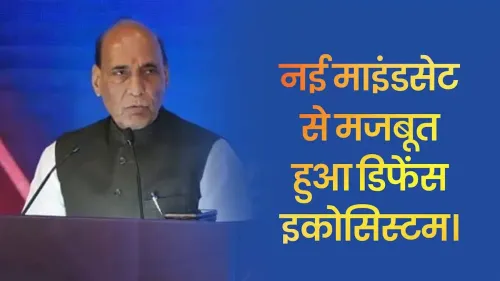
Rajnath Singh lays out four pillars of India's defence transformation
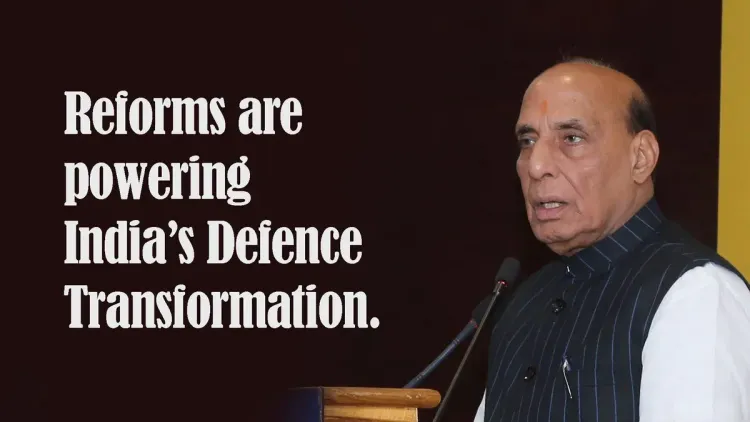
Synopsis
Union Defence Minister Rajnath Singh on 3 November 2026 outlined four strategic pillars — Reforms, Self-reliance, Collaboration and Exports — driving India's defence-sector transformation, stressing that technological and industrial preparedness now rival military readiness in importance.
Key Takeaways
Four pillars named by Rajnath Singh: Reforms, Self-reliance, Collaboration and Exports .
Singh argues technological and industrial preparedness are now as vital as military preparedness as the character of warfare evolves.
The policy arc began with Make in India in 2014 and deepened with Atmanirbhar Bharat in 2020 and successive negative import lists.
The Chief of Defence Staff role, created in December 2019 , was designed to improve jointness and procurement efficiency.
Defence production corridors in Uttar Pradesh and Tamil Nadu and eased FDI norms underpin the Collaboration and Exports pillars.
Budget allocations and capital acquisition decisions in the next fiscal cycle will test how far reform intent has translated into industrial capacity.
The character of modern warfare is shifting faster than armies can re-equip — and Union Defence Minister Rajnath Singh wants India ahead of that curve. On Tuesday, 3 November 2026, Singh took to X to articulate the strategic logic underpinning a decade of defence-sector change, naming four pillars that he says are driving the transformation of India's Defence Ecosystem: Reforms, Self-reliance, Collaboration and Exports.
The four-pillar doctrine explained
Singh's framing is deliberate. 'Technological and industrial preparedness have become as vital as military preparedness,' he wrote, signalling a shift in how New Delhi thinks about deterrence — not just in terms of troops and hardware, but in terms of factories, supply chains and intellectual property. The four pillars map neatly onto a reform arc that began in earnest in 2014 with the Make in India initiative and has since deepened with each successive policy cycle.
Self-reliance is the most prominent strand, anchored by the Atmanirbhar Bharat initiative launched in 2020, which set out to cut import dependence across platforms and ammunition. Complementing it, the government notified successive negative lists — essentially import bans — on specific weapons and platforms, compelling the armed forces to source domestically. Exports, once an afterthought, now sit alongside self-reliance as an explicit national ambition, with India targeting a larger share of the global defence market.
From procurement reform to industrial corridors
The policy lineage behind Singh's four pillars runs deep. Revised Defence Procurement Procedures have progressively raised the bar for indigenous content. Ordnance factories were corporatised to inject commercial discipline. The creation of the Chief of Defence Staff position in December 2019 was designed to improve jointness and procurement efficiency across the three services. Dedicated defence production corridors — in Uttar Pradesh and Tamil Nadu — were set up to cluster manufacturing capacity and attract private investment.
Foreign Direct Investment norms in the sector were eased significantly, inviting global original equipment manufacturers to partner with Indian firms rather than simply sell finished systems. That pivot toward Collaboration — Singh's third pillar — reflects an understanding that cutting-edge defence technology is rarely built in isolation; it is co-developed, co-produced and co-marketed.
Why the timing of this statement matters
Singh's post arrives as the defence sector approaches the next major fiscal cycle, when budget allocations and capital acquisition proposals will test how much of the reform rhetoric has converted into real industrial capacity. Showcases like DefExpo and Aero India are expected to serve as barometers. The minister's emphasis on the convergence of technological and military preparedness also lands against a backdrop in which drone warfare, cyber capabilities and space-based assets are rewriting the rules of engagement globally — making Singh's point about industrial readiness harder to dismiss as rhetoric.
For a country that has historically ranked among the world's largest arms importers, the ambition coded into these four pillars is significant. The question the next budget season will answer is whether policy intent has matured into measurable industrial output.
Point of View
Communicable shape to a decade of overlapping policy initiatives that have sometimes lacked a unified public rationale. Placing 'Exports' on equal footing with 'Self-reliance' is analytically interesting: it signals that indigenisation is no longer sold purely as import substitution but as the launchpad for global competitiveness, a harder and more credible ambition. The timing, ahead of the next defence budget cycle, suggests the minister is also setting the evaluative yardstick by which the government expects its record to be judged. Whether the armed forces' still-significant reliance on foreign platforms will validate or complicate that narrative remains the central tension in India's defence modernisation story.
NationPress
3 Nov 2026
Frequently Asked Questions
What are the four pillars of India's defence ecosystem transformation mentioned by Rajnath Singh?
Rajnath Singh identified Reforms, Self-reliance, Collaboration and Exports as the four pillars driving the transformation of India's Defence Ecosystem.
What is Atmanirbhar Bharat in defence?
Atmanirbhar Bharat is a government initiative launched in 2020 to promote self-reliance in defence manufacturing by reducing India's dependence on imported weapons and platforms through domestic production and negative import lists.
When was the Make in India initiative launched for defence?
The Make in India initiative was launched in 2014 to encourage domestic defence production and attract private and foreign investment into India's defence industrial base.
What are India's defence production corridors?
India has established dedicated defence production corridors in Uttar Pradesh and Tamil Nadu to cluster manufacturing facilities, attract private sector investment and boost indigenous defence output.
When was the Chief of Defence Staff created in India?
The Chief of Defence Staff position was created in December 2019 to improve jointness among the three armed services and increase efficiency in defence procurement and planning.