Lalan Singh inaugurates microbiology lab at Sikkim dairy cooperative
Synopsis
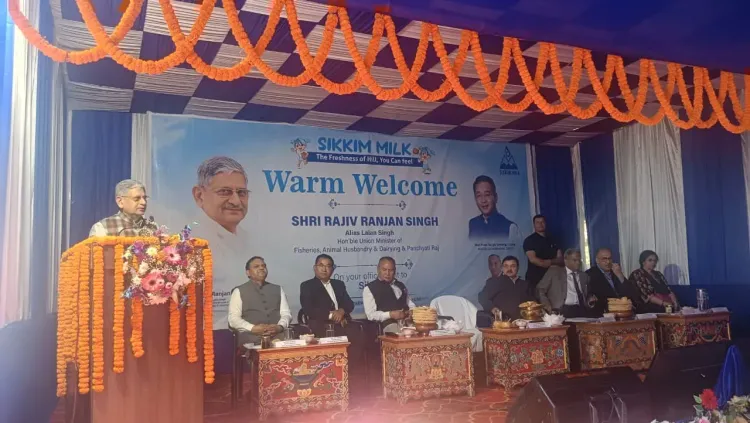
Union Minister Rajiv Ranjan Singh inaugurated a microbiology laboratory at Sikkim Cooperative Milk Producers Union in Tadong on November 3, 2026, and distributed farmer registration certificates under the Sikkim Cooperative Societies Act, 1978, bolstering the state's dairy quality and cooperative formalisation drive.
Key Takeaways
Microbiology laboratory inaugurated at Sikkim Cooperative Milk Producers Union Limited, Tadong , on November 3, 2026 , by Union Minister Rajiv Ranjan Singh .
The lab strengthens on-site milk quality testing and safety compliance for Sikkim's dairy cooperative.
Certificates of Registration distributed to dairy farmers under the Sikkim Cooperative Societies Act, 1978 , formalising their membership and legal stake.
NDDB and the Department of Animal Husbandry and Dairying are partners in this initiative, consistent with the national push to extend cooperative infrastructure to northeastern states.
The move builds on the legacy of Operation Flood (1970) and the National Programme for Dairy Development , targeting quality assurance in underserved regions.
A new microbiology laboratory now stands at the heart of Sikkim's dairy cooperative network — and it carries the promise of safer milk, better farmer incomes, and a sector finally equipped to meet modern quality standards. Union Minister for Animal Husbandry and Dairying Rajiv Ranjan Singh inaugurated the facility at the Sikkim Cooperative Milk Producers Union Limited (SCMPU) in Tadong, Sikkim, on Tuesday, November 3, 2026, and used the occasion to hand out Certificates of Registration to dairy farmers under the Sikkim Cooperative Societies Act, 1978.
A lab built for quality — and for compliance
Microbiology laboratories are not ceremonial additions. In a dairy cooperative, they are the frontline defence against adulteration, contamination, and the kind of quality failures that can shut a cooperative out of urban markets — or export corridors — entirely. For SCMPU, which handles milk procurement and processing for the state, the new lab means on-site testing capacity that was previously unavailable. The National Dairy Development Board (NDDB) and the Department of Animal Husbandry and Dairying — both tagged in the minister's post — have been instrumental in extending this kind of infrastructure to northeastern cooperatives, replicating the model that transformed India's dairy sector after Operation Flood in 1970.
Registration drives that put farmers on the map
The distribution of Certificates of Registration is the quieter but equally consequential part of Tuesday's event. Formalising farmer membership under the Sikkim Cooperative Societies Act, 1978 is not paperwork for its own sake — it is the mechanism by which a dairy farmer gains legal standing within the cooperative, access to shared profits, and eligibility for government schemes. Unregistered participation leaves farmers vulnerable; a certificate changes that calculus. Central government efforts across northeastern states have increasingly paired infrastructure investments with these formalisation drives, recognising that a lab means little if the farmers supplying the milk have no formal stake in the cooperative.
Sikkim and the northeast's dairy ambition
Sikkim is a small but symbolically significant piece of a larger push. The National Programme for Dairy Development — expanded across successive five-year plans — has specifically targeted quality testing infrastructure and cooperative strengthening in states where the formal dairy chain remains underdeveloped. The northeast, with its terrain challenges and historically low cooperative penetration, has been a particular focus. A functioning microbiology lab at Tadong signals that this push is moving from policy documents into concrete facilities on the ground.
The next measure of success will be whether similar labs follow in other northeastern cooperatives — and whether next year's budget allocations continue to back the ambition the minister put on display today.
Point of View
It also projects visible delivery in a border state where the BJP-led alliance is keen to demonstrate governance reach. The deeper policy arc is the Northeast's integration into India's organised dairy economy: NDDB's involvement signals institutional continuity, but the real test is whether today's single facility catalyses a broader rollout across the region's cooperatives before the next budget cycle.
NationPress
3 Nov 2026
Frequently Asked Questions
What was inaugurated at Sikkim Cooperative Milk Producers Union Limited in Tadong?
A microbiology laboratory was inaugurated at the Sikkim Cooperative Milk Producers Union Limited (SCMPU) in Tadong, Sikkim , by Union Minister Rajiv Ranjan Singh on November 3, 2026 . The lab is designed to test milk quality and ensure safety and compliance standards for the cooperative.
What are Certificates of Registration for dairy farmers in Sikkim?
These are official documents issued under the Sikkim Cooperative Societies Act, 1978 that formally recognise a dairy farmer as a member of the cooperative. Registration gives farmers legal standing, access to shared cooperative profits, and eligibility for government dairy schemes.
Who is Lalan Singh and what ministry does he head?
Lalan Singh , formally known as Rajiv Ranjan Singh , is a senior Janata Dal (United) leader and the Union Minister for Panchayati Raj, Fisheries, Animal Husbandry and Dairying . His ministry oversees dairy development policy and quality infrastructure across India.
What is the role of NDDB in Sikkim's dairy cooperative?
The National Dairy Development Board (NDDB) is a statutory body that supports dairy cooperatives nationwide, including extending quality testing infrastructure and technical capacity to northeastern states like Sikkim. It was tagged in the minister's announcement of the Tadong lab inauguration.
Why is a microbiology lab important for a dairy cooperative?
A microbiology laboratory allows a dairy cooperative to test milk on-site for contamination, adulteration, and safety compliance. This is critical for meeting urban market standards and export requirements, and helps protect both consumer safety and the cooperative's commercial credibility.