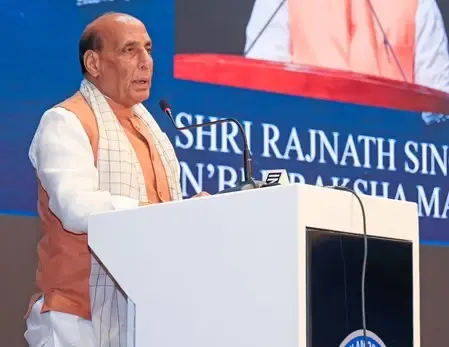
Rajnath Singh: India to be global defence hub by 2047
Synopsis
Union Defence Minister Rajnath Singh has articulated a vision for India to become a global defence design, manufacturing and export hub by 2047, anchoring the Atmanirbhar self-reliance push in co-development and co-production partnerships with major global defence nations.
Key Takeaways
Union Defence Minister Rajnath Singh stated India's goal to become a global hub for defence manufacturing, design and exports by 2047 .
Singh called self-reliance an opportunity for deeper global partnerships, emphasising co-development and co-production over traditional buyer-seller ties.
The Atmanirbhar Bharat Abhiyan , launched in May 2020 , and the Defence Production and Export Promotion Policy 2020 form the policy foundation for this vision.
Negative import lists and mandatory technology-transfer clauses in acquisitions have progressively deepened indigenisation since 2014 .
The 2047 target aligns with the broader Viksit Bharat 2047 national development framework, marking the centenary of Indian independence.
India's defence ambitions have a new vocabulary — and Union Defence Minister Rajnath Singh spelled it out with precision on Tuesday, November 3, 2026: co-development, co-production, shared innovation, and a hard deadline of 2047 to emerge as a world-leading centre for defence design and exports.
Posting on X, Singh framed India's Atmanirbhar (self-reliance) drive not as a turn inward but as the opposite — a launchpad for deeper global partnerships. 'India's pursuit of Self-Reliance is an opportunity to build stronger global partnerships,' he wrote. 'By moving beyond buyer-seller relationships towards co-development, co-production and shared innovation, we aim to make India a global hub for defence manufacturing and technology.'
From buyer to builder: what the 2047 target actually means
The 2047 horizon is not an arbitrary number. It marks the centenary of Indian independence and anchors every major national ambition under the broader Viksit Bharat 2047 framework. For defence, it translates into a specific aspiration: that India should not merely field indigenously made weapons, but design them, innovate around them, and sell them to the world.
The foundation was laid in May 2020 when the Atmanirbhar Bharat Abhiyan was launched with an explicit defence-indigenisation vertical. The Defence Production and Export Promotion Policy (DPEPP) 2020 followed, setting concrete targets for domestic manufacturing output and export revenues. Together, the two documents marked a shift from ad-hoc import substitution to a systematic industrial strategy.
Strategic partnerships that move beyond licensed production
Singh's language — 'co-development' and 'shared innovation' — signals a deliberate step beyond the older model of licensed manufacturing, where India assembled foreign-designed platforms under technology-transfer agreements. Since 2014, progressive negative import lists have forced the domestic defence industry to produce components that were previously purchased abroad, while R&D funding has been expanded and technology-transfer clauses have become standard in major acquisitions.
Partnerships with the United States, France, Israel and Russia have evolved accordingly. The emphasis is now on joint design bureaus, shared intellectual property and export rights — the preconditions for any country that wants to compete as a genuine defence supplier rather than a large and profitable customer.
The armed forces, domestic industry and global firms all have skin in the game
Three sets of stakeholders watch this space closely. India's armed forces need reliable domestic supply chains to reduce strategic vulnerability to import disruptions. The domestic defence industry — a mix of public-sector undertakings and a growing private sector — needs long-term policy certainty to invest in high-risk, capital-intensive programmes. And global defence firms are recalculating the calculus: India's combination of engineering talent, a large domestic market and explicit co-production openings is now a serious pitch, not a promise.
Whether the 2047 target translates into sustained annual export growth and marquee co-development contracts will depend on how quickly joint programmes move from signing ceremonies to serial production lines. Rajnath Singh has set the compass bearing. The distance left to travel is still considerable — but the direction has rarely been stated this clearly.
Point of View
Not just market access, which raises the stakes of every forthcoming defence deal. The 2047 deadline also gives the policy a generational accountability marker that previous defence reform efforts conspicuously lacked. Whether successive governments can hold the industrial and diplomatic thread that long is the central test this vision sets for itself.
NationPress
3 Nov 2026
Frequently Asked Questions
What is India's defence manufacturing goal by 2047?
India aims to become a leading global centre for defence design, innovation and exports by 2047 , the centenary of its independence, as stated by Defence Minister Rajnath Singh.
What is the Atmanirbhar Bharat defence policy?
The Atmanirbhar Bharat Abhiyan , launched in May 2020 , includes a dedicated defence-indigenisation vertical that promotes domestic manufacturing, reduced import dependence and increased R&D investment.
What does co-development mean in India's defence strategy?
Co-development refers to joint design and innovation programmes between India and partner nations or firms, moving beyond licensed production to shared intellectual property and export rights.
Which countries does India partner with for defence co-production?
India has pursued defence co-production and technology-transfer partnerships with the United States, France, Israel and Russia , among others.
What is the Defence Production and Export Promotion Policy?
The DPEPP 2020 is an Indian government policy that sets targets for domestic defence manufacturing output and export revenues, forming a core pillar of the Atmanirbhar Bharat defence strategy.