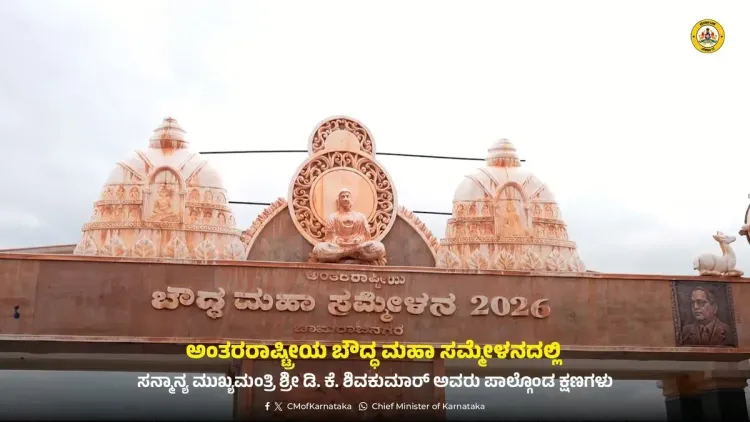
CM Shivakumar attends International Buddhist Mahasammela in Chamarajanagar
Synopsis
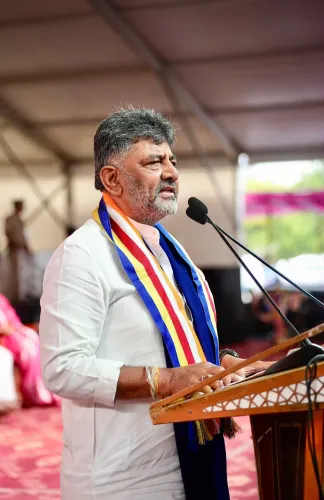
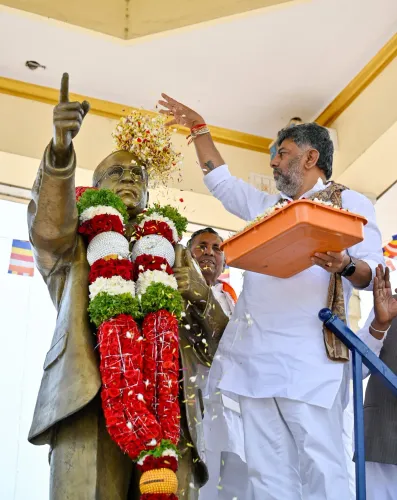
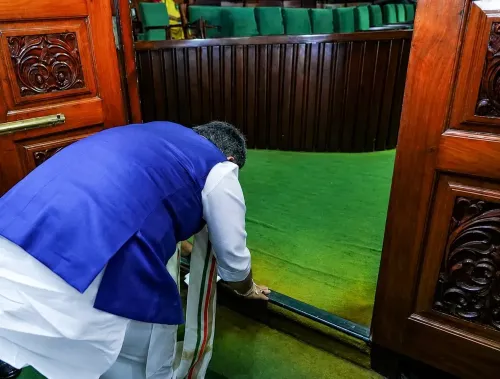
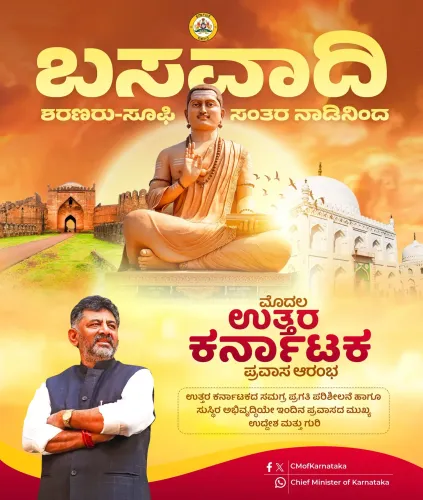
Karnataka CM D.K. Shivakumar attended the International Buddhist Maha Sammela in Chamarajanagar on 26 October 2026. The CMO declared that the principles of Buddha, Basava and Ambedkar guide the state government, invoking the triad that bridges Karnataka's Buddhist, Dalit and Lingayat communities.
Key Takeaways
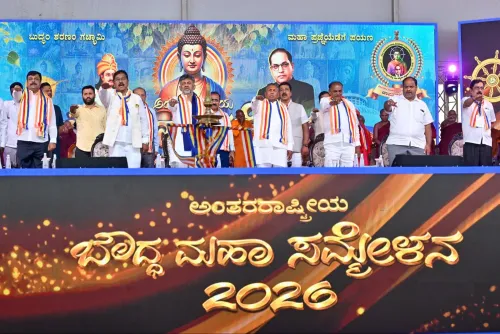
Shivakumar participated in the International Buddhist Maha Sammela held in Chamarajanagar , southern Karnataka, on 26 October 2026 .
The Chief Minister's Office of Karnataka declared that the principles of Buddha, Basava and Ambedkar serve as guiding philosophy for the state government.
Ambedkar embraced Buddhism in 1956 , making Buddhist symbolism central to Dalit political assertion across India.
Basava , the 12th-century Kannada reformer, founded the Lingayat movement on egalitarian, anti-caste principles — a legacy invoked alongside Ambedkar and Buddha.
Karnataka administrations have long used the Buddha-Basava-Ambedkar triad at state-sponsored events to signal inclusive governance across multiple communities.
The international character of the Chamarajanagar conference connects Karnataka's social-reform discourse to a global Buddhist audience.
Three names — Buddha, Basava, Ambedkar — and one governing philosophy. Chief Minister D.K. Shivakumar of Karnataka participated in the International Buddhist Maha Sammela held in Chamarajanagar on Monday, 26 October 2026, with the Chief Minister's Office declaring that the principles of these three towering figures serve as the guiding light for the state government.
What the Chamarajanagar conference brought together
The Chamarajanagar district in southern Karnataka served as the venue for this international-level Buddhist congregation. The post, shared by the Chief Minister's Office of Karnataka, described the event as an Antarrashtriya Bauddha Maha Sammela — an international Buddhist grand conference — and shared moments of CM Shivakumar's participation. Chamarajanagar, a district with significant Scheduled Caste and backward community populations, carries deep resonance as a setting for a gathering rooted in social-reform philosophy.
The Buddha-Basava-Ambedkar triad in Karnataka's political DNA
The invocation of this three-figure triad is not incidental. B.R. Ambedkar, the principal architect of the Indian Constitution, famously embraced Buddhism in 1956 as an act of social emancipation, making Buddhist symbolism inseparable from Dalit assertion in Indian politics. Basava, the 12th-century Kannada philosopher-saint, founded the Lingayat reform movement on radical egalitarian principles — rejecting caste hierarchy centuries before modern social movements gave it a vocabulary. Together with the Buddha's foundational message of compassion and non-violence, the triad bridges Karnataka's Buddhist, Dalit-Ambedkarite, and Lingayat constituencies in a single ideological frame.
Karnataka governments across administrations have periodically organised or backed events that invoke this combined legacy, using cultural and religious gatherings to signal commitment to inclusive social values. It is a formula that speaks across community lines — deliberately so.
Why this moment carries weight
Hosting an international Buddhist conference elevates the occasion beyond routine state-level ceremonialism. It places Karnataka on a platform that connects to the global Buddhist community — from Sri Lanka and Thailand to Japan and the Tibetan diaspora — while the Chief Minister's direct participation signals that this is a deliberate statement of governance values, not a delegated protocol event. The CMO's framing — 'the principles of Buddha, Basava and Ambedkar guide the government' — makes the philosophical commitment explicit.
Whether concrete programmes — scholarships, pilgrimage infrastructure, or welfare initiatives anchored to these principles — emerge from the Chamarajanagar conference will be the real measure of intent. The stage has been set. The follow-through is the story to watch.
Point of View
Basava and Ambedkar as governmental guideposts is a calibrated move in Karnataka's complex social arithmetic — it speaks simultaneously to Buddhist converts, Dalit communities who identify with Ambedkar, and the influential Lingayat constituency that venerates Basava. Hosting the event at Chamarajanagar, a district with a substantial marginalised-community population, reinforces that spatial symbolism is as deliberate as the rhetorical one. For a Congress government navigating coalition-sensitive social terrain ahead of local-body and eventual assembly cycles, anchoring governance identity to reform philosophy is both cultural statecraft and electoral groundwork. The real test is whether the conference produces tangible follow-on policy — if it does, the symbolism hardens into substance.
NationPress
26 Oct 2026
Frequently Asked Questions
What is the International Buddhist Maha Sammela held in Chamarajanagar?
It is an international Buddhist grand conference hosted in Chamarajanagar , southern Karnataka, where religious leaders, scholars and policymakers gather to discuss Buddhist philosophy and its social relevance. CM D.K. Shivakumar participated in the 2026 edition of the event.
Why do Karnataka leaders invoke Buddha, Basava and Ambedkar together?
The three figures represent distinct but complementary strands of India's social-reform tradition — Buddha's compassion, Basava's 12th-century Lingayat egalitarianism, and Ambedkar's Dalit emancipation movement. Invoking all three at once allows Karnataka's government to address Buddhist, Dalit-Ambedkarite and Lingayat communities under a single inclusive message.
Who is D.K. Shivakumar?
D.K. Shivakumar is a senior Karnataka Congress leader who has held significant state positions. The Chief Minister's Office post references him as the Chief Minister of Karnataka at the time of the October 2026 conference.
What is the significance of Chamarajanagar as a venue for this conference?
Chamarajanagar is a southern Karnataka district with a substantial Scheduled Caste and backward-community population, making it a symbolically resonant location for a conference centred on social-reform philosophies championed by Ambedkar and Basava.
When did Ambedkar convert to Buddhism and why does it matter in Indian politics?
B.R. Ambedkar embraced Buddhism on 14 October 1956 as an act of social emancipation from caste discrimination. The conversion made Buddhist identity inseparable from Dalit political assertion, which is why Buddhist events frequently carry Ambedkarite significance in Indian public life.